
Let's Row Together
I never gave curling a second thought. Now, after watching matches in the 2026 Olympic Games, I'm transfixed by the granite stone's looping, gliding motions and intrigued by its strategic intricacies.

I am transfixed by the sight of these 40-pound granite stones gliding 130 feet down a lane of Olympic ice.
And by the operatic yelps of the athletes when the stone is on its way.
Shouts travel teammate to teammate, with commands relayed so rapidly I can rarely follow what they are saying.
But that really doesn’t matter since I watch the commands being executed by the team member working the “broom,” which these days is more like a flattened squeegee.1
With broom in hand, the sweeper moves as the stone moves down the ice, employing the broom’s flattened end to guide the stone around one stone or deliberately banging it into another stone, which already had traveled the 90-or-so feet before stopping.
To do this, the sweeper dances vigorously on muscular legs.
Preparation for curling’s rigors involves single-leg drives, squats, lunges and deadlifts — all designed for the necessary explosive power.
Meanwhile, the athlete’s core is strengthened for stability.
When sweeping, the athlete’s back foot, encased in rubber-soled gripper sneakers, propels the body forward from its toe, relying on strong leg muscles.
Meanwhile, the solid core holds the leaning body up.
The front foot, tucked into a teflon-soled sneaker, slides ahead.
All body parts moving in rhythm with the stone.
Sometimes, a team will purposely steer the stone to come to rest far away from the others, strategically placing it to guard “the house” – the colorful circular target where curlers want their stones to collect.
And from which they try to evict their opponent’s stones.
The bullseye of the curling “house” is located 93 feet from where the stone begins its journey. The entire “house” consists of three colorful rings, one nested inside another, with diameters of 12, eight and four feet.
Positioning a guard stone in front of “the house” challenges an opponent to maneuver around it. By forcing such a looping motion to happen, it makes it more difficult to position a stone close to “the button” – the foot-wide circle at the center of the “house.”
The sweeper steers the stone at the broom handle’s distance away. When action is needed, the broom, placed in front of the moving stone, moves with rapid, pressured strokes that weigh down the broom’s flat end on the ice.
The broom’s firm pressure on the ice melts its raised frozen mounds made from the water sprayed on the ice before the match. These droplets freeze to roughen the ice’s surface, dotting it with millions of tiny peeks of ice.
Try gliding a curling stone across a skating rink.
It’s a no go.
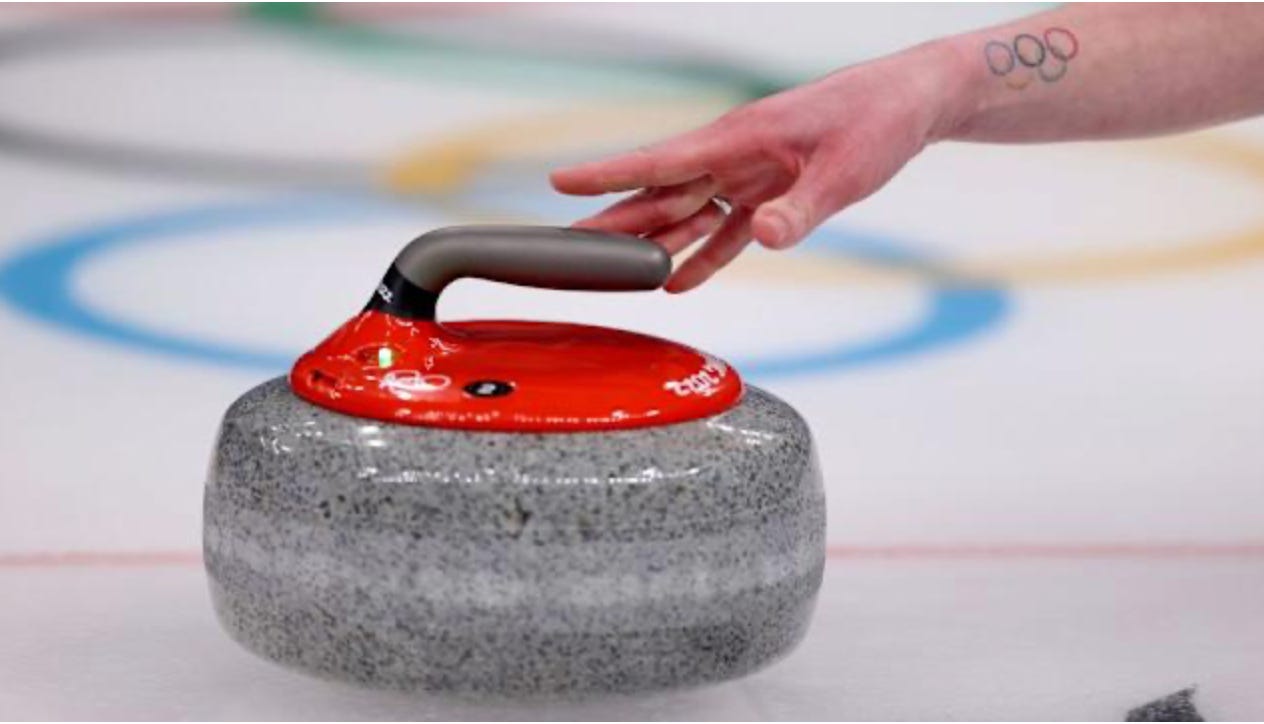
A curling stone is made from a rare micro-granite mined in only two places – the uninhabited island, Ailsa Craig, near Scotland and a quarry in North Wales. All of the Olympic curling stones were made in a small Scottish factory with the granite cut from Ailsa Craig.
Only when these frozen droplets – what curlers call “pebbles” – create this raised and bumpy highway does this heavy granite stone move.
Think of these “pebbles” as the pavement of a stone’s icy track. They lift this curling stone off the ice so it will ride on a raised circular ring carved into the tapered bottom.
The stone glides with ease when atop these ubiquitous “pebbles” since this motion creates the friction needed to melt the bumps. It’s this melting that propels the stone forward as it surfs on the thin water stream. It’s what also enables the stone to curl.
By scrubbing these bumps with the broom, the curler is also melting these “pebbles,” thereby further lubricating the stone’s desired path.
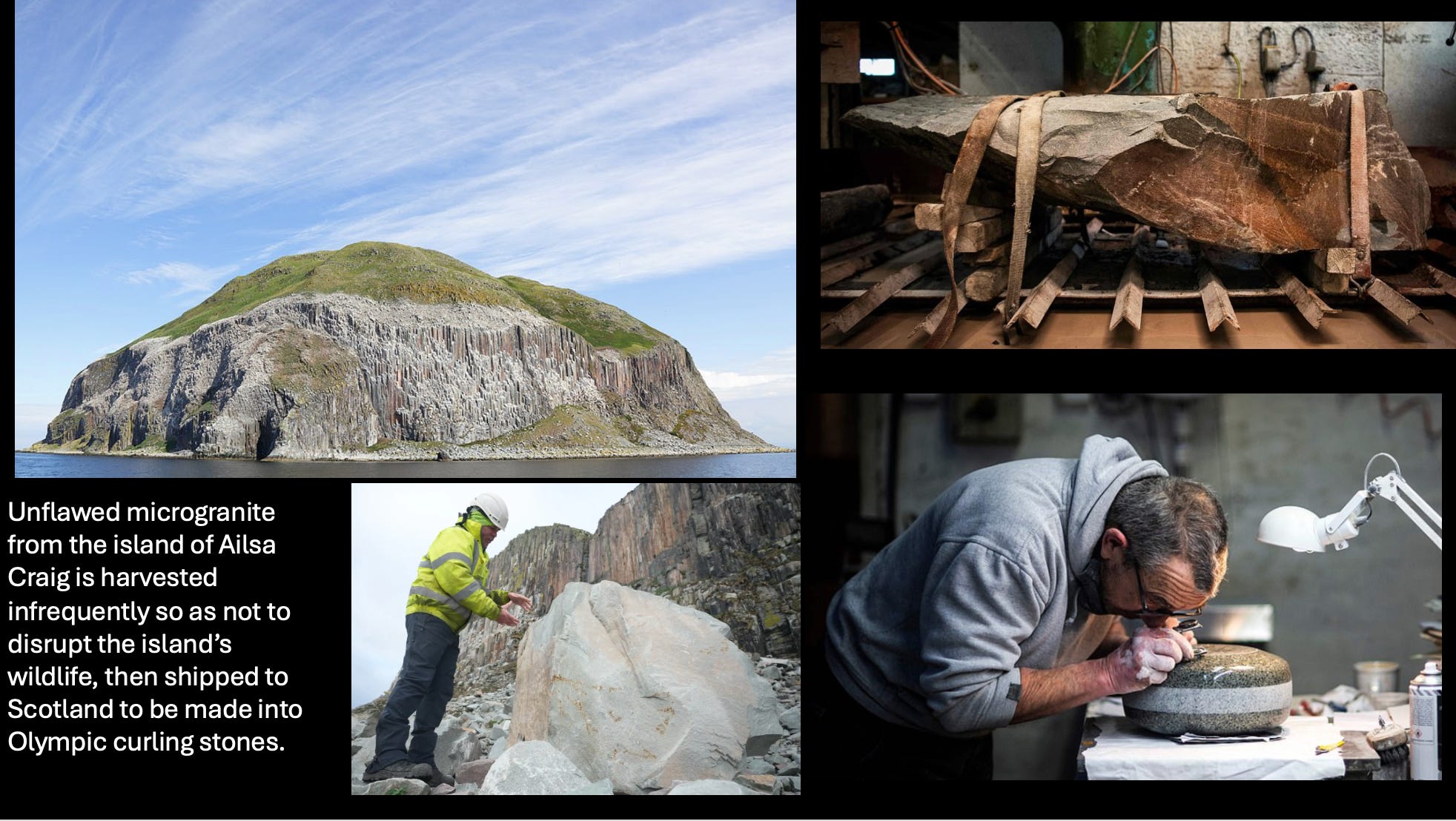
A total of 38 stones a week are made, around one an hour, with their quality diligently checked to be certain they meet Olympic standards. Curlers cannot use their own stones or brooms in the games; everything is standardized, so no advantage goes to any team with the equipment.
The action of curling is mesmerizing.
Okay, I know most of you think that not much of anything happens in curling.
I’m here to tell you it does!!!
In fact, I find it magical to watch this shiny polished stone flicked into motion with the precise turn of its sender’s wrist.
Just the sending of a curling stone is an awesome feat to observe,
To do it, the athlete must crunch into an improbably low lunge after pushing off of the rubber footholds secured in the ice. They are called “the hacks,” and are like starting blocks used by 100-meter runners.
From that push to the athlete’s lunge, this entire act defies the physics of balance, all while the athlete intensely focused on the strategic turn of the stone’s handle, twisting it just so to establish its rotation.
Twist the handle clockwise — the so-called “in turn” – and the stone moves left to right. "Out turn” it, and the opposite result happens.
“We’re working with millimeters,” one curler explained.
It’s a delicate maneuver made to look easy only because of the many times this athlete likely tumbled trying to perfect it.
The brooms rests in the sender’s free hand, its end stationed on the ice to act as the counterbalance that this unnatural stance demands.
The stone’s release happens 33 feet after the sender’s gliding push-off from “the hacks.” The send-off happens the so-called “hog line,” the stone’s release point. If a stone’s front edge crosses this line while any part of the sender’s hand touches the handle, the red light, embedded in the stone and keyed to a sensor in the ice, goes on.
To signal an error. This hasn’t happened in the curling matches I’ve watched.2
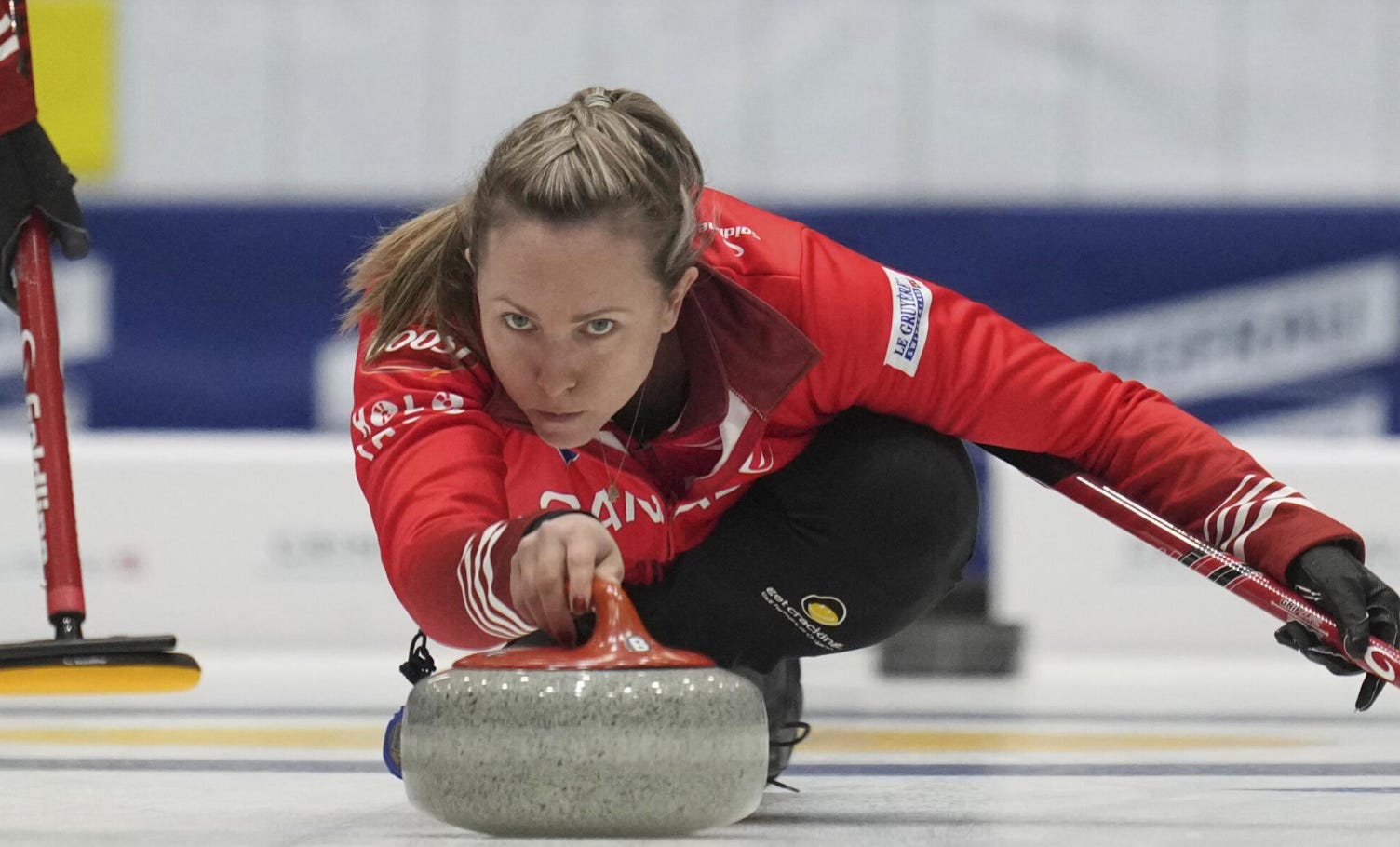
Holding the “broom” in her left hand with its end on the ice to act as a counterbalance, this curler crouches low, with her left slider foot crossing in front of her right foot, the gripper, preparing to “throw” the stone, sending it on its ride down the ice.
In few other Winter Olympic sports do we get to see the intense expressions on the faces of these athletes.
In curling, we do.
And at the end of each “end” – after each team’s set of throws – points are determined. Stones inside “the house” – having survived the opponent’s attempts to shove them out – stand a chance of scoring points for their team. A point is tallied for each stone belonging to the team that is closer to “the button” than its opponents’ best stone.
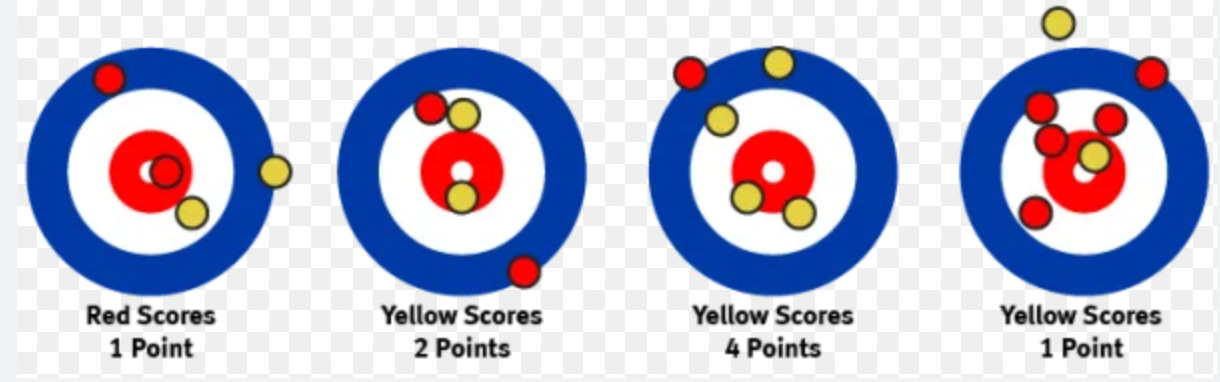
Examples of scoring in curling with stones in “the house” when an “end” is finished.
Curling Welcomed me to the Milan Cortina Olympics.
I started watching the Olympic curling two days before the Opening Ceremony.
That happens today.
So, for me, the 2026 Olympics opened on Wednesday morning.
Working at my desktop computer, I had Peacock streaming the mixed-doubles curling.
Do you know that curling — the mixed doubles, men’s, women’s team play – is the ONLY Olympic sport in which athletes compete every day of the Winter Games?
Discovering this thrilled me since I plan to stick close by Peacock knowing that NBC seldom shows curling in its prime-time coverage. Even when the network turns to curling, it usually shows a highlight reel that misses the details of drama that make this sport shine. ( For this reason, I bought a monthly Peacock subscription - roughly $10.00 – so I can watch curling and other less spotlighted sports in the Winter Olympics).
Glimpses of this sport cannot do justice to the constancy of calculations that this thinking person’s sport demands.
Perhaps it’s why I also love baseball.
The thinking aspects of curling reminds me of the strategizing demanded by bridge. I also compare it to chess when curlers lean on their brooms studying “the house.” As they map the position of the stones, they are calculating how to alter those locations to benefit them. And figuring out exactly how to throw their next stone to do this.
In these moments, I’m reminded of a chess master surveying the remaining pieces on the board … a million calculations happening all at once.
Assessing the probable impact — measuring the pros and cons – of making one move vs. another.
That’s curling.
I see this strategic thinking in the art of billiards, too. With the cue tapping a ball in the hope of it knocking other balls away. Or angling the ball’s bounce off the cushion to send it into a distant pocket.
I think of many pool games in my youth as I watch curlers huddling near “the house” to determine their next stone’s trajectory. Though in curling there is no gutter, as in bowling, nor cushioned rails, as in billiards.
In curling, it’s only a 16-foot wide lane of ice.
Curling also has a bit of shuffle board in it. Though its players push their pucks; they don’t throw them, but still they are trying to send them around other ones, if they want to settle them in the high-point zones.
Or when we think of throwing objects to a designated spot, then horseshoes could be considered a distant cousin.
And oddly tennis, too, shares something in common with curling.
In tennis, it’s considered an advantage to be the server.
In curling, competing teams serve the same number of stones in each “end” but an advantage goes to the team that wields “the hammer.” This team sends the final stone of each “end” down the ice. This gives them the opportunity to disrupt nearly every stone either in or near “the house.”
“Having the hammer is the last-stone advantage,” one curler observes.
But when a team loses an “end” – and there are 8 to 10 ends in each curling match –that team gets “the hammer” for the next “end.”
And so it goes.
I figure skated as a child, and then a bit more as a grown-up when Maya spent a lot of hours at the rink with her lessons.
Through it all, I was never very good.
But what I learned as I dug into curling’s history is that many top curlers can barely skate.
So, figure skating isn’t really a cousin sport, though both happen on ice.
I guess the closest I’ve come to doing anything like curling is when I used to send bowling balls on their way to the pins. Which I did all the time as a child, bowling candlepins for hours at the University of Massachusetts Student Center.
As a teen, I switched to the bigger, heavier bowling balls. Ones with three finger holes.
Just as curlers lunge low to propel the gliding “throw” flat along the ice, so too I dipped low to sweep my arm close to the floor so the ball wouldn’t bounce onto the lane. In bowling, smooth met smooth as the ball streaked onto the synthetic laminate surface and headed for the pins.
If I’d sent the ball twirling just right, I’d watch it loop in, twisting right to left, so that it skimmed the lead pin enough to set off a chain reaction to hopefully bring every pin crashing to the floor.
Curling isn’t like this, though it has a few things in common.
But for me, the great fun I had bowling, the joyful companionship I found in playing those games – most of all those times when I bowled with my dad and my brother, Mark – is something I relive as I tune into curling.
Finally, to learn that curling is an ancient sports – and an “honorable” one, has me falling in love with it, too.
Its foundation rests on what is called the Spirit of Curling, a code of morals that is part of its heritage. Curling is gifted by Scotland, where outdoor curling began in the early 16th century. The Scots founded curling clubs and established the sports’s rules in the early 19th century, with the Grand Caledonian Curling Club (now Royal Caledonian Curling Club) formed in 1838.
During the 19th century, curling moved indoors and spread past Scotland.
In the United States, curling found its forever hub in Minnesota, in Duluth, to be exact.
Today Duluth’s curlers who compete internationally and in the Olympic Games call their town “the biggest small town there is” given its global reach of its community’s curlers.
Whether curling Olympians are from the United State or Canada, China or South Korea, Italy or Switzerland, Great Britain, Sweden or Norway, their competition will among be the friendliest you’ll find in the Olympics.
Here’s why: Each curling competitor (apart from the Olympics) is obliged to honor the Spirit of Curling’s code of morals:
"Curling is a game of skill and of tradition. A shot well executed is a delight to see and it is also a fine thing to observe the time-honoured traditions of curling being applied in the true spirit of the game. Curlers play to win, but never to humble their opponents. A true curler never attempts to distract opponents, nor to prevent them from playing their best, and would prefer to lose rather than to win unfairly. Curlers never knowingly break a rule of the game, nor disrespect any of its traditions. Should they become aware that this has been done inadvertently, they will be the first to divulge the breach. While the main object of the game of curling is to determine the relative skill of the players, the spirit of curling demands good sportsmanship, kindly feeling and honourable conduct. This spirit should influence both the interpretation and the application of the rules of the game and also the conduct of all participants on and off the ice."
At a time when the monks are ending their Walk for Peace in Washington, D.C. and the residents of Minneapolis are protesting with courage our country’s founders would admire against the lawless treatment of residents, we can certainly use a dose of kindness and an adherence to a moral code of decency and honesty — while we also marvel at what surely be magnificent displays of athleticism at the 2026 Olympics.
Speaking of Throwing
Stay tuned for more information about a Saturday afternoon (July 25) baseball game at which I will throw the ceremonial first pitch for the Triple AAA Red Sox at Polar Park in Worcester, MA.
If only Mark “The Bird” Fidrych were alive to train me!
He was a Worcester boy with a remarkable, albeit short, injury-prone stint as a pitcher with the Detroit Tigers. In 1976, he led the major leagues with a 2.34 ERA, winning the American League Rookie of the Year award with a 19–9 record.
America fell in love with his bird-like antics on the pitching mound. Soon, he earned the nickname “The Bird". In the spring of 1977, as a Sports Illustrated baseball reporter, I assigned to hang out with Mark when he came to New York City to pose for a cover photo with Big Bird.

Before I throw the first pitch at Polar Park, I’ll talk about my book as a guest of the WooSox’s Author Series before the game.
If you are nearby, I hope you’ll come out to Polar Park that afternoon.

Locker Room Talk: A Woman’s Struggle to Get Inside is widely available in print and audio. If you haven’t read about my 1978 equal access case against Major League Baseball yet, perhaps you’ll fit it into your spring training plans.
Until the 1950s, the brooms used by curlers were similar to the hardwearing corn brooms that people use around the house. The standardized brooms used in the Olympics are made of carbon fiber and synthetic fabric.
This is such a wonderful essay, a breath of fresh air. Evidently curling also offers some pretty fine lessons associated with physics and I hope teachers pick up on that (there are posts on social). Delighted that you wrote this.
Wish I’d had the chance to write about curling for SI. I watched the U.S. mixed doubles team play a thrilling match for the silver today. I’m enthralled.