
Let's Row Together
We sing to ease our pain, gather our courage, share our message and protest the injustice experienced by our neighbors and strangers. Together we sing to right the wrongs for those who cannot.

I can’t sing.
In fact, I’m tone deaf.
None of this mattered to my mother.
When I asked her to drive me to a music store to buy sheet music to rehearse a song, she never hinted that I might consider not trying out to be a soloist in the school’s Christmas show.
She wasn’t about to tell me I couldn’t sing.
She’d let me find out. It’s something I love about her.
I was in 7th grade when I practiced, practiced and practiced singing “Oh, Holy Night.”
Standing in front of my full-length mirror, alone in my bedroom, I took on this super tough song spanning an octave and a half and demanding a nearly operatic voice to hit its high C-sharp.
At times, I’d play Oh, Holy Night! on my record player so I could pretend that I could hit its soaring notes. With the song as back-up, I thought I sounded okay. When I sang it a capella, well, let’s say I was in denial.
The true test came at my audition when the music teacher quickly waved me off stage.
When he did that, I wasn’t even through “the stars are brightly shining” at the end of the song’s first line.
Then, I knew. I never auditioned to sing again.
Still, I love to sing.
At the gym, my playlists go on when my exercise starts.
Songs push me to push through my exercise-ending, two-minute plank, then help me to endure my immersion in the frigid cold plunge pool.
I’m always looking for opportunities to belt out songs. This requires me to find times and places where lots of other voices will drown out mine.
Seventh-inning stretches at ballparks come to mind.
And “Sweet Caroline” at Fenway Park midway through the eighth.
But years ago it was at protest rallies of the 1960s and ‘70s that I sang loudly, proudly, defiantly.
Belting out choruses while mouthing the verses since fewer people sang those.
By then, I was self-conscious about my off-key singing.
Still, it was liberating to blast out my feelings in song.
Singing with others at sit-ins and protests. At times, in marches, though in those it was more often responsive chants.
For me, when voices unite in song, they really do lift me higher.
And singing pushes us forward. Lifting us up in ways words with no music don’t.
In song, we saw the potential to rock our nation, even as we frightened our elders at first with changes we sought.
In time, our protest songs - echoed on the streets, played in cafés and on the radio – delivered us to where we hoped one day we’d be.
Stirring the conscience of the American people, who then acted.
As we watched us turn into we.
Come senators, congressmen
Please heed the call
Don’t stand in the doorway
Don’t block up the hall
For he that gets hurt
Will be he who has stalled
The battle outside ragin’
Will soon shake your windows
And rattle your walls
For the times they are a-changin’ – Bob Dylan, The Times They Are a-Changin’, 1964
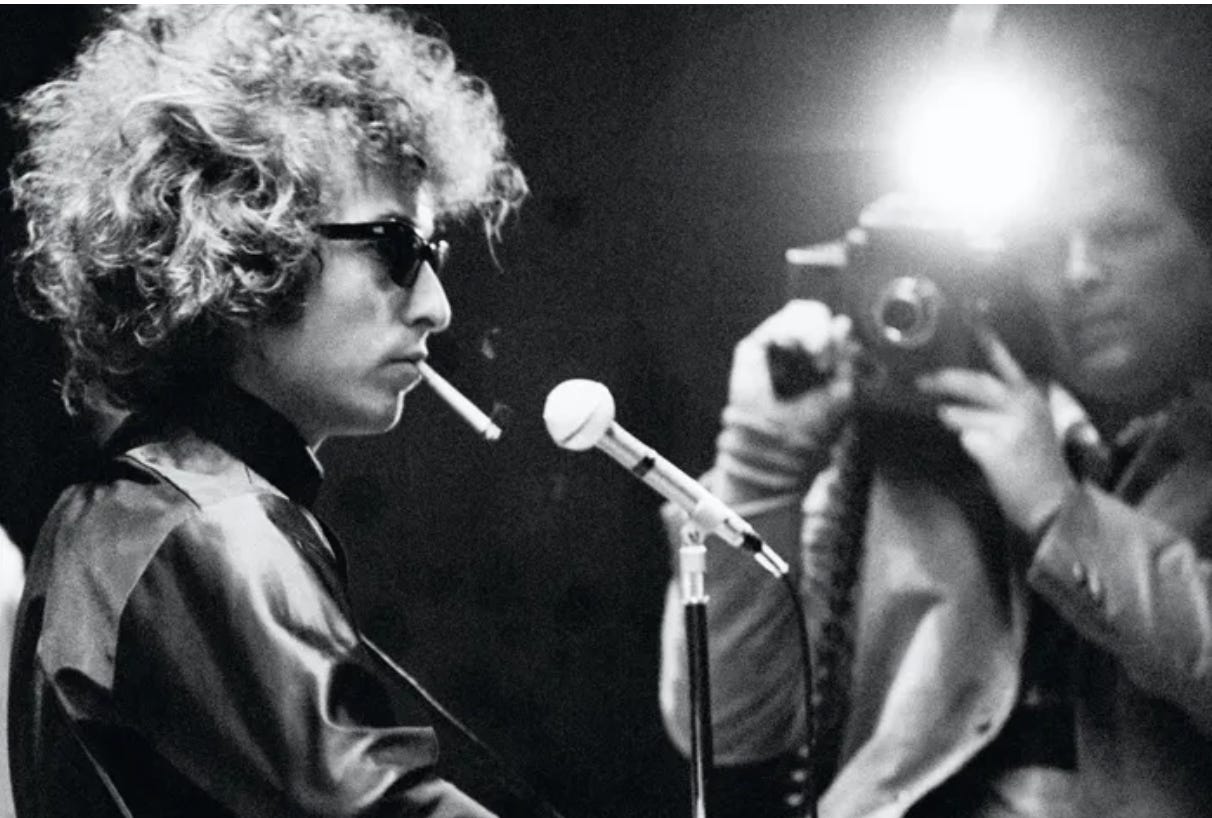
“I don’t write no protest songs,” Dylan told his audience on the night he sang “Blowin’ in the Wind” for the first time.
Dylan can protest all he wants – contending he “don’t write no protest songs” – but his raw, emotive, whining voice, combined with his poetic lyrics, formed the spine of my ‘60’s protest canon.
In that era’s nonviolent actions for civil rights and women’s rights, in young people’s campaigns to end the Viet Nam war, we gathered in sanctuaries to learn songs before carrying them onto the streets with us.
Just as protesters do today in Minneapolis, in Maine, in Massachusetts, turning out by the thousands. Walking on streets and gathering in vigils in the frigid weather, people are showing up to protest the lawless injustices in our time.
In a Minneapolis church, protesters sing:
We are here.
In our city.
Our love for each other.
Will carry us through.
Yes, it will.
Yes, our love for each other will carry us through.
Yes, our love for each other will carry us through.
In Minneapolis, Singing Resistance, a group formed four days after ICE’s bullets killed Renee Nicole Good, brings hundreds of people together to learn songs. Then, the protesters take these new songs to the streets and pass them on to those joining them there.
“Song is a vehicle for us to grieve … for us to feel rage … to strengthen ourselves,” one of Singing Resistance’s organizers tells CNN’s Anderson Cooper in this video, above.
Then, she sings for Cooper:
I am not afraid
I am not afraid
I will live for liberation
Cause I know why I was made.
We might sing of not being afraid, she tells Cooper, but afraid they all are, rightfully so. As she speaks, she shields herself from being identified, fearing what many people in this country are learning to fear — the arbitrary endangerment of state terror.
They sing “I am not afraid,” she says to Cooper, as “a way to gather our courage.”
Just as generations before hers have, too.
As when Joan Baez sang “We are not afraid” in uniting the marchers at the Lincoln Monument after many had risked much to travel there in August, 1963 to hear Martin Luther King, Jr. proclaim his dream.
We are not afraid
We are not afraid
We are not afraid, today
Oh, deep in my heart
I do believe
We shall overcome, someday
We rely on protest songs to push down our fear when actions we take have invited fear to live within us.
Protest songs inspire hope in protesters. Singing them helps protester believe that one day the nation they love will believe, as they do, in the words they sing.
Often protest songs retell the stories of injustice with lyrics both blunt and bitter.
Songwriters convey vivid details that listeners might otherwise have turned aside.
Yet their songs’ plain-spoken truths convince people to protest this injustice they now know and feel.
Protest songs help individuals overcome personal fear by the act of joining others. In song.
Together, building a movement.
With song at its root. Its lyrics shared like a flower’s pollen spread far and wide.
The poet Langston Hughes and composer Jobe Huntley exhaled cries of anger at the gruesome, racist murder of 14-year old Emmett Till in Money, Mississippi in 1955.
His father died for democracy
fighting in the army over the sea.
His father died for the U. S. A.
Why did they treat his son this a-way?
in Money, Money, Mississippi,
Money, Mississippi. …
Like old boy, just fourteen years old,
shot, kicked, and beaten ‘cause he was so bold
to whistle at a woman who was white.
He was throwed in the river in the dead of night
In Money, Money, Mississippi,
Money, Mississippi.
In the face of lawless experiences that generations of Americans have witnessed, poets and songwriters, painters and playwrights, authors and actors come forth to express what is known and felt even as those in power deny it.
These artists’ creativity creates campfires around which people gather, first seeking solace, then finding strength.
As poets and composers did in Emmett Till’s time, so, too, they do in ours.
Just walk back in time to read their words, to hear their songs, and you’ll find yourself walking a path that loops you back to our present. Such are the similarities to be found in songwriters’ motives, in the means of delivering these songs to the masses, and their mesmerizing impact.
Step into “Blues for Emmett Till,” (1955), as poet Aaron Kramer and composer Clyde R. Appleton conceived it.
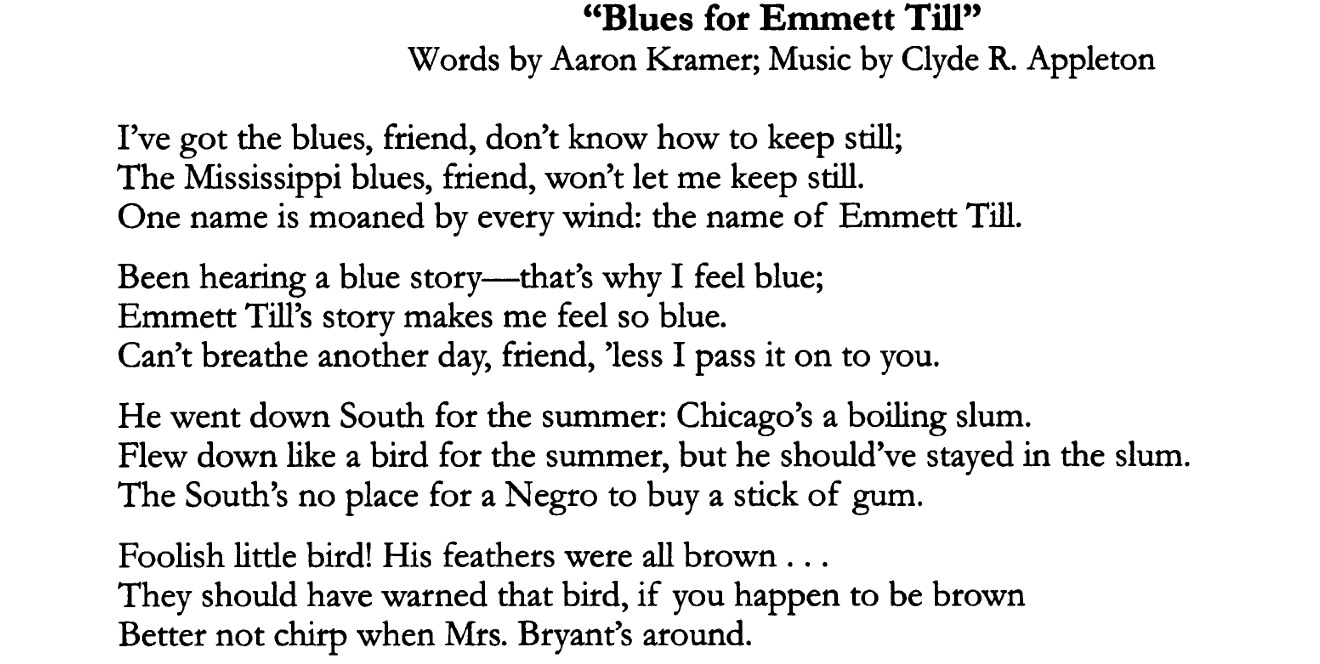
Spend time with The Death of Emmett Till, (1962) as a young Bob Dylan reckons with Americans’ racist beliefs and actions, just as his mentor, Woody Guthrie, sang about the racist housing practices of his landlord in his 1954 song, “Old Man Trump.” [In Oxford Town (1963), Dylan did this again, then again the next year with the murder of Medgar Evers (Only a Pawn in Their Game (1964)]
Listen to Mississippi Goddam, (1964), to hear Nina Simone plaintively pleading for equality among a people without compassion.
Or revisit Strange Fruit (1939), in which Billie Holliday took a poem about Southern lynching and made it her song, courageously performing it despite government intimidation and threats against her for doing so. Her record label refused to record it, so she took the song elsewhere. This song sold more than one million records, the most of any of her songs.
Southern trees bear a Strange Fruit
Blood on the leave and blood at the root.
Black bodies swingin’ in the Southern breeze
Strange Fruit hangin’ from the poplar trees.
Last night I attended a talk by James Sullivan, a longtime music critic and author of Which Side Are You On? 20th Century American History in 100 Protest Songs. I listened as he carried a full-house crowd along on a nearly two-hour exploration of the breadth and depth of protest songs.
It turns out the universe of protest songs is far broader than I envisioned it to be. By flashing the words, “Attention, please!” on the screen, Sullivan was alerting me and others that he was taking us to places where protest songs hide. Reminding us of songs we’d heard without thinking of them as the protest songs they are.
At first, I was dubious. Surely, I’d know a protest song if I heard it. But he started to win me over with Frank Sinatra’s song, The House I Live In (1945) when he linked it to the wave of MAGA nostalgia promulgated by folks like Stephen Miller, longing for a return to wholesome times. Sullivan told us how after Miller recently watched a 1967 holiday special, Christmas with The Martins and The Sinatras, he extolled the show when he said how much he wanted America return to this time when the country was great without any mass immigration. Miller evidently forgot that Sinatra and Martin are first-generation Italian immigrants.
Perhaps Miller and his gang ought to hear Sinatra sing this song.
What is America to me?
A name, a map, a flag I see
A certain word, democracy
What is America to me?The house I live in
A plot of earth, a street
The grocer and the butcher
And the people that I meet
The children in the playground
The faces that I see
All races and religions
That’s America to meA place I work in
A worker by my side
A little town or city
Where my people lived and died
The howdy and the handshake
The air of feeling free
And the right to speak my mind out
That’s America to me
By the time Sullivan got around to Connie Francis’s Where the Boys Are, a 1961 song for a film about girls on spring break in Fort Lauderdale, my ignorance was ensured. He’d also convinced me to buy his book. It turns out that by the late 1960s, New York City’s Stonewall Inn, its popular gay bar, closed down the bar each night by playing Connie’s song.
Songs, it seems, spur protest in the ears of their beholders.
Speaking of Listening
Thanks to James Sullivan and Joyce Linehan, my friend and a rock-and-roll band producer in her younger years, those of us who live near Boston can come together each month to listen to protest songs, past and present. In these 90-minute live shows, six artists with the back-up band, named the Paid Protesters, sing an old protest song and a new one. In the course of the evening, Sullivan shares a story or two about the history of protest songs in shows he and Linehan produce in the back room of The Burren in Somerville, MA.
Eight months into these monthly gigs, tickets sell out in less than a day.
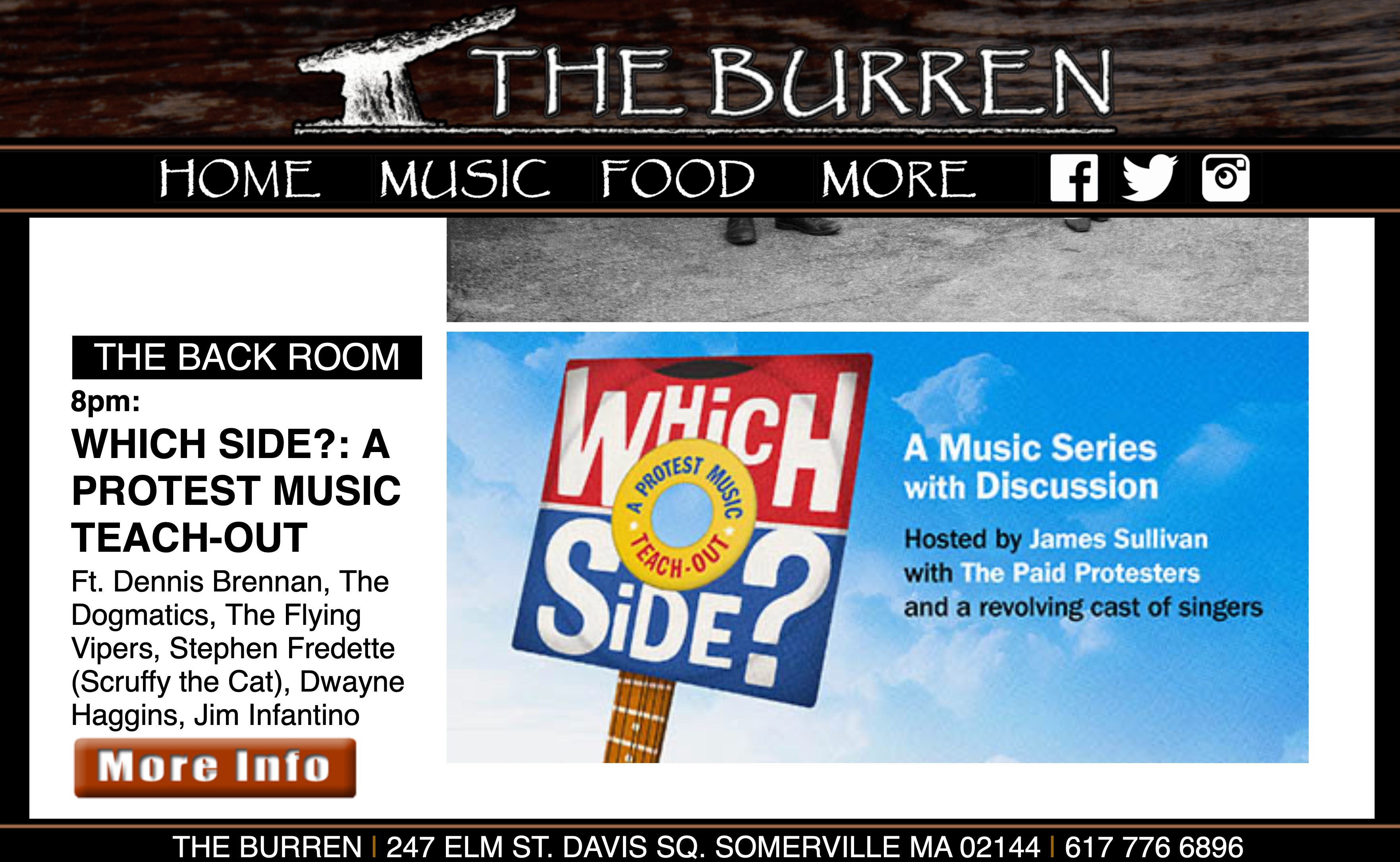
Sullivan and Linehan are in touch with folks in other cities encouraging them to do live protest song shows of their own. Bostonians’ appetites are ravenous and the pay-off could be adding bricks to the foundation of democracy we’re rebuilding.
I’ll close with the song that convinced me to write about protest songs today.
It’s Bruce Springsteen’s "Streets of Minneapolis,” of course, and I lack space to offer even a beginner’s profile of him as a writer of protest songs through the decades. I heard this song yesterday. Since then, I’ve played it many times, its lyrics in hand at times, even with the Boss singing his words crystal clear.
May this song’s power endure, being as strong and poignant years from now as it is today. And he’s joined by many others writing songs that speak to our challenging times – Jesse Welles foremost among them, as he sang about ICE on Stephen Colbert.
Through the winter’s ice and cold
Down Nicollet Avenue
A city aflame fought fire and ice
‘Neath an occupier’s boots
King Trump’s private army from the DHS
Guns belted to their coats
Came to Minneapolis to enforce the law
Or so their story goes
Against smoke and rubber bullets
By the dawn’s early light
Citizens stood for justice
Their voices ringing through the night
And there were bloody footprints
Where mercy should have stood
And two dead left to die on snow-filled streets
Alex Pretti and Renee Good
Oh our Minneapolis, I hear your voice
Singing through the bloody mist
We’ll take our stand for this land
And the stranger in our midst
Here in our home they killed and roamed
In the winter of ’26
We’ll remember the names of those who died
On the streets of Minneapolis …
Oh our Minneapolis, I hear your voice
Singing through the bloody mist
Here in our home they killed and roamed
In the winter of ’26
We’ll take our stand for this land
And the stranger in our midst
We’ll remember the names of those who died
On the streets of Minneapolis
We’ll remember the names of those who died
On the streets of Minneapolis
A note about next Friday’s essay: I have a colonoscopy scheduled for the morning, so I might - or might not - write an essay next week. I’ll decide then.
Yeah Melissa!
Very well said Melissa. Much needed in these times. I grew up singing many songs -- those that carried the inspiration from Gandhi and later, in my teenage years -- Bob Dylan, who was very popular among the youth of my generation in India.