
Let's Row Together
Keeping joy paramount in youngsters' athletic pursuits turns out to be the key ingredient in the Winter Olympics' medal sauce.

Walk with me down a path of imagination.
A path that others might label as the road to blasphemy.
As we enter the cathedral of youth sports,
Carrying with us a vision of what might be.
Set against what usually is.
For in America, when children are young devotion to and victory in sports are treated as their launch pad to future fame.
With fortune tagging along.
As the enticing glow of riches dangle in front of sports stars at younger and younger ages.
While their families endure the mind-boggling cost of chasing this dream.
Not to mention upending family time together.
As a few of them travel to competitions and specialized sports camps.
Sometimes families split, living far from each other to train their child.
It’s this insatiable hunger that fuels youth sports.
Ignoring what the youthful athlete might find joyful about this sport.
So, stay with me as we imagine what could be.
Which means leaving behind what we know about youth sports.
Leaving us the freedom to bask in a forsaken land called JOY.
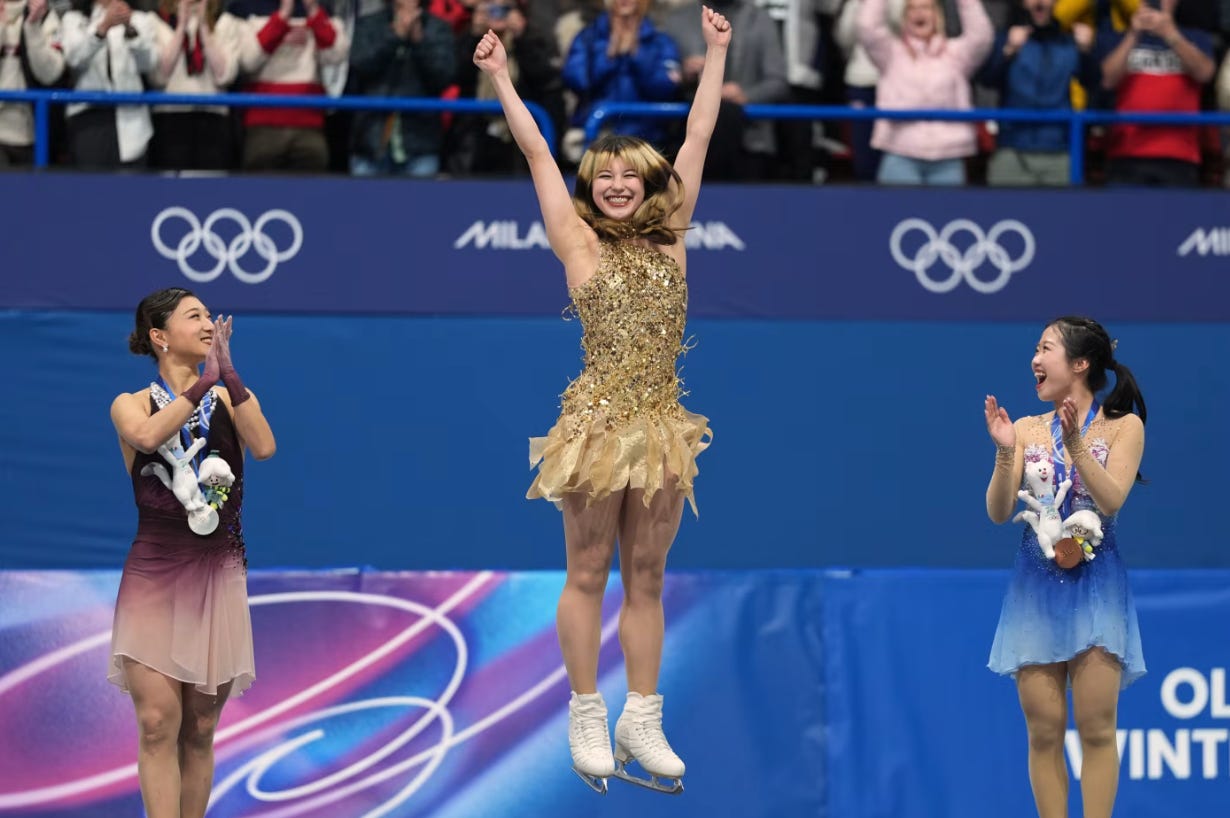
Aylsa Liu leaps for joy on the Olympic figure skating podium after winning gold.
Liu transformed her skating from “a JOB” to JOY!
When she was 13 years old, Liu became the youngest U.S. national champion.
Three years later, after skating in the 2022 Olympics, 16-year-old Liu retired from the sport.
A decision she made on her own.
Shocking her dad who’d paid for and dreamed his daughter’s future. (Liu’s father estimates he paid up to $1 million trying to build his daughter’s skating career.)
Liu announced her departure from skating on Instagram.
Later, she explained that she was escaping what felt like “a burden, a duty.”
She quit because it wasn’t fun.
“She avoided the ice rink at all costs. She was just traumatized. She was suffering from PTSD and she wouldn’t go near the ice rink,” her father said at the time.
Skating for fame and fortune and medals was her father’s dream. Never hers.
“It was essentially his business,”1 Liu observed in this recent video interview, below. “It wasn’t truly mine at all.”
In this wide-ranging interview before the Olympics, Liu candidly reflected on her personal growth, describing how she discovered her own passion for skating.
Two years after quitting, Liu stepped back on the ice.
On her own, at first. Just her gliding across the ice. No one but her in the know.
Just to find out if skating was fun.
It was.
But to return to competition meant practice and coaches, something she’d consider only if she controlled what happened with her skating - and her life.
She was sick of being told what to do.
What to wear.
What to eat.
When to practice.
How to present herself to the curious world.
Sick of living an “abnormal” childhood.
She craved a teen’s life – the time to hang out with friends and family, time for other sports, and the freedom to do all kinds of things that her intense training didn’t allow.
In essence, Liu valued her mental health over skating’s fame and fortune.
So she was clear that she’d oversee the creative elements of her skating – from her music and choreography to her dresses, for which she gave their designer a “vision board” she’d created.
And she’d decide what she ate.
With her conditions articulated to her coaches, Liu returned to training at the start of the 2024-25 season – and won the world championship.
Thought that wasn’t her goal.
With her skating, Liu hoped to “display my art.”
Not seek podium placements.
And if her return skating wasn’t fun – if it felt like doing it was too much – she’d walk away, again.
Liu stayed. And in Italy, she won Olympic gold.
Doing it her way.
“Liu looked completely impervious to the intensity of the moment, just as she has been at every point since making her audacious comeback to the sport two years ago. Instead of feeling pressure, the extrovert appeared ecstatic simply to be performing on a global stage. … If skating once felt like her job, or something she was doing to please her father, now she treated it as a chance to express herself as an artist. … Then Liu stepped onto the ice, looking relaxed and free, as if she were in a rink by herself. [WSJ, Feb. 19, U.S. Figure Skater Alysa Liu Seizes Her Moment—and Olympic Gold]
Norway Should Make Liu an Honorary Citizen
For the whole-bodied JOY she exudes in her skating.
For her rare habit of sticking around after her competitive skate to root for her American teammates — even when they’re skating against her!
For exemplifying the joyous spirit of sports as Norwegians live them.
Notions embedded in Norway’s youth sports.
Then, ingrained for life.
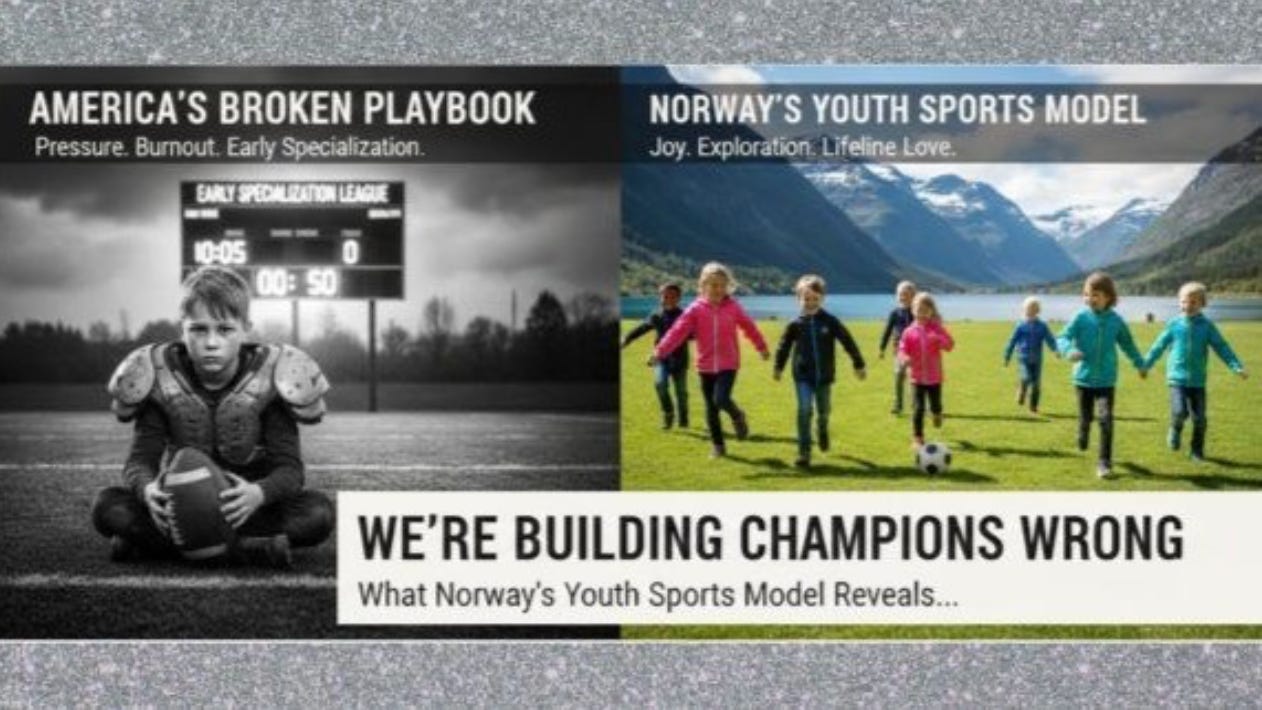
As youth sports become outrageously expensive in the U.S., Norway insists that organized sports be affordable for everyone. They also prioritize having fun over winning. They make sure costs are low and participation is high. They encourage kids to sample as many sports as possible and don’t force youth athletes to specialize too early. They don’t even bother keeping score until athletes are 13.
Only then are the country’s elite athletes selected for training academies where they have access to top coaches and other elite athletes. …
Norway’s sports “facilities are modest. The schedule is downright sane. The people inside are perfectly willing to share their secrets with anyone willing to listen. They explain their philosophy of humanistic development and ‘joy for all,”’wax lyrical about raising happy children, focused athletes and healthy citizens, speak earnestly about how their organization is more like an organism—and to the rest of the world, they might as well be speaking Norwegian. [Wall Street Journal, Feb. 18, 2026, One Tiny Country Dominates the Olympics—and Everyone Wants the Secret ]
Even though youth sports in Norway don’t involve fierce competition and grueling training, this nation perennially takes home more Winter Olympic medals than any other country.
As it will again in 2026. Already, Norway has broken its own record for most gold medals won at a Winter Olympics, achieving this with its tiny population, which is just 2% of ours, roughly the equivalent of South Carolina’s.
Habits – good and bad – are rooted in our childhood experiences.
Which is why Norway’s approach to youth sports matters so much.
Children’s Rights in Sports
Children's Rights in Sports form the basis for youth sports in Norway. The eight rights set forth in this document put the needs and participation of children at the center of all activities, expressing what the nation values regarding the importance of participation, safety and joy of sports for every child. Declared in 1987, these rights and values underpin Norway’s entire sports ecosystem.
TAKE A LOOK INSIDE … these few pages tell the story!
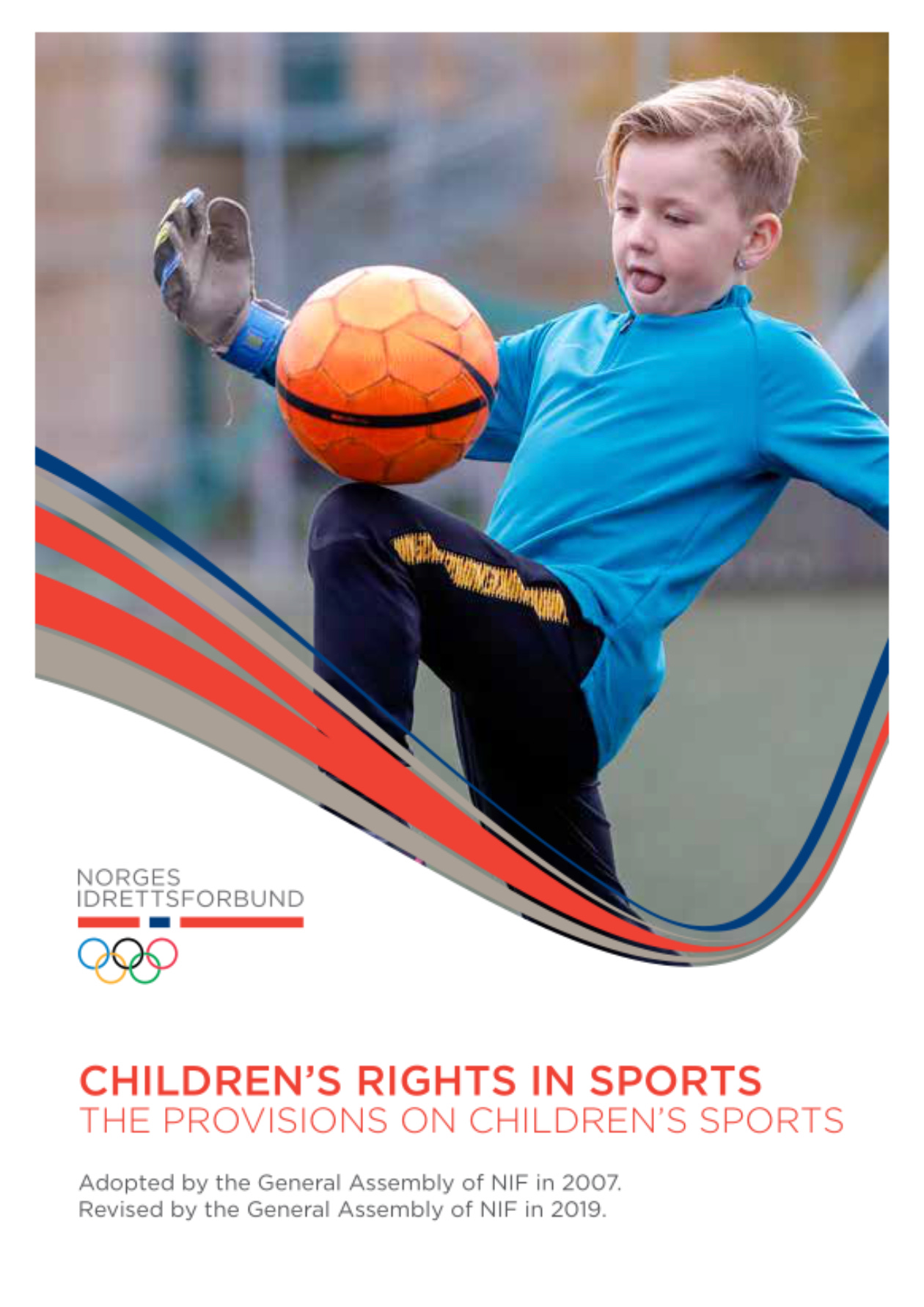
NORWAY EMPHASIZES JOY, IGNORES COMPETITION
They give this foundational cultural attitude a name: ldrettsfglede.
It means “the joy of sport.”
Children “must be granted opportunities to participate in planning and execution of their own sport activities,” according to the document. [Remind you of Liu?] They may “decide for themselves how much they would like to train,” and can even opt out of games if they just want to practice.
“Want to transfer clubs in midseason? Go ahead, no penalty. Suit up with a rival club next week, if you wish.”
“We believe the motivation of children in sport is much more important than that of the parent or coach,” said Inge Andersen, former secretary general of the Norwegian confederation. “We’re a small country and can’t afford to lose them because sport is not fun.”
Here are comparative consequences of our differing approaches with youth sports:
93% of Norwegian children participate in youth sports, with few leaving sports before they celebrate their 13th birthday
In the U.S., about half as many children participate in youth sports. By age 13, 70% of American kids have quit organized sports.
The most common reason those who quit gave was not injury or cost but that it stopped being fun.
Check out this short video to discover Norway’s secret sauce.
Want to witness a GREAT example of Norway’s successful approach: Cross-country skier Johannes Hoesflot Klaebo has won 6 gold medals at the 2026 Olympic Games, which means he’s won the most golds of any Winter Olympian. He is also only Winter Olympian to win 11 gold medals. The three next-closest gold-medal winners are from Norway, each with eight gold medals, but none of them are active.
Not until he was 15 years old did Klaebo make the decision to focus on cross-country skiing over other sports, like soccer, which he played in his youth, as he also skied.
Climbing Mountains to Ski Down
From skis to running, and now back on skis with uphill running.
American Anna Gibson of Wyoming only had competed in her fourth professional ski mountaineering race when she was named a member of this U.S. team at the 2026 Winter Olympics. There, she made it to the semifinals before being eliminated. This is the first time ski mountaineering has been included in the Olympics.
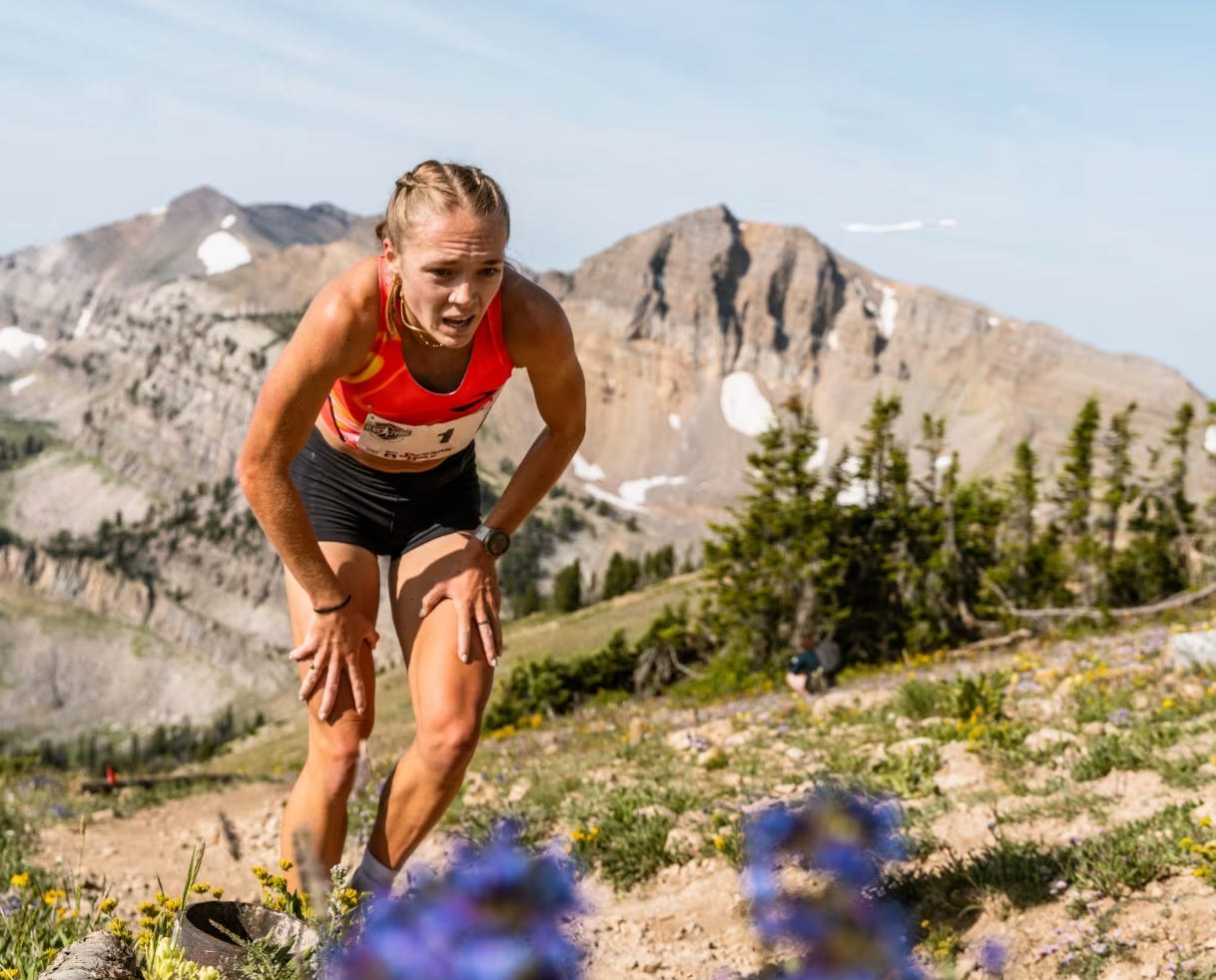
Until recently, Anna Gibson was known as a trail runner, not a ski mountaineer. As a child, she raced on skis, then in college, she ran track, and later she became a trail racer, and then a mountain racer, until she recently started competing in ski mountaineering.
Now, she’s just finished competing in the Winter Olympics:
Anna Gibson left the Olympic event “on a high. Six months ago, she’d never competed in a skimo race, though she’d spent plenty of her childhood finding ways to climb snow-covered mountains. Thursday she competed in the Olympic Games.
“I’ve been doing this sport since I was a little kid, just in a really recreational way,” Gibson said. “It’s something I’ve always loved. Sometimes, it turns out that loving something is enough to get you all the way here.” [New York Times, Feb. 20, 2026, “Ski mountaineering’s Olympic debut: Beautiful races, beautiful place and a sport that belongs.”]
Joy. Love. Contentment.
All found in doing. For some, without bringing a medal home.
Can America’s youth sports stir in Norway’s secret sauce?
Probably not, at least not in any significant way, given that our youth sports are inherently tied to the ferocious competition of collegiate recruitment. This is made more pernicious with the addition of large amounts of money being paid to athletes from Name, Likeness, Image [NIL], and this practice is infiltrating high school sports. Some communities try to have their youth sports imbue Norway’s spirit, but for this to happen more widely would require:
A separation of youth sports from college recruitment
Lesser incentives related to commercial benefits
A huge cultural shift in embracing multi-sport play and later specialization
Leadership coming from the top levels of sports governing bodies.
None of this is about to happen. In fact, movement is in the other direction.
Still, thank you for walking down this path of imagination with me.
That Liu is living it is reason for joy.
MEMORABLE OLYMPIC MOMENTS — without medals
The IOC SAFEGUARDS HUMAN HEALTH
Olympic athletes SPEAK UP ABOUT THE PERILS OF CLIMATE CHANGE
The IOC is way ahead of the U.S. policy when it comes to regulating PFAS.
In fact, in America, the floodgates have been opened to permitting widespread use of PFAS and other toxic chemicals dangerous to human health.
Kudos to the IOC for recognizing the toxic harm PFAS poses to health.
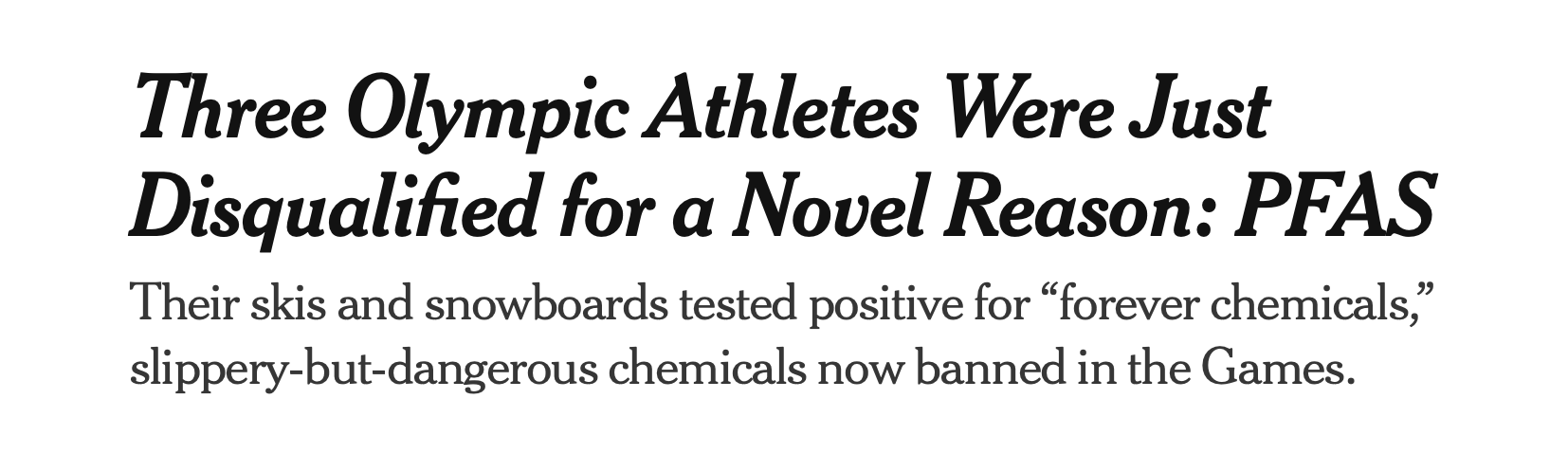
Japanese snowboarder Masaki Shiba and two South Korean skiers were disqualified because their snowboards tested positive for traces of PFAS, or “forever chemicals.” At these Winter Olympics, PFAS are banned for the first time because of their damage to the environment and the human body. These skiers are the first known offenders in using ski wax that contains these chemicals. They likely did so because this wax has moisture-wicking properties that can help skis and snowboards go faster in the snow.

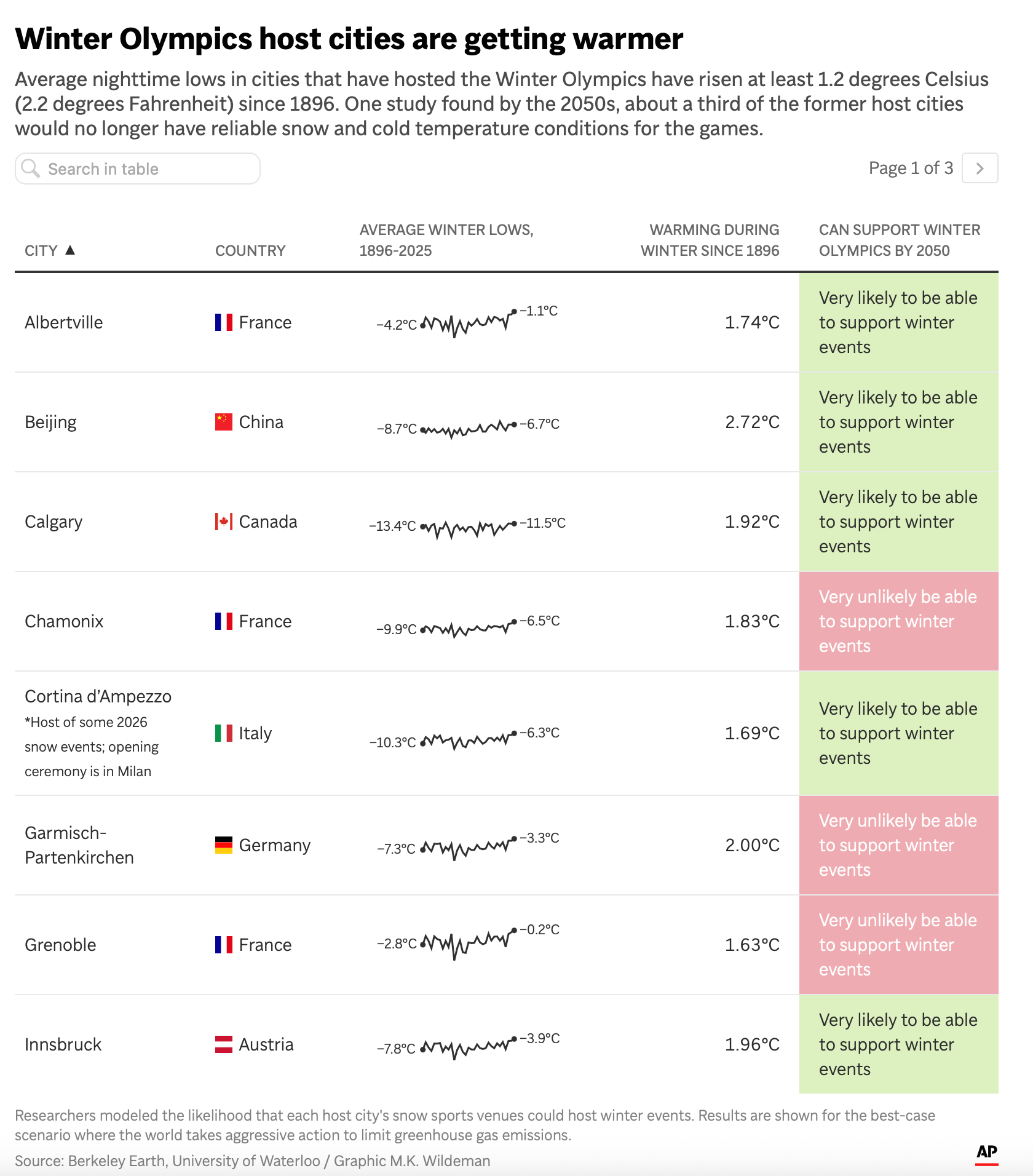
“Grenoble [France] isn’t the only past host that the researchers believe won’t be ‘climate reliable’ enough to host the game again by the 2050s. Chamonix, France, Garmisch-Partenkirchen, Germany, and Sochi, Russia, also didn’t make the cut, while past venues in Vancouver, Canada; Palisades Tahoe, California; Sarajevo, Bosnia-Herzegovina; and Oslo, Norway, would be ‘climatically risky.’” [AP, January 2026, How will climate change reshape the Winter Olympics? The list of possible host sites is shrinking.]
I fall into the category of not-all-that-engaged follower of the Oympics, Melissa, and have found your last couple of essays to be especially good reads. Athletics for the fun of it. What a concept! Thanks for the great angle on this.
One of your very best Substack's for depth and breadth of what does it mean to keep the focus on joy of being physically active in a variety of sports/physical activities vs. early specialization and all or nothing: Winner/Loser valuation. As a mom of a former professional ballet dancer, I relate to both Alysa and her father on their assessment of the fallacy of sunk costs demanded in the early training through the pressures of performing amongst the select few.