
Let's Row Together
Everything you DON'T know about women drivers, baseball's "Suffrage Days" and the time when powerful American men performed tasks assigned to them by female suffrage leaders to win the vote for women.

In January I met my friend Kathy Bonk for breakfast.
And she gave me two books.
One for kids. The other meant for me. Each telling a remarkable story I’d never known.
About two suffragist women - Alice Burke and Nell Richardson – driving a car farther than any woman ever had.
Circumnavigating America in 26 weeks in 1916. In a yellow Saxon roadster.
“Ten thousand bumpy, muddy, unmapped miles – facing danger and adventure all alone, with just each other (and a kitten) in their little yellow car.” [“Around America to Win the Vote”]
Alice and Nell brought with them a typewriter, sewing machine and fireless cooker!
“They said the typewriter and the sewing machine were all part of their plan. If anyone said women didn’t have brains to vote, then Nell would dash a poem off right then and there to prove they did. If anyone said they should cook and sew and leave running the nation to men, then Nell would whip an apron up while Alice gave a speech to prove they could do both.”
At the time these women drove, few women did. They were usually passengers.
For a woman to drive, especially a long distance, was an act of liberation.
Rebellious women breaking the mould of their day.
Which was exactly the point of Nell and Alice’s decision to drive around America.
To showcase the rebellious women they were – and their rebellious cause.
By driving a distance, they’d attract media attention, as curious men turned out to write newspaper stories about women who dared to be different.
Women painting outside the prescribed lines of their gender role.
Oddities made news. Women didn’t.
As members of the National American Woman’s Suffrage Association, Alice and Nell knew their road trip would stir up headlines. Become front-page news.
Letting Americans hear their arguments for why women ought to be able to vote.
To drive a yellow roadster across America was a gimmick, their way to catch the eye of the men who’d bring their cause to Americans.
By shining first a spotlight on them — then, by necessity, their cause.
To get the vote for women!!
They did this at a time when the suffrage movement was stalled.
Driving through 29 states and Washington, D.C..
Collecting signatures on their petition for the voting amendment. Winning converts and leaving naysayers with reasons to reconsider.
In 26 weeks of driving, they spread this message far and wide:
It was long past time for women to vote.

One hundred + 10 years later, a hardy group of women – my breakfast companion among them – left New York City on March 2 to retrace a good part of Alice and Nell’s 1916 route.
Their cause: Congressional recognition of the Equal Rights Amendment [ERA].
With the ERA’s progress stalled – just as Alice and Nell’s suffrage cause had stalled in 1916 – women are driving the Golden Flyer II, a restored 1914 yellow Saxon roadster, on their 2026 Vote for Equality Tour.
One goal: To collect one million signatures by Election Day in November.1
The Golden Flyer II will traverse 25 states as its drivers mobilize voters and motivate Americans to join the national ERA petition drive. [You can join, too, by signing it at Sign4ERA.org.] At each stop, Jeryl Schriever, who wrote Driving the Vote for Women, about Alice and Nell’s rebellious – and within a few years successful – drive to get the women’s right to vote, aka the 19th Amendment, in our Constitution.

Eyes are opening to this cause. Here’s the New York Times headline.

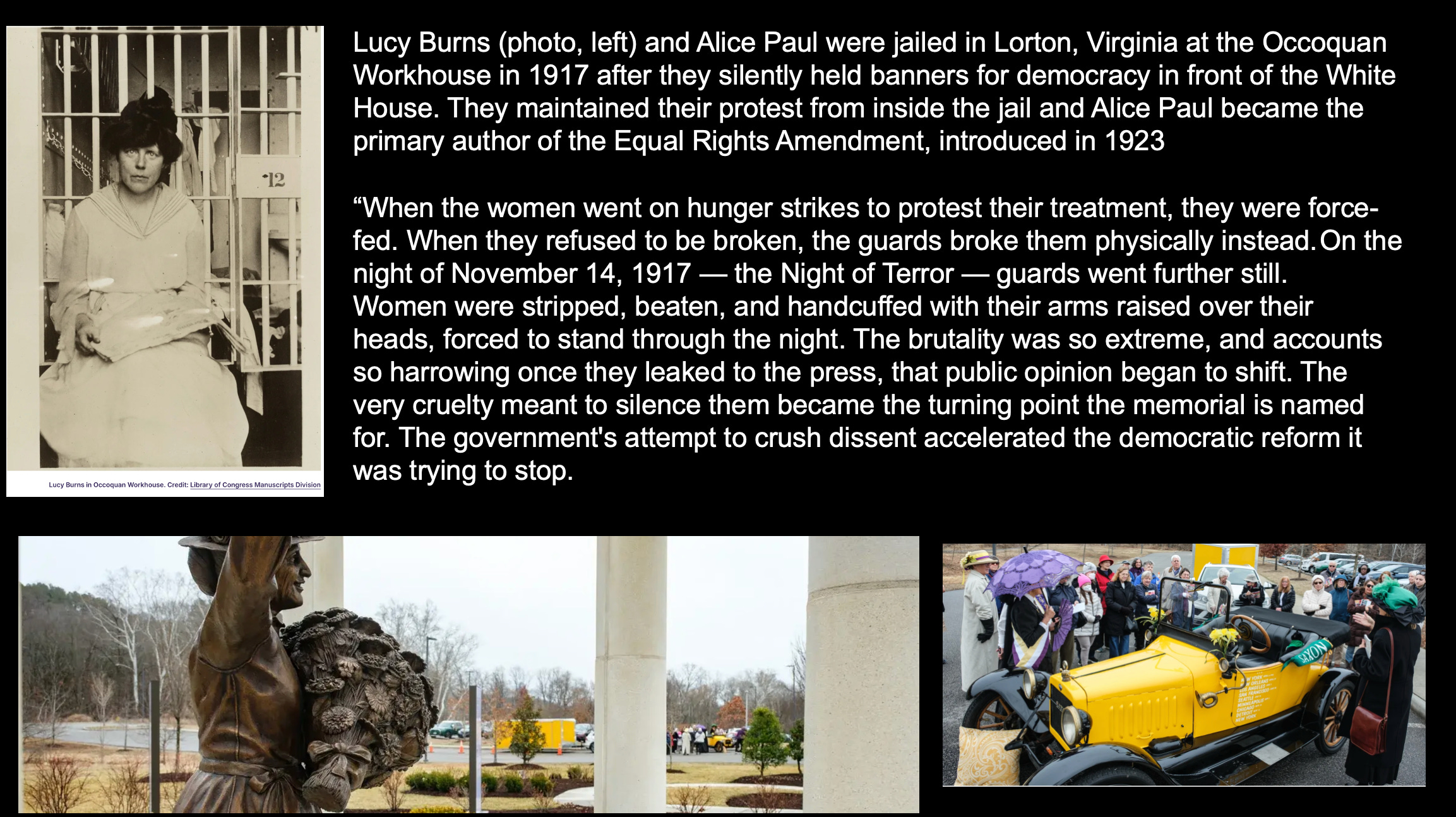
Along the way, the women make stops of remembrance. In Lorton, Virginia, they visited the Turning Point Suffragist Memorial on the grounds of the old Occoquan Workhouse. In 1917, suffragists, ages 19 to 73, were arrested for silently protesting at the White House and brought here to live in filthy and inhumane conditions. Denied contact with family and lawyers. Some endured solitary confinement; many were severely beaten.
“That is the ground the Golden Flyer II pulled into on the morning of March 7.”
Here’s why the ERA fight matters — and is winnable
The ABC’s of the ERA. What it means for YOU!
Give me an E! – Economic, Equal Pay, Education and AI Equality. Equality under the law – written in our Constitution – is foundational for our economic security.
Give me an R! – Rights, Reproductive Freedom and Decision-making. Women’s equality - written in our Constitution - strengthens accountability for sexual violence and trafficking and undergirds our rights in reproductive health care.
Give me an A! – The ERA works for ALL of Us. This demand links us to our nation’s founding when Abigail Adams wrote to her husband, “Remember the Ladies.” If attention was not paid then, she said, “we are determined to ferment a Rebellion”
Just Nell and Alice did in their time, rebellious women are doing today.
Suffragist Women Led – and Men Followed
It took another friend of mine, Brooke Kroeger, handing me her book to help me discover this time when powerful men joined forces with rebellious women.
These influential men did not assume leadership roles but did tasks to help women win the right to vote. Suffragist women determined the campaign’s strategy, then the men got to work doing all they could to make the women’s strategy succeed.
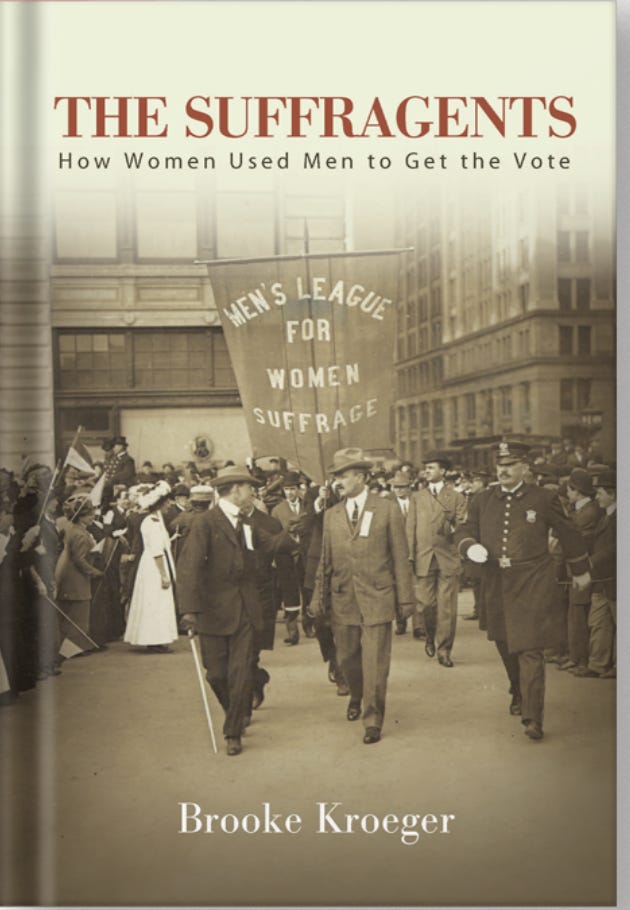
“Brooke Kroeger shows how the suffragist movement, engineered by women from top to bottom, cleverly stitched in the involvement of men from all walks of professional and political life, directed by women who used neither gun nor blade to direct the men, but the weapons of intelligence, cleverness, and when necessary, subterfuge. The collaboration in this balance of power between prominent men who invested in the movement, and the women who directed them, has everything to teach us today.” – written by author James McBride in his review of this book.
The Suffragents: How Women Used Men to Get the Vote tells the story of New York’s most powerful men creating the Men’s League for Woman Suffrage. Between 1909 and 1917, their league grew from its 150 founding members to thousands in 35 states. The book shows men acting at the behest of the movement’s female leadership, explaining why they did.
The National American Woman Suffrage Association decided wisely to accept the men’s offer to act as “suffrage foot soldiers,” a role they accepted with “uncommon grace.” The men carried the suffrage message “to the streets, the stage, the press” and to legislators and executive branch leaders, convincing more than a few uncertain politicians. They engaged “a dismissive public and dealt with a largely hostile press in support of the women’s demands.” [Adapted from Kroeger’s description.]
“Together, they swayed the course of history,” Kroeger wrote.
Could such support from men happen today?
A Perfect Pairing: Baseball and Women’s Suffrage
As chairman of publicity for New York’s Men’s League for Women’s Suffrage, George Creel, a highly respected former newspaper editor and publisher, flexed his influencer muscle to promote “Suffrage Day” on May 18, 1915 at New York City’s Polo Grounds.
The Chicago Cubs were in town to play the New York Giants and the suffragists had purchased 8,000 tickets and 125 boxes to sell on commission for the game. Similar ballpark Suffrage Days had occurred in Philadelphia and Pittsburgh. With men seated in most ballpark seats, the suffragists found it a promising place to try to change a few minds. Besides, baseball was a great way to get their male allies involved, too.

On game day, the Polo Grounds were festooned with yellow banners and streamers – yellow being the suffragists’s color due to sunflowers in Kansas. The banner blew in the breeze, while ballplayers wore sashes championing the women’s vote despite polls indicating their near unanimous opposition to this idea.
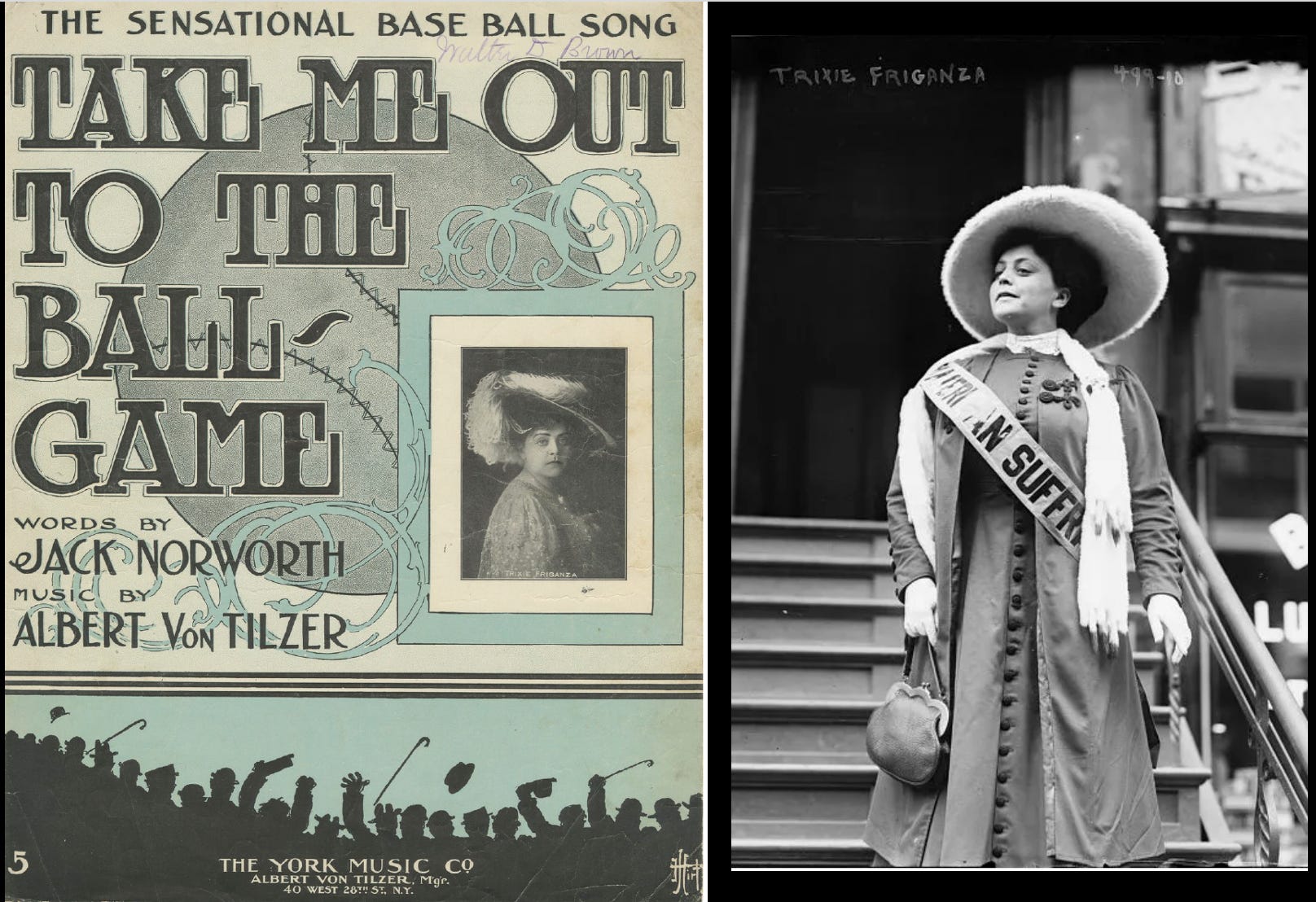
We don’t know if Trixie Friganza, a New York suffragist and vaudeville star, was at the Polo Grounds that day. It’s likely she was since off the stage “she was an influential and prominent suffragist who advocated for women’s social and political equality.”
“She attended rallies in support of women’s right to vote, gave speeches to gathering crowds, and donated generously to suffrage organizations. “I do not believe any man – at least no man I know – is better fitted to form a political opinion than I am,” Friganza declared at a suffrage rally in New York City in 1908.” [Smithsonian magazine, July 2020]
We also know that Friganza was Jack Norworth’s mistress.
And Jack Norworth, a songwriter, was inspired to write baseball’s most famous song, Take Me Out to the Ball Game, when he saw the sign “Baseball Today—Polo Grounds,” from a subway car. He’d never been to a baseball game, nor had the man who wrote its music.
Friganza became Katie Casey in Norworth’s song – a baseball-loving young woman. Hear a sultry Carly Simon sing it!
Katie Casey was baseball mad,
Had the fever and had it bad.
Just to root for the hometown crew,
Every sue – Katie blew.
On a Saturday her young beau
Called to see if she’d like to go
To see a show, but Miss Kate said “No,
I’ll tell you what you can do:Take me out to the ball game,
Take me out with the crowd;
Just buy me some peanuts and Cracker Jack,
I don’t care if I never get back.
Let me root, root, root for the home team,
If they don’t win, it’s a shame.
For it’s one, two, three strikes, you’re out,
At the old ball game.
And Norworth’s song a nod to suffragists.
“Take Me Out to the Ballgame” tells the story of a woman operating and existing in what is traditionally a man’s space—the baseball stadium. Katie Casey was knowledgeable about the sport, she was argumentative with the umpires, and she was standing, not sitting, in the front row. She was the “New Woman” of the early 20th Century: empowered, engaged, and living in the world, uninhibited and full of passion. She was, historians now believe, Trixie Friganza.” [Smithsonian magazine]
When its sheet music was published in 1908, Friganza’s photo was on the cover.
Baseball fans sing the chorus of “Take Me Out to the Ball Game.” But few people – myself included, until I wrote Locker Room Talk, – have heard of Katie Casey, nor have any idea that Norworth wrote this popular song about a baseball-mad girl begging her beau take her to a ballgame to root, root, root for her team. As I wrote in my book:
“What if I’d known about Katie Casey when I was a girl who loved to play ball? Or a woman going to ballparks to report on games? Would knowing this have made a difference? I think it would have. To not see oneself in the place where you want to believe you belong makes it harder to keep taking those steps inside. Or in Shirley Chisholm’s way of thinking, I’d have known how to bring a folding chair so I’d have a place to sit as I found my way inside. [Adapted from Locker Room Talk]
Hillary’s Expressions Speak for Millions
When she gave testimony about the Epstein files, Hillary Clinton’s “expressive face displayed a full range of aggravation. It was incredibly satisfying to watch, because it felt as though she was channeling the exasperation and rage that many American women have felt at least for the past decade. … Watching this long deposition also reminded me that we are experiencing a vacuum of durable female political power at the national level.” [New York Times, What Watching a Furious Hillary Clinton Showed Me, Jessica Grose]
So, I figured why not offer another chance to check out Hillary’s expressions when she and I talked at the 92NY last October.
LET US commit ourselves to creating durable female political power at the national level. If men want to join in, I say “welcome aboard.” Start right now by signing this ERA petition, strategically organized by Congressional district. Then, take a petition with you to the No Kings rally on March 28 to collect signatures there. And follow the Golden Flyer II as its campaign rolls on.
Since Thirty-eight states have ratified the Equal Rights Amendment, Americans have fulfilled every constitutional requirement of this amendment. So, ERA NOW and other supporters are pushing Congress for a Joint Resolution to recognize the ERA as the 28th Amendment, thus eliminating any uncertainties about an arbitrary time limit.
I haven't read the books, but I love Alice and Nell's story. Driving is freedom! I took the driving test to get my license in the middle of a snowstorm on my 16th birthday. I would not wait another day. Thank you for sharing the baseball suffrage history. How refreshing to read this considering how many owners today seem to dismiss women even coming to the ballpark. Hillary was all of us in that hearing.
Loved these stories. and Trixie Friganza! What a name.