
Let's Row Together
Motherhood – as in my long, winding road to raising a child – and the reluctance of women globally to be mothers now despite the coercive strategies governments use to pressure them to give birth.

I can’t remember a time when I didn’t want to be a mother.
So strong was my desire to raise a child that in my late 30s I sunk into a deep clinical depression and was hospitalized in an effort to deal with my emotional emptiness.
Brought on by my sorrow in thinking that motherhood would never happen for me.
In my twenties, I’d had an abortion after a hazily remembered, post-bar escapade had resulted in a pregnancy that I wasn’t ready to continue. Six months later, I married the man who I’d dated only a few weeks before saying “yes” to his midnight proposal.
I hastily accepted amid the dizzying whirlwind of my widely publicized legal case against Major League Baseball [MLB] charging gender discrimination. At that time, I was in the bullseye of the media’s evisceration of me for having the audacity to fight MLB over equal access to locker rooms.
In other words, I felt exceedingly vulnerable. In need of buttressing.
So, when his idea of marriage popped up, in my mind I saw marital stability, a stability that my media-maligned life as a single woman lacked. Okay, I know this rationale does not make sense, but I’m telling you how I thought at that time as I was waking up to the daily onslaught of mocking, mean-spirited public words said about me.
It was this dreamy promise and not my love for this man I barely knew that compelled me to accept his proposal. But, all too soon after saying, “I do,” I understood all too well the promise wasn’t real. My cockamamie idea of stability in marriage vanished.
Thankfully, I had paused my desire to be a mother at the moment our relationship began, a good thing since soon I realized how unhealthy we were together.
A while later, I walked out of my marriage after ducking my head just in time to avoid being hit by the wooden clog my husband threw at me.
In reintroducing myself to the single life, I relaxed. At 30, I had time for motherhood to happen. Surely, I’d find a partnership in which I wanted to raise a child.
First, I needed to strengthen the core of my own life. Fortunately, my journalism career as a Sports Illustrated reporter, and after leaving my marriage, a correspondent for Time, was enormously fulfilling. And I filled my life with close friendships, family gatherings and more activities than my wall calendar could hold.
Motherhood would happen. Just not right away. I had time.

At bat for our Sports Illustrated Publisher’s League softball team.
This essay about motherhood takes a hard look at the decisions women globally are making to NOT be mothers, while many also resist the pressures put on them by the state and their families to be wives, as a prelude to motherhood. Their decisions have broad ramifications for the health of nations’s economies, which is why governments are doing all they can to convince women to have babies.
Once a nation enters the low fertility trap, it rarely escapes. And nations move into this trap when their Total Fertility Rate (TFR) falls below 1.5. In East Asia, the TFR of several countries is below 0.8, otherwise known as “severe.”
In France, 29-year-old women (and men) received letters from the health ministry reminding them to have children. President Emmanuel Macron speaks of the need to “demographically rearm” after its fertility rate fell 18 percent over a decade.
“How would I feel if my government wrote to me, reminding me to have children? … on the one hand, it’s none of your business who has kids but on the other, how about we just all keep out of each other’s business? … [and] while unveiling a 16-point plan to tackle low birth rates, why not make the 17th point that if anyone could afford to house themselves, they might be quicker to settle down?” [The Guardian, Feb. 9, “France’s letters to 29-year-olds to remind them to have babies is a spectacular missing of the point.” ]
In the United States, birth rates keep falling with the biggest drop among teens and white women ages 20-24. Half of all 30-year old women are childless. A woman in her 40s is more likely to give birth now than a teen. “I would expect them [birth rates] to fall because childbearing is highly related to economic conditions and uncertainty,” a family demographer observed.
In response, the Trump administration took measures to encourage more births, issuing an executive order designed to expand access to and reduce the costs of in vitro fertilization. It also backed the idea of “baby bonuses” to try to convince more couples to have kids”.
In the European Union, fertility experts expect “its population to hit a peak before sliding into the first sustained decline … since the 14th-century Black Death.”
Commissions in Scandinavian nations examine new strategies, while looking at why their “strong welfare programs couldn’t prevent a fertility rate nosedive.” Nationalist leaders roll out generous financial incentives to urge births “while extolling traditional families.” Italy gives bonuses to working mothers with two or more children. Poland boosted a monthly payment to families — $220 for every child every month – as its president okayed a large tax break for parents with two children or more. [Washington Post, Europe is panicking over its shrinking population, Dec. 13, 2025]
Before turning to how China is responding to rapidly declining rates of marriage and motherhood, I’m going to bullet-point my own quest for motherhood:
When a three-year relationship with a childhood friend in my late 30s led him to suggest marriage but reject children, I walked away and joined Single Mothers By Choice to learn from women my age how they were approaching motherhood. By then, mothering on my own seemed my destiny.
For a year, I went monthly to a clinic for donor insemination. When hormones I took to stimulate ovulation caused havoc with my mental health, I stopped.
I set out to write On Our Own: Unmarried Motherhood in America for Random House, describing my personal journey while also exploring unwed motherhood as a societal issue and portraying experiences of many single moms. In the early stages of writing that book, I fell into my clinical depression; it was impossible for me to separate my longings to be a mother from my writing about single moms.
In 1997, after finishing my book, I went to Changzhou, China to adopt a nine-month old girl whose birth family “left her to be found” in China’s one-child policy era. I was 46 years old.
Since then, I’ve closely tracked news coverage out of China — and about China – that relates to the lives of girls and women and reproductive messages and policies of the government. China’s women lost their bodily autonomy during its one-child era under the strict government enforcement including forced abortion and sterilization. Today, women of childbearing age again are being pressured about their reproductive lives, this time pushed to have babies the state realizes it needs. Women are told to have three children, even though wives and mothers often live under harsh economic conditions and raise children amid traditional patriarchal attitudes and practices.

In 2015, when China declared an end to its decades-long one-child policy, I wrote an essay on Medium.com about adopting my daughter. For nine months, she lived in an orphanage crib in Changzhou, China after police took her there when she was three days old. Her birth family likely wanted a son. She was found in the rural farming town of Xiaxi in Jiangsu province in September 1996. An excerpt:
I’ll be watching closely in years ahead to see how this two-child change by China’s leaders affects the intense pressures already being put on its well-educated young women to adjust their lives to fit their expected family roles of wife and mother. … for urban women who might not be so interested in reducing their own ambitions for a marriage at a younger age, there is already a popular slang term that stigmatizes them as “leftover women.” This morning a close watcher of women’s rights in China tweeted that this new second-child policy could be summed up in this way: “Hurry up and have two children, leftover women.”
Well, now it’s “Hurry up and have THREE children"
For a fourth consecutive year, China’s population fell as its birth rate plunged. Hit a record low in 2025 of 1.0 to 1.09 children per woman, which makes it one of the lowest fertility rates in the world. Experts warn of further decline, which would be catastrophic for China’s economic growth. In Beijing to plan the nation’s next five years, top lawmakers put population planning at the top of its economic strategy.
In 2026, Beijing will spend 180 billion yuan ($25.8 billion) to boost births, according to Reuters estimates. Key costs include its national child subsidy, introduced for the first time last year along with the government’s pledge that pregnant women will have “no out-of-pocket expenses,” with all of their medical costs, including in vitro fertilization (IVF), which are fully reimbursable under its national medical insurance fund.

China adds its top-down approach to censor disparaging messages about marriage and motherhood. Before Chinese New Year, the Cyberspace Administration of China described the actions it would take against online accounts that “maliciously incite negative emotions.”
Prominent examples included posts “promoting unhealthy values such as refusing marriage and childbearing, advocating anti-marriage and anti-natalist ideas, stirring up conflicts between men and women, exaggerating fears about marriage, and increasing anxiety about fertility”.
In the comments section appeared a screenshot of the post that led to Uyghur stand-up comedian Xiao Pa being punished. In early February, she wrote: “I was down with fever for two days, and I thought if I had a husband and children, I would have to lean against the wall to prop myself up and cook for them.” [South China Morning Post ]

Given space constraints, I’m linking you to an excellent resource about policies and approaches that are more likely to succeed in promoting motherhood,
A FEW LOOSE ENDS … relating to last week’s essay

Here’s a great example of the ol’ girls’ network in action: the hockey essay I wrote last week was read by my longtime friend, Lynn Povich, author of The Good Girls Revolt who was the moderator for my talk about Locker Room Talk (on sale, half price on Amazon) at the New York Historical Society. Lynn was impressed by Sarah Spain’s video exhortation about the Olympic hockey blow-up so she sent it to her friend Letty Cottin Pogrebin, the founding editor of Ms magazine. She listened and agreed with Lynn that more folks need to hear it. Pivoting from her customary focus on news, she wrote her Substack about Sarah’s video. Thank you, Lynn. Thank you, Letty.

The Professional Women’s Hockey League will host sold-out crowds in team debuts at Madison Square Garden and TD Garden; Sirens play Seattle on Apr. 4 and the Fleet play Montreal on Apr. 11. These will be the largest home-game attendance for both teams.
In you missed SNL’s open last weekend, don’t miss it. Fun surprise at the end!!
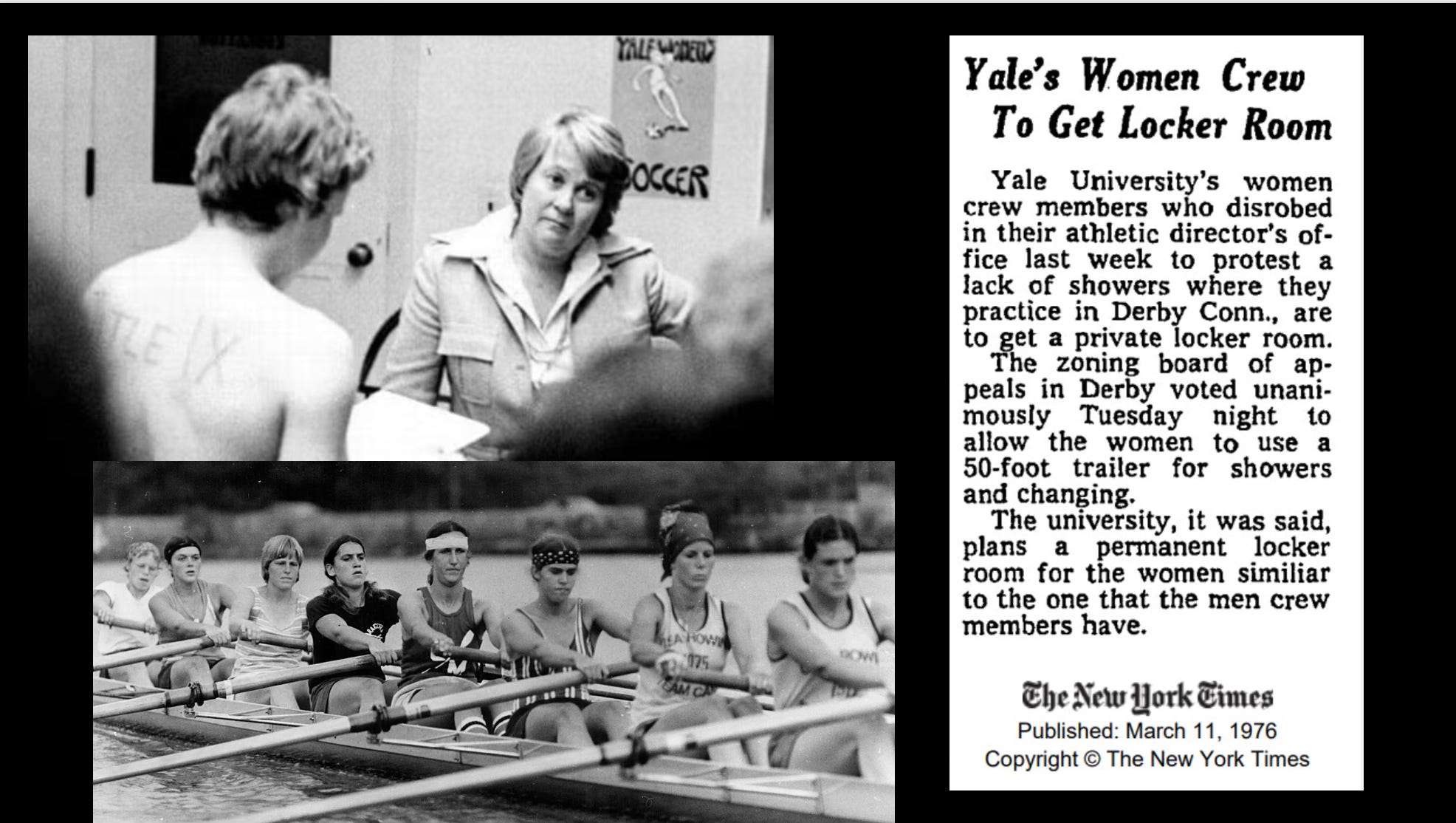
In closing, this week marked the 50th anniversary of the Yale women’s crew team’s 1976 protest-heard-round-the-world. A reminder of that historic day.
Another good one in the Ludtke tradition, Melissa: courageous personal story-telling coupled with reporting that tells us stuff we didn't know before. Plus a great video clip. We could have hoped that the last two people to step on stage would do so, but it was still kind of thrilling to watch them do so!
Thx for directing me to SNL.
I especially loved the reception given to the women’s hockey players!
Thank you for bringing the remarkable Maya to the US!