
Let's Row Together
"Let it go," women were told. I'm glad we didn't listen to that advice when a men's locker-room moment called on us to respond. Women persisted to the befuddlement of many men.

Some moments are stubborn.
They hold on beyond their sell date.
Slow to fade from public view.
This week a locker-room moment is sticking around.
Oh, you know the one I’m talking about. I’m sure you do.
Hard to imagine breathing and not somehow picking up that the U.S. men’s hockey team laughed when the President, talking by phone, whined about having to invite the Olympic women’s team if the men’s team were his guests in D.C., an invitation already extended. Otherwise, he quipped, he’d be impeached.
His words were again met with a supportive chorus of guffaws.
A moment to which global attention was — and still is being – paid.
A moment so embedded in this week’s conversations and commentaries that when folks aren’t being queried about the Epstein tapes or asked to define the “Epstein class,” they are opining on locker room talk.
A topic I know a bit about, and about which I’ll have more to say later in this essay.
Anyway, this locker-room-talk moment lingers, in part, due to familiar bells it rings.
Bells that women hear, loudly.
Maybe they’re muffled a bit for men, though heard still, perhaps for different reasons.
Like the latter stages of the 2016 presidential race. Access Hollywood, anyone?
When we had stage-lit exposure to the misogynist-in-chief’s bragging about the ease of sexual abuse.
So, when the uproar ensued, he apologized, well, sort of, in a typically insincere way: “if anyone was offended,” while shrugging off his lewd comments with these words: “It's locker room talk and it's one of those things.”
Regretfully, this moment was ignored by too many Americans who’d joined his cult.
Little did we appreciate then how his locker room talk foreshadowed the future.
His future as a defendant found guilty in court and ours living in the nation he rules.
He and his followers demeaned women, then.
They still do. Aided by a social media army eager to weaponize such words and attitudes. Trying to intimidate and silence women.
All the while claiming immunity under the “locker room talk” excuse.
Just boys being boys.
All said, in good fun.
Get over it. Stop being so serious, the detractors are told, when the men’s talk escapes its locker-room walls.
I mean, can’t you take a joke?
All the while, our nation is more and more suffused with misogyny.
Not coincidently at a time that women’s rights are being erased and women are being punished (at times, left to die) for their reproductive choices.

Matthew Tkachuk (19) carried Noa Gaudreau, daughter of their teammate who died in a tragic accident, onto the ice following the men’s ice hockey gold medal game between Canada and the United States. Photo by Petr David Josek The Associated Press
Imagine how different - how much more uplifting – our conversations about hockey would be now if this image of the triumphant moment when Tkachuk hoisted Noa up to his shoulder was telling the story to America of a daughter of their fallen teammate one day holding her own gold medal.1
Instead, here we are, stuck in the predictable cycle in which women feel they must speak up, if only to challenge men to do better.
Inevitably, in scenarios such as this, the spin cycle tosses women full circle.
As they start off being the butt of men’s jokes.
Then, a few brave folks, usually women, protest this treatment, knowing that if such behavior isn’t called out, it tends to be repeated. And it intensifies.
Inevitably, name calling and belittling ensue, often in an attempt to push away these women’s consternation.
Men chime in to say it’s all just silly to be so upset, and so it goes, until women end up being blamed for making more out of these insults than we should.
“Complain all you want that I’m being overly sensitive. That’s your right. Rant all you desire if you feel the men’s gold-medal performance is being unfairly overshadowed. But that’s not my fault. Blame the locker room celebration seen ’round the world, and the laughter whose echo won’t go away.” [Sports columnist Tara Sullivan, The Boston Globe, The US men’s hockey team should be celebrated, but the gold medal won by the US women is no laughing matter, Feb. 25]
Meanwhile, men do their best to slip out the back door.
Sit tight. Waiting for things to blow over.
Some still issuing ad hominem comments while heaping praising on themselves for supporting the women’s team.
Let It Go
Let it go, we’re told.
I’ve heard this so often I just might start singing, on repeat like 3-year olds do, the ear-piercing chorus from Disney’s Frozen.
I heard this said or implied in a few conversations I had this week.
You’re making too much about what should be seen as unthinking behavior of young men who were caught up in the exuberance of their gold-medal locker-room moment.
Not exactly a time to expect them to model emotional intelligence.2
I mean how can we expect young men not to laugh when the man in charge expects them to?
Just like his crowds who laugh when he demeans others.
Even if I accepted this excuse, which I don’t, since when cooler heads prevailed no team apology was publicly offered, it doesn’t mean that women should lose their right to speak out when this banter sounds all too familiar to what bombards them in their daily work.
In the men’s laughter, women heard many echoes.
And saw many flashbacks of the demeaning attitudes that seep into their lives as women hockey players, who are paid far less than the men to play, whose games are covered much less by the sporting press and broadcast less often, which adds up to fewer viewers. And fewer endorsements.
Disparities not confined to locker rooms, but which play out in real ways in real lives.
Why shouldn’t women commentators (and yes, some men) convey in this moment the pain that these insults inflict on women athletes?
Why should they be castigated for urging men’s put-downs to stop?
By them speaking up, the U.S. women hockey players could remain on high ground, ceding the response space to the multitude of commentators, like this hockey fan, wife, and mom, below, who spoke what I’m sure many hockey women feel.
The U.S. women’s captain Hilary Knight urged us to just get on with celebrating what the women and the men hockey teams achieved at these Olympics.
“Our genuine level of support and respect [for each other] is being overshadowed by a quick lapse … the guys were in a tough spot … and it’s a really good learning point to focus on how we talk about women not only in sport but industry. .. the joke was distasteful, … Now I have to sit in front of you and explain someone else’s behavior. It’s not my responsibility … but what is [my responsibility] is shifting the focus and the narrative of this amazing accomplishment we did together, the women’s and men’s teams; it’s never happened before. I want the legacy of this team to be remembered, and so that is what I am trying to shift in the narrative to what we’ve accomplished in the last two weeks together. … This is the best American women’s team we’ve put together on a world stage when the lights have been the brightest.” [And The Guardian’s story on her remarks.]
But even as Knight lauded the support the teams gave each other, she was applauded only once, when she bluntly said it shouldn’t be her responsibility to sit in front of microphones and be asked to explain the men’s behavior.
No it shouldn’t be.
And that’s the value this flood of commentators bring to this moment – both those who work in sports media and the individuals, like the mom in the video above, who refused to stay silent when confronted with this latest round of locker-room talk.
It matters that they push back.
For not speaking up has its own price to pay, as we witness in history’s tendency to overlook and hide women’s achievements.
Tipping the telling of our history towards the men. Yes, it must be said, the white men.
By not walking away, these women say to daughters watching and listening that they’ve left a sign on their pathway telling them “when you see her, you can be her.”
So, here’s some really good news: my friend, Jean Fruth, whose visual storytelling created the terrific documentary film, “See Her Be Her,” about young women playing baseball globally, has turned her camera on women hockey players, including on the 2026 Olympic ice. Her photography book will be out in the Fall, 2027.
Can’t arrive soon enough!
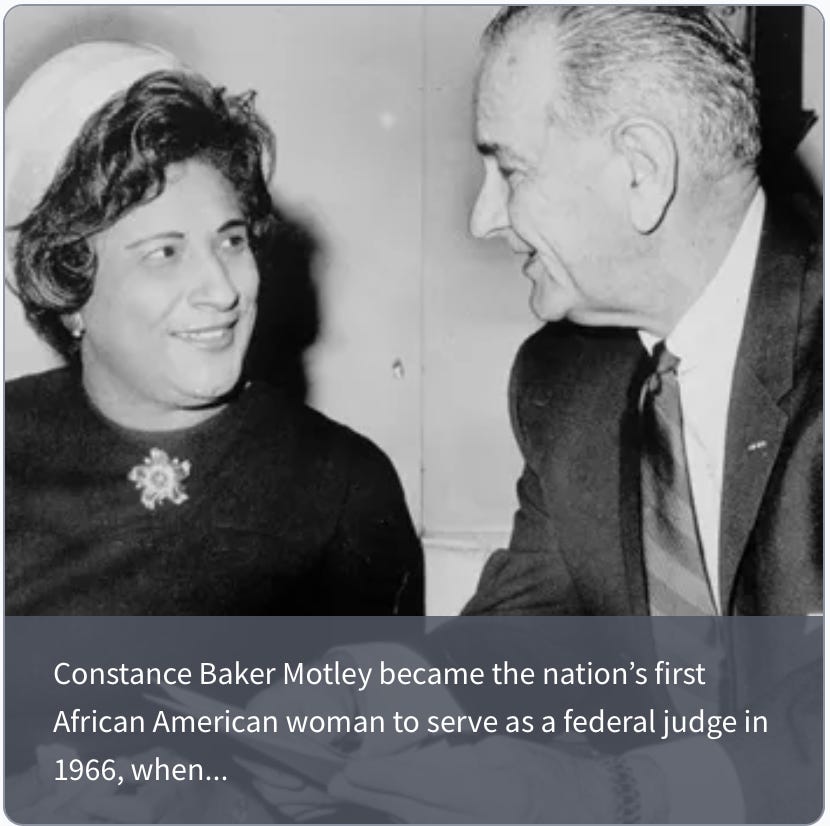
But right now we have Norah O’Donnell’s book, We the Women: The Hidden Heroes Who Shaped America that was published on Tuesday. In it, she reminds us — by using Constance Baker Motley, the judge in my federal court gender discrimination case against Major League Baseball, as a prime example – how women’s achievements too often are hidden from view.
I’m delighted to add that US. Courts also honored Judge Motley this week.
“Remember the Ladies” - We hear you, Abigail!
Now is a good idea to pause and take in the thrilling overtime win by the U.S. women’s hockey team against its arch-rival Canada.
Followed by the team’s ebullient gold-medal ceremony.
Which never gets old, despite how many they’ve had — in 1998, 2018, and 2026.3
Yet, these gold-medal women were not invited to the White House or the State of Union.
Their invitations must be lost in the mail.
Just like the praise from on high for what is arguably America’s best women’s hockey team ever is deafening in its silence.
Clearly an oversight.
But even with this context in mind, when women dare to raise their ire at these men’s complicit laughter, they’re blamed for spoiling what was harmless fun.
This charge brings to my mind the moment in my legal case’s hearing when baseball’s attorney made his audacious claim in what can only be seen as a ridiculous argument. Here, I quote from my book, “Locker Room Talk”:
“Can’t the player just protect himself by a curtain?” Judge Motley asked Andrews [the lawyer representing baseball], posing to him one of the questions she’d put to Climenko [another of baseball’s lawyers]. “Put a curtain on front of his cubicle if he doesn’t want anybody to see him or a towel or something like that while he is naked. I don’t suggest that he ought to be in front of anybody naked. It seems to me he doesn’t have to be. This is just being injected in here. He doesn’t have to be naked.”
“It’s the women being injected into the locker room,” Andrews replied with a brash certainty that Climenko didn’t bring to his responses. This younger lawyer was faster on his feet and more adroit with words. “Nakedness is indigenous to the locker room and women are not,” he added. His sharp-edged responses pushed me back in my seat, and I sat upright and attentive as he pressed on. “There are many affidavits, which no doubt you will have an opportunity to read, which establish that nakedness and openness are part of the entire spirit and atmosphere of the locker room. These cubicles are tiny. To put these men who are star players behind a curtain and in bathrobes to go to shower would cut down on their access,” he explained.
Andrews had stolen our word – access – and was using it against us. Like most people in the 1970s, I’d watched on TV as heavyweight boxing champion Muhammad Ali wore a bathrobe as the writers surrounded him to talk after a fight. It never crossed my mind that in doing this he had “cut down on his access.” Access to what? I wasn’t sure I understood what he’d meant by “access,” and evidently Judge Motley didn’t either.
“Cut down on their access to one another?” she said, asking his to clarify this point.
“When a fellow comes off the field, he takes his clothes off and casually walks about talking with his friends while he undoes his shirt,” Andrews explained. His descriptive details brought the locker room scene to life in ways that Climenko never managed to do. “They talk to one another in and out of the shower room.”
“Yes, they talk to each other,” she repeated, but seemed skeptical about this had to do with what the ballplayers wore or didn’t wear while they talked.
“They visit one another at the cubicle,” he told her, again. “They don’t go behind cubicles and hide from one another.”
“They could if they didn’t want anybody to see them naked,” she countered, seeming a bit bewildered about where Andrews might be leading her.
“It would change baseball, the locker room and the way teammates have related to one another for one hundred years,” he declared.
So, baseball’s argument came down to its tradition triumphing over equality of access.
Judge Motley, who seemed uncertain of what to ask next, called on my lawyer.
So, lighten up, ladies. I mean it’s not like women don’t get to play hockey.
I mean, you’ve heard how these two Olympic hockey teams supported each other. Hey, they respect each other, too. They hung out with each other at the Games. Heck, they drank beer together at 3:00 am in the Olympic Village, didn’t they?
So, with that in mind, Jessica Valenti, author of Abortion. Our Bodies, Their Lies, and the Truths We Use to Win, took time out from her usual writing about the life-threatening challenges to women’s reproductive choices to share thoughts about this harmless fun.
“Publicly supporting women is nice, but what really matters is what men do behind closed doors. What matters is how they hold each other accountable. The men’s hockey team shouldn’t get a pass because they were in the locker room—that’s where women need their support the most.” Jessica Valenti on Substack, The U.S. Men’s Hockey Team Failed the Locker Room Test: Men need to stop bonding over humiliating women, Feb. 24.]
Yet in the Olympic locker room, gold medals dangling, beers being chugged, laughter came at the expense of their fellow Olympians.
The fellow Olympians they support. And respect. And drink beers with.
In that moment, those women were a punch line. And their laughter enshrined them as that for everyone – as them being butt of what Knight generously referred to as a “distasteful”4 joke.
“It’s not about offence; it’s about tackling everyday sexism and changing the culture of sport. When equality is framed as optional or inconvenient—even if done so as a "joke"—it sends a clear message about whose achievements are seen as important and whose are not.” [Psychology Today, Gill Harrop, Feb. 23]
But heard in the locker room video, if one listens carefully, are two voices standing out, each separating himself from the laughter by the act of speaking up.
“We’re going to have to bring the women’s team,” one voice near the camera replies, "Absolutely," while another says, "Two for two," highlighting that both teams had won gold. These voices were in the minority and were largely drowned out by the laughter of the others, but the fact that they were there at all is vitally important.” [Harrop, Psychology Today]
As the week moved on, I listened to, watched and read lots of commentaries about this moment, as well as tracked many interviews with men who were in that locker room and women who were not.
To my ears, none stood out as the one done by sports podcaster Sarah Spain. When her voice stood out, I emailed her, asked her to post it to YouTube so I could embed it in my essay to share with you. Sarah did. I hope you’ll take a few moments to allow her words to sink in. Might not change your mind, or any mind, but no one who listens to her can come away without knowing that they now know why women feel the way many of them do about this locker-room moment and why some are speaking up.
Sarah Spain on her podcast “Good Game,” on which I appeared talking about women and locker rooms in October 2024.
And here is excerpt from this week’s Boston Globe magazine describing what it feels like to be at a women’s professional hockey game in these early years of the league’s existence.
“Walking into the Boston Fleet women’s hockey game was like that scene in Barbie where the Barbies hold every position of power. Women in green and blue jerseys packed the stands; little girls on peewee hockey teams pressed their homemade signs against the glass; and everyone belted the lyrics when Taylor Swift blasted through the speakers. … love [for a sports team] isn’t measured in stats or factoids. It’s measured in the moments we show up for the ones we love, even when they’re in a slump. It’s defending them with our whole chest when the opposition is out for blood. It’s staying up past our bedtime to watch them do the impossible.
Eight-year-old Emily always knew that. She just needed a place to be reminded.” [Emily Schario, Feb. 25, 2026, Boston Globe magazine.]
GROUNDING US
In Milan, U.S. women won six gold medals and 17 medals overall.
The U.S. men took four golds and twelve medals overall.
Two more gold medals, four overall, were won in mixed gender events.
At past Olympic Games, Team USA’s women have brought home more medals than the men have at three consecutive Winter Olympics and four consecutive Summer Olympics. [USA Today, Christine Brennan]
Now, as promised, my “a bit more later” words about locker room humor, which in this case is genuine humor, delivered by men and received by me, as such. This is a scene in my book from the winter of 1978, before my case was heard by Judge Motley.
“Reading [Roger] Angell’s affidavit [written for my case] took me back to that winter evening when he and I were in the Nets’ locker room at Madison Square Garden. When he entered, I was seated on a narrow bench in front of lockers talking with Phil Jackson, who was the Nets’ player-coach. Angell approached and I watched as the two men shook hands. Jackson made space for Angell to join us and soon these two men were talking about women writers working in locker rooms. Jackson assured Angell that “nobody thinks about it anymore.” In the prior season, he told Angell, when he was playing with the Knicks, a few of the rookies “were a little tight about it – a few guys ran into the training room – but we told them to shape up, and they did.”
Suddenly, Jackson shifted gears and offered Angell an unsolicited opinion: ‘I don’t know why baseball makes so much of it all. Nobody cares or notices.’
“I stayed quiet, just listening to these two men talk. Then, Jackson surprised me by turning to look in my direction as he kept talking with Angell. With a mischievous grin on his face, he said to Angell, ‘Nobody looks – except Melissa here. Melissa is a peeker, a regular Peeping Thomasina.’ The three of us howled with laughter as I was at ease with his humorous aside. His lighthearted frivolity gave us all a moment to exhale.
“Only when our laughter faded did I realize how tired I was of the biting, demeaning humor and tiresome, insulting jokes that too many men didn’t tire of repeating. How refreshing to be with men whose conversation about my situation was tinged with the kind of humor that erased the nasty stuff. That people made a huge stink about a circumstance that was relatively easy to fix irked me. It delighted me to discover that the first female writer to work in an NHL locker room had also used sardonic wit to counter the absurdity of how men wrote about our equal access to locker rooms. “Ifound myself forced to muster Supreme Court-worthy arguments for an inane essentially logistical problem that could easily have been solved by a few big towels,” Robin Herman wrote years later on her “Girl in the Locker Room” blog.
“In his New Yorker article,“Sharing the Beat,” Angell nailed the end of our encounter with his perfect-pitch words: “He [Phil Jackson]laughed, and we laughed, and he put on his underpants.
Women’s Professional Baseball
In upcoming essays, we’ll talk more about the women’s professional baseball. This new league plays its first games on August 1, 2026. For now, I’m leaving you with a photo and a video— each marks this special moment in the lives of girls and women who fought for decades to play baseball.

Young women with dreams of playing baseball will finally realize their dreams.
Instead, Matthew Tkachuk joined Sean Hannity after the State of the Union when they talked about the men’s team goalie. In their lengthy conversation, neither man thought to even mention the women’s team goalie, Aerin Frankel, who had an extraordinary .980 save percentage (of 99 shots, she’d allowed only 2 goals) in the team’s 5-0 run at the Olympics. Frankel is the first goaltender in Olympic women's hockey history to record three shutouts in a single tournament.
Olympic men’s hockey team goalie Jeremy Swayman acknowledged that the team “should have reacted differently.” But most players have avoided expressing regret for the team’s laughter choosing to spotlight their support for the women. [Want to sample the range of responses from the men hockey players, click my gift link)
Add those gold to their silver medals (2002, 2010, 2014, 2022) and one bronze (2006), with the women on the medal point in every Olympic appearance. The men’s team hadn’t won gold since the “Miracle on Ice” team in 1980, which was their second gold; they also have won eight silver Olympic medals and one bronze.
Distasteful is the adjective the U.S. women’s hockey team captain Hilary Knight attached to this supposed joke.
Melissa, I'm glad that you wrote about this infuriating incident. I am reminded of how women tennis players were mocked and insulted as they struggled for recognition and fair treatment...and the same in track and field sports...and boxing...and basketball and so on.
I wasn't shocked by the President's insulting, dismissive comment. I was infuriated that he instigated the laughter and snickering.
The laughter of the men on the hockey team was both shocking and disappointing. I guess I thought things had changed by now.
It took a while for the public to be informed of what happened. Folks did not approve, and some of the men on the hockey team backed up and expressed at least some regret.
Sure - there are jerks out there - including a columnist for the Washington Post - who whine that critics like me are just spoiling the fun. I wonder if he has daughters or granddaughters who like to play a sport or two?
Sarah Spain's comments were so good. I keep thinking, "What do women have to do to be respected?" But, I think men understand our value and they are insecure, so that's why they can't respect women's accomplishments.