
Let's Row Together
While personal sacrifices of protesters, whether Olympic athletes or people taking to the streets, are often enormous, so might be the world's acknowledgement of their courage and impact one day.

Two men clenched their black-gloved hands into fists.
Then reached them skyward.
With his right fist, one athlete sent forth a Black Power salute.
The other, his left fist extended, issued a call for Black unity.
Each wore black socks. No shoes.
To bespeak the poverty of too many Americans who shared their skin color.
John Carlos, the bronze medal winner, wore a beaded necklace around his neck.
Remembering the lynching nooses.
Gold-medal winner Tommie Smith tucked a scarf around his neck symbolizing Black Pride.
Portraying to the world an emerging societal movement of Black Americans.
Propelled by power of Malcolm X’s belief in self-determination, birthed in racial pride.
And urged to do this by Martin Luther King Jr..
The two athletes weren’t smiling, in this moment larger than themselves.
They stood tall in solemn protest.
Not in celebration of their achievements in the 200-meter race.
They stood as Black men on an Olympic stage in October of 1968.
No words needed. None said. Nor lyrics sung, as the Star Spangled Banner played in tribute to Smith’s world-record, gold-medal run.
Instead, they stood to represent people seeking a new way forward in a nation convulsed by the assassinations of Martin Luther King Jr. and Robert F. Kennedy.
In a nation experiencing a transition from nonviolent civil rights demonstrations to more confrontational encounters in the fight for racial equality.
These men’s protest spoke loudly.
In dignified silence.
Their heads bowed as the American flag was raised in Mexico City.
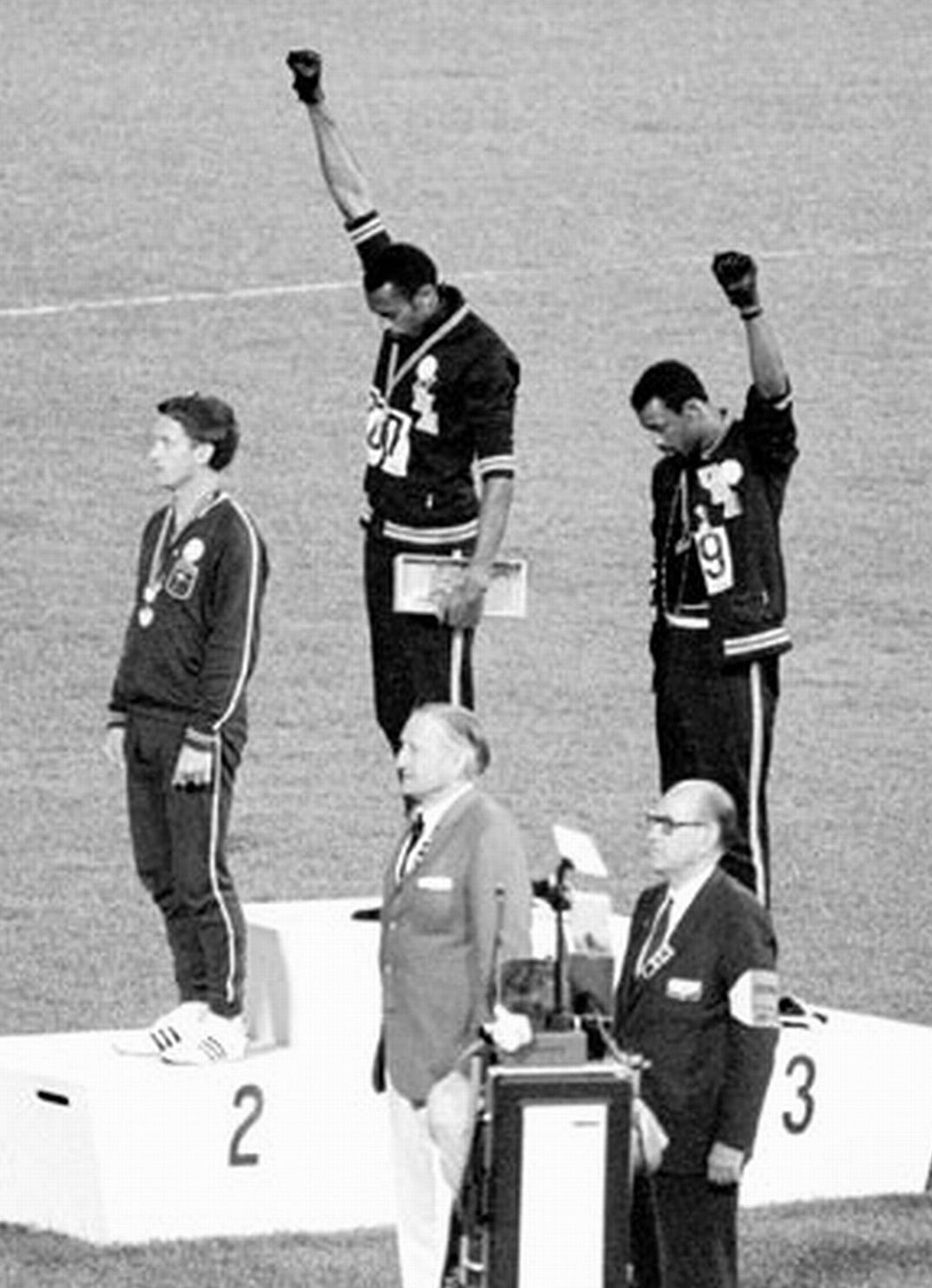
Tommie Smith (gold medalist, center) and John Carlos (bronze medalist, right) raised their gloved fists at the 1968 Olympic Games.
Within hours, the International Olympic Committee had condemned their action.
Two days later, the U.S. team suspended them. Sent them home, where news media greeted them with vilification. The U.S. Olympic committee ostracized them. No longer would they compete national and international meets. The men received death threats, as their families faced financial hardship. After Smith’s marriage felt apart, he moved to England to train youngsters in running. Carlos’s wife committed suicide.
Still, these men stayed in the fight for racial equality in sport and society. Forty years later, in 2008, Arthur Ashe Courage Award recognized them for their contributions that “transcend(ed) sports.” President Barack Obama remarked: “Their powerful silent protest in the 1968 Games was controversial, but it woke folks up and created greater opportunity for those that followed.” A statue of their protest is in the Smithsonian.
Asked in 2012 by BBC Newsnight if he regretted taking his action, Smith said: “The only regret was that it had to be done.” [BBC, In History, 2023]
The Olympics historically experience political and societal tumult.
As sports, in general, do.
Witness the impact of Title IX on gender equality in the U.S.
And the battles being fought now about participation of transgender athletes.
Soak in the immense impact that Smith and Carlos had on racial progress through the decades.
Reminding us that societal change often travels through sports on its way to societal and political acceptance. After being driven by courageous acts of protest, paid for by personal sacrifice of the dedicated few. In venturing forth, they change the lives and opportunities for many.
Let’s also applaud the decades of international sports boycotts of South Africa, which contributed mightily to apartheid’s end.
That boycott stands out among the many Olympic boycotts involving athletes, many of whom became unwilling absentee athletes due to political decisions made by their government not to attend.
The 1952 Helsinki Games were the first Olympic Games that a nation boycotted. When the IOC included Taiwan, China stayed home - a boycott lasting until 1980.
1956 Melbourne Games: More nations joined China in boycotting these games, all for different political reasons: The Netherlands, Spain, and Switzerland showed support for Hungary after the Soviet invasion. (At the games a brawl broke out between those two nations’ water polo teams.) Egypt, Iraq, and Lebanon boycotted due to France’s invasion of Egypt. Israel and the United Kingdom didn’t send athletes due to Cairo’s nationalization of the Suez Canal.
In 1972, Middle East politics played out on the global stage in the killing of Olympic athletes. Members of Palestinian leader Yasir Arafat’s militant Fatah party stormed the Olympic Village in Munich and murdered an Israeli athlete and a coach, taking nine hostages, who also died in a rescue attempt.
In 1980, 60 nations, led by the United States, boycotted the Olympics in Russia to protest its invasion of Afghanistan.
In 1984, the Soviet Union led a boycott of the Los Angeles Olympic Games. Nearly all of the Warsaw Pact nations refused to compete, along with Cuba and East Germany. Romania was the only Soviet-bloc country to attend.
On it goes, to this day. And while no nation boycotted the 2026 Olympics, the IOC banned the national teams of Russia and Belarus due to the ongoing war in Ukraine.
Let’s delve a bit into the irony of this stance.
Protest at the 2026 Olympic Games
The rule governing athletes’s right to express themselves at Olympic Games is in the Olympic Charter.
Known as Rule 50, its interpretation remains fluid, at least in the minds of those who challenge it and those who rule on the challenges.
In the mid-1950s, the International Olympic Committee wrote this rule into its bylaws stating that “no kind of demonstration or political, religious or racial propaganda is permitted in any Olympic sites, venues, or other areas.” Current Rule 50 guidelines, developed later by the IOC Athletes’ Commission, provide a “non-exhaustive list” of actions that could constitute prohibited protests, such as displaying political messaging, including signs or armbands; “gestures of a political nature, like a hand gesture or kneeling”; and “refusal to follow the Ceremonies protocol.”
In Italy, Rule 50 is again being challenged on the Games’ global stage.
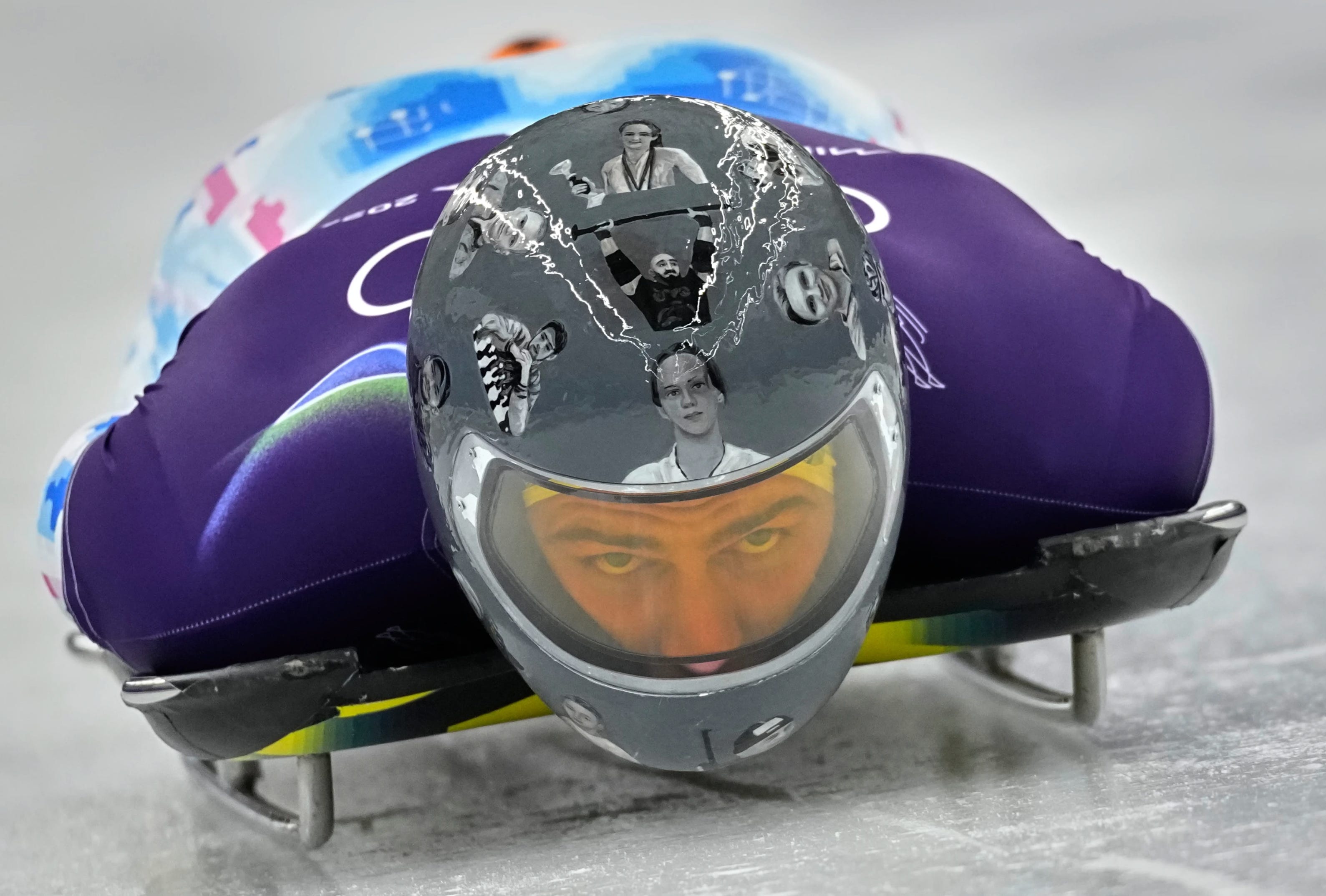
Ukraine’s Vladyslav Heraskevych starts a men’s skeleton training session at the 2026 Winter Olympics, wearing his “helmet of remembrance” with photos of more than 20 Ukrainian athletes killed since Russia’s invasion of the country on it. on Feb. 9, 2026. (AP Photo/Alessandra Tarantino) For more AP photos, click here.
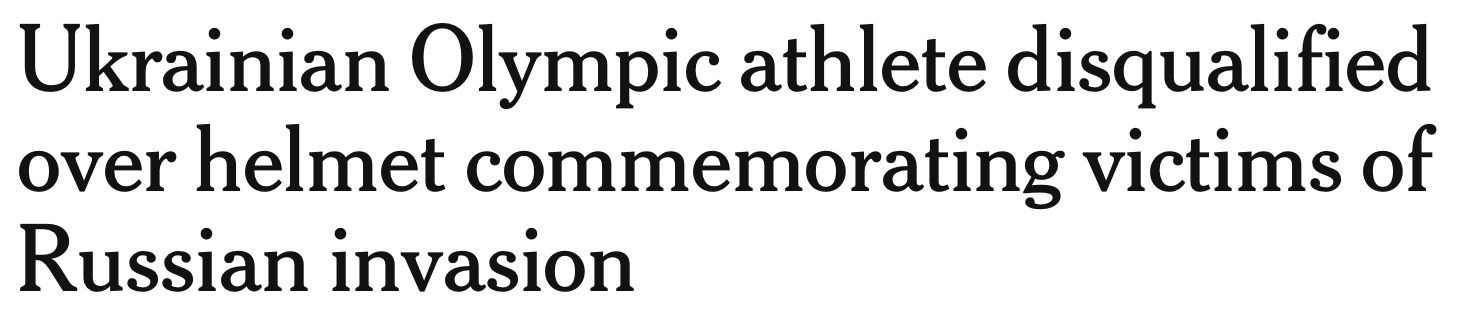
Since Russia invaded Ukraine, 660 Ukrainian athletes and coaches have died while defending their country.
In claiming his right to compete while wearing this helmet, Heraskevych made Rule 50 visible in one of the Games’ least visible sports - the skeleton. Lying flat on a small metal sled, he slides headfirst down an icy chute at around 75 mph.
Except in these Games he won’t.
As the Athletic observed: “This was a clash of competing beliefs: Heraskevych’s conviction that expressing grief for fallen athletes, some of whom were close friends, was not a political message; and [IOC president Kirsty] Coventry’s longstanding view that the field of play must be kept free from all messages.”
After an emotional meeting with Heraskevych and his father, who is his coach, a teary Coventry acknowledged they’d reached an impasse. The Ukrainian was disqualified from the competition. The IOC officials didn’t object to his message, they said, or his right to have his helmet express his beliefs at the Olympic Games. Rather, it was his determination to wear his helmet during the competition that crossed their line, i.e. their interpretation of Rule 50.
Permitting “the field of play” to become “a field of expression” would result in“chaos and hurt play,” according to IOC spokesman Mark Adams, who added: “(If) we have no rules, we have no sport.”
Back in Ukraine tracking this dispute, the country’s president Volodymyr Zelensky said: “We are proud of Vladyslav and of what he did. Having courage is worth more than any medal.” Fellow Ukrainian Olympians backed him at the games: luger Olena Smaha held up her glove to display the words “remembrance is not a violation,” while skier Dmytro Shepiuk held up a small piece of paper bearing the words “UKR heroes with us.”
Heraskevych refused the IOC’s offer of wearing a black arm band to compete, instead of the helmet. If he did so, he felt he’d betray these fallen athletes.
When the event went on without him, he felt “empty.”
Courage takes longer to sink in.
He filed an appeal with the Court of Arbitration for Sport.
American Athletes Speak Their Minds
At the Games, freestyle skier Hunter Hess spoke of how he struggled to reconcile the gap between what his country represents and his individual values. When asked, Hess told reporters he has “mixed emotions” in wearing America’s colors at these Olympics.
“There’s obviously a lot going on that I’m not the biggest fan of and think a lot of people aren’t. If it aligns with my moral values, I feel like I’m representing it. But just because I’m wearing the flag doesn’t mean that I represent everything that’s going on in the U.S.”
Backlash from a past Olympian (later erased) and the President (“a real loser,” he said of Hess), which was echoed on social media, came swiftly.
Ski racer Mikaela Shiffrin came prepared to respond when it was her turn to be asked. She quoted Nelson Mandela and read from notes she had in her phone.
“I think it’s always an honor and privilege to represent Team USA and to represent your country. For me, as this relates to the Olympics, I’m really hoping to show up and represent my own values, values of inclusivity, values of diversity and kindness and sharing, tenacity, work ethic, showing up with my team every single day.”
Olympian Hunter Hess and other U.S. Olympians responded to the criticism of Hess that came from the president and others, in the video above. Chloe Kim said the question “hits pretty close to home,” before she and other snowboarders told of being immigrants in the U.S.. Maddie Mastro Mastro said she’s “saddened with what is happening at home. … It’s really tough and I feel like we can’t turn a blind eye to that, but at the same time I represent a country that has the same values as mine of kindness and compassion.
We come together in times of injustice.”
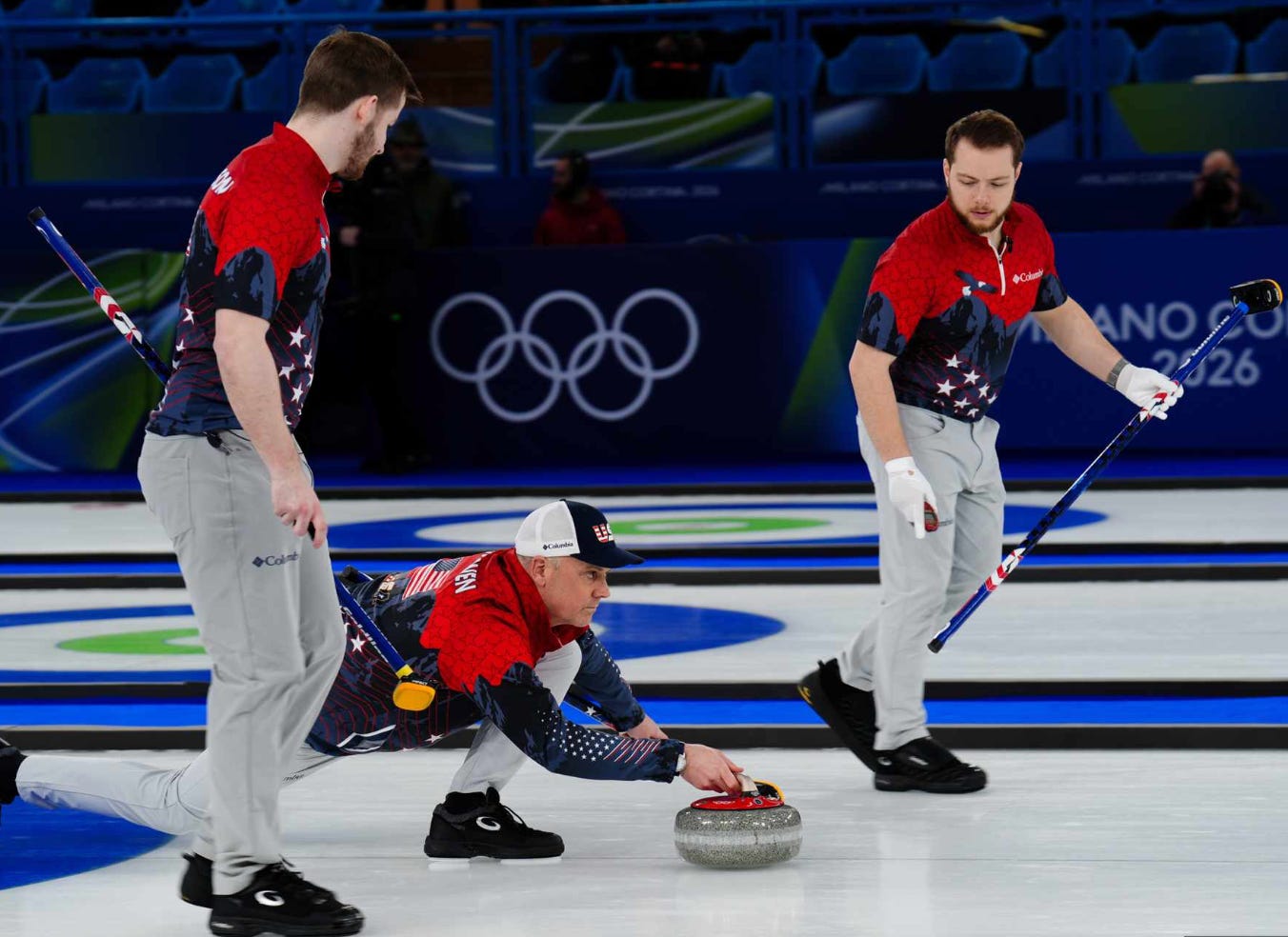
Rich Ruohonen, an alternate, played briefly in a U.S. men’s team curling match at the 2026 Olympics.
Ruohonen became the oldest American Olympic competitor,1 in yesterday’s men’s curling match. A personal-injury lawyer2 in Minnesota, he spoke bluntly about what he views as unlawful activities of ICE agents in Minneapolis.
“I am a lawyer, as you know, and we have a Constitution, and it allows us freedom of press, freedom of speech, protects us from unreasonable searches and seizures. It makes it that we have to have probable cause to be pulled over. What’s happening in Minnesota is wrong. There’s no shades of gray. It’s clear.” Rich Ruohonen, the oldest American to compete in any Olympic Games.
Athletes Protest Fossil Fuel Sponsorship of Winter Sports
Protests aren’t only about ICE. They are also about our Earth’s warmth due to the burning of fossil fuels, which jeopardizes winter sports like skiing happening in places where they’ve traditionally taken place.
A Norwegian skier Nikolai Schirmer handed the International Olympic Committee a petition signed by more than 21,000 people, including Olympic athletes, requesting that the IOC stop fossil fuel companies from sponsoring winter sports. This is the first coordinated campaign aimed at fossil fuel advertising at an Olympic Games. It resembles the campaign that led to banning tobacco advertising at the Games, which took place 40 years ago.
Two days later, on Feb. 9, another open letter from For Future Games urged the IOC to develop and formally adopt a clear policy banning fossil fuel companies from sponsoring any future Olympic Games. (Italian oil and gas company Eni is a premium partner and official sponsor of the 2026 Winter Olympic and Paralympic Games.) “The biggest threat to the Olympic dream is fossil fuels. As athletes, we are asking you to help remove their influence,” declared 88 Olympians and 53 hopefuls who have signed the For Future Games campaign letter to date.
Words to Live By
Shared by three-time Olympic medalist Lindsey Vonn while recovering from one of what will be multiple surgeries on her fractured tibia, injured while she competed in the 2026 Olympic Games with a torn ACL.
Similar to ski racing, we take risks in life. We dream. We love. We jump. And sometimes we fall. Sometimes our hearts are broken. Sometimes we don’t achieve the dreams we know we could have. But that is the also the beauty of life; we can try.
I tried. I dreamt. I jumped.
I hope if you take away anything from my journey it’s that you all have the courage to dare greatly. Life is too short not to take chances on yourself. Because the only failure in life is not trying.
I believe in you, just as you believed in me. – Lindsey Vonn
THE 37TH COOPERSTOWN SYMPOSIUM ON BASEBALL AND AMERICAN CULTURE, May 27 - May 29
“We provide a unique platform for attendees to visit Cooperstown and to discuss baseball and its relation to our culture and society. We don’t talk about baseball on the field; we talk about everything else – art, music, poetry, literature, economics, architecture, whatever.”
Or WHATEVER!
At 1:00 pm on May 27 – on my 75th birthday – my job will be to fill in the “whatever” of this unique gathering. I received an invitation this week to be this year’s keynote speaker at the symposium.
I accepted. Now I must rise to this occasion with words worthy of this honor.
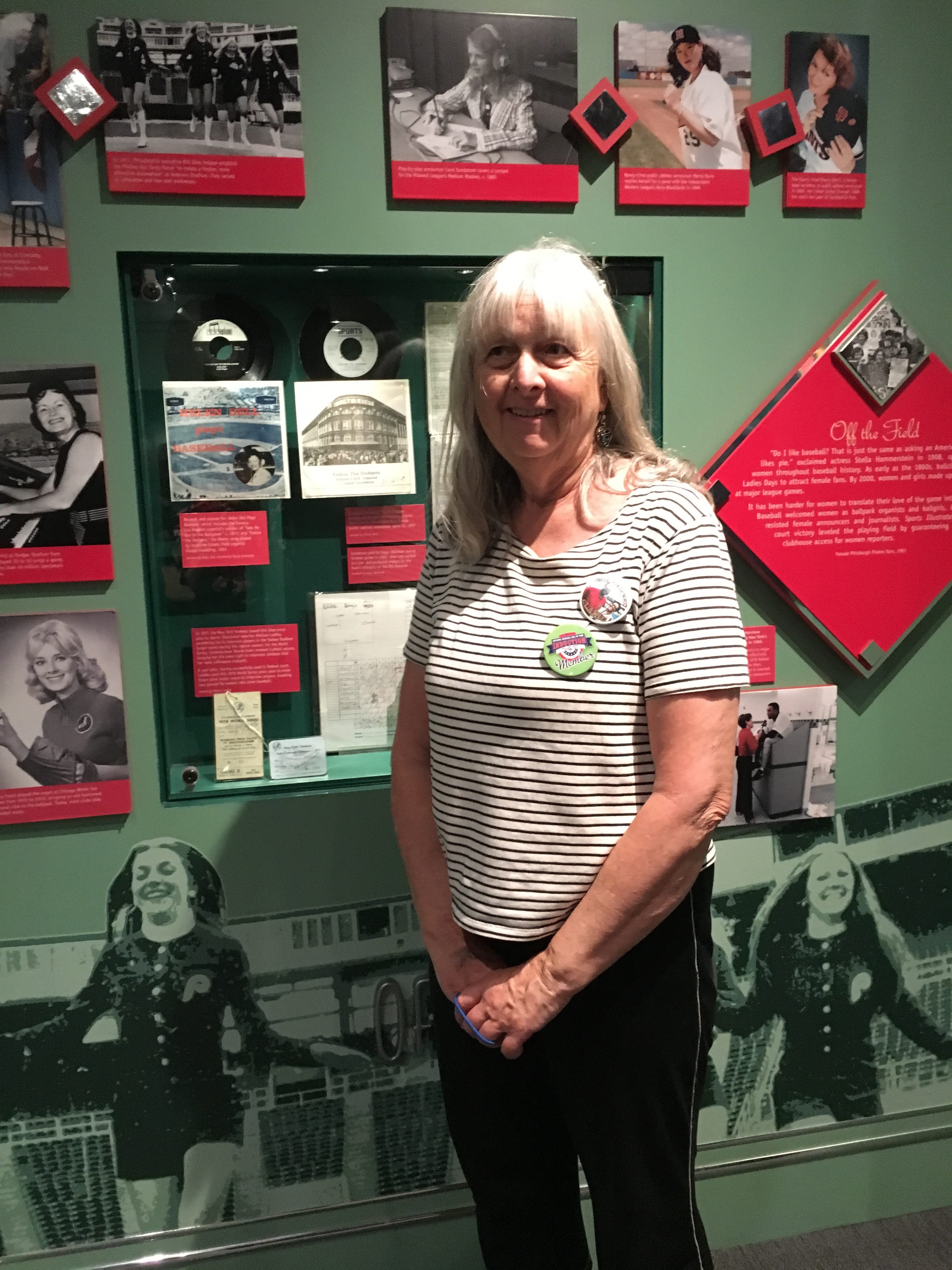
Maya took this photo of me in the Diamond Dreams exhibit standing next to my clubhouse press passes from the 1970s and a description of my victory in the 1978 equal access case against Major League Baseball. We were in Cooperstown in July 2017 to see my friend Claire Smith be honored as the first woman given a plaque in the Hall of Fame. Hers is in with the writers, where all of the rest are still men.
Impossible to imagine in 1978 that one day I’d be at this exhibit in the Baseball Hall of Fame with my daughter. And on another day I’d give the symposium’s keynote speech.
Goes to show that unpopular actions taken in one decade are sometimes celebrated in another.
A valuable lesson for all of us. Especially now.
She was known as the Civil Rights Queen, but you’ve probably never heard of her …
This exemplary SHORT video opens with these words. It’s a bio of Constance Baker Motley, a giant in American history and the federal judge who ruled in my 1978 case against Major League Baseball.
In Black History Month, there can be no greater privilege for me than sharing this video with you.
PLEASE take time to watch it. Do this, so she will live with you forever.
As she should.
Share it widely, too … as an act of protest against those school districts that are erasing Black history from our children’s education.

A 52-year-old figure skater Joseph Savage competed in the 1932 Winter Games.
As the Wall Street Journal put it, “In other words, he’s a slip-and-fall attorney who would become an Olympian if a curler slips and falls.”
Melissa, timely piece and honestly we need to hear these stories in these times.
Smith’s comment about his “only regret was that it had to be done” rings true today. I grew up as the child of WW2 vets thinking fighting Nazis was what my parents did. And now here we are. Still fighting Nazis, marching for civil rights and not living in a post-racial America.
Hope you give one hell of a speech in Cooperstown. My mom would have loved to hear it.