
Let's Row Together
Where have all the bookshelves gone? Will books be next?

My daughter Maya isn’t always right.
But I’ve learned never to bet against her when it comes to organizing my life. And my surroundings.
Simple replaces surplus.
Clarity overcomes chaos.
Fewer overtakes many.
And this human tornado touched down again about 10 days ago after Maya said to me:
“Mom, let’s take a look at your books.”
She’d caught me off guard, and I’d said “okay.”
By now I should know that when Maya says “take a look” I need to find bags.
Bags in which to put what I’m about to agree to throw out or give away.
Maya did this a few years back soon after I’d broke my ankle.
And I was confined to my bed with my ankle and my head each upraised with pillows.
And I was eager for company.
Seizing the moment, Maya targeted my closet.
Letting me know it was long past time to sort out the “keepers” from those items I’d be giving to Goodwill.
At the foot of my bed, Maya dangled each piece of clothing before me, while I played Judge Judy.
Maya is good at indulging my memories, letting me tell stories I associated with some of these outfits.
Acknowledging my memory, she’d nudge me to let go of its physical manifestation.
Usually I did, though a fair number of items I did ask her to rehang.
Meanwhile, I watched as the rejects fell from her hand, dropping out of my sight presumably into a give-away pile at her feet.
In an hour, we’d done what it had taken me two decades NOT to do.
We’d rid my closet and my drawers of clothes I didn’t wear and wouldn’t wear again.
On a recent Sunday, Maya’s target was my books.
When I moved into my Cambridge condo in 1989, I hired a carpenter to build as much space for books as the narrow L wing of my bedroom would allow.
Floor to ceiling. Both sides. Then, I moved a bookcase into the space remaining on the room’s back wall.
I wanted books to be the first thing I saw each morning. And I needed books to surround me while I writing my own.
That was 37 years ago. Was I to move in to a new home today, I’d do the same thing.
Which makes me an outlier since bookshelves aren’t “in” these days.
Just scroll through photos of homes for sale on Zillow. Its hard finding ones that even have a built-in bookshelf. More the reason for me to stay right where I am since I’m not at all attracted to the notion that our living spaces should reflect the ascendency of our digital lives.
Especially if that means diminishing the presence of books.
Fewer homes have built-in bookshelves than they did a few decades ago. Homes built from the 1950s into 1970s accomodated books since they were assumed an essential part of family life, and the display of books hinted at the resident’s sense of identity.
In my Amherst childhood, bookshelves were ubiquitous, which is not surprising in a university/college town of that era. Like my dad, many of my friends’ parents taught at UMass Amherst or Amherst College.n My family’s bookshelves bulged with weighty sets of encyclopedias — World Book and Britannica— alongside oversized photo and art books. Leather-bound sets of books by famous authors were side-by-side with novels that nudged up to collections of poetry. On different shelves were biographies ad nonfiction titles, with the classics sharing shelf space with newer titles.
Comfy chairs were nearby when I had the impulse to pull a book from the shelf to read it.
No longer. Or at least in most homes I’m in, though my sister Betty is rebuilding her home and she’s adding a library. With comfy chairs.
Once Ikea started to sell inexpensive, all-sized bookcases, the gig was up. Around that same time, built-in bookshelves no longer showed up on blueprints. Homebuyers had that square footage go to walk-in closets, larger kitchens, home theaters, and multiple bathrooms instead of “library” space.
Huge entertainment centers or rooms organized around a massive wall-mounted TV occupy that cherished space of my younger years. Shelf space, when it exists, is given over to digital devices. Or perhaps family photos.
As always, how we build the space we inhabit reflects the ways we spend our time in it.
Which tells us what we value.
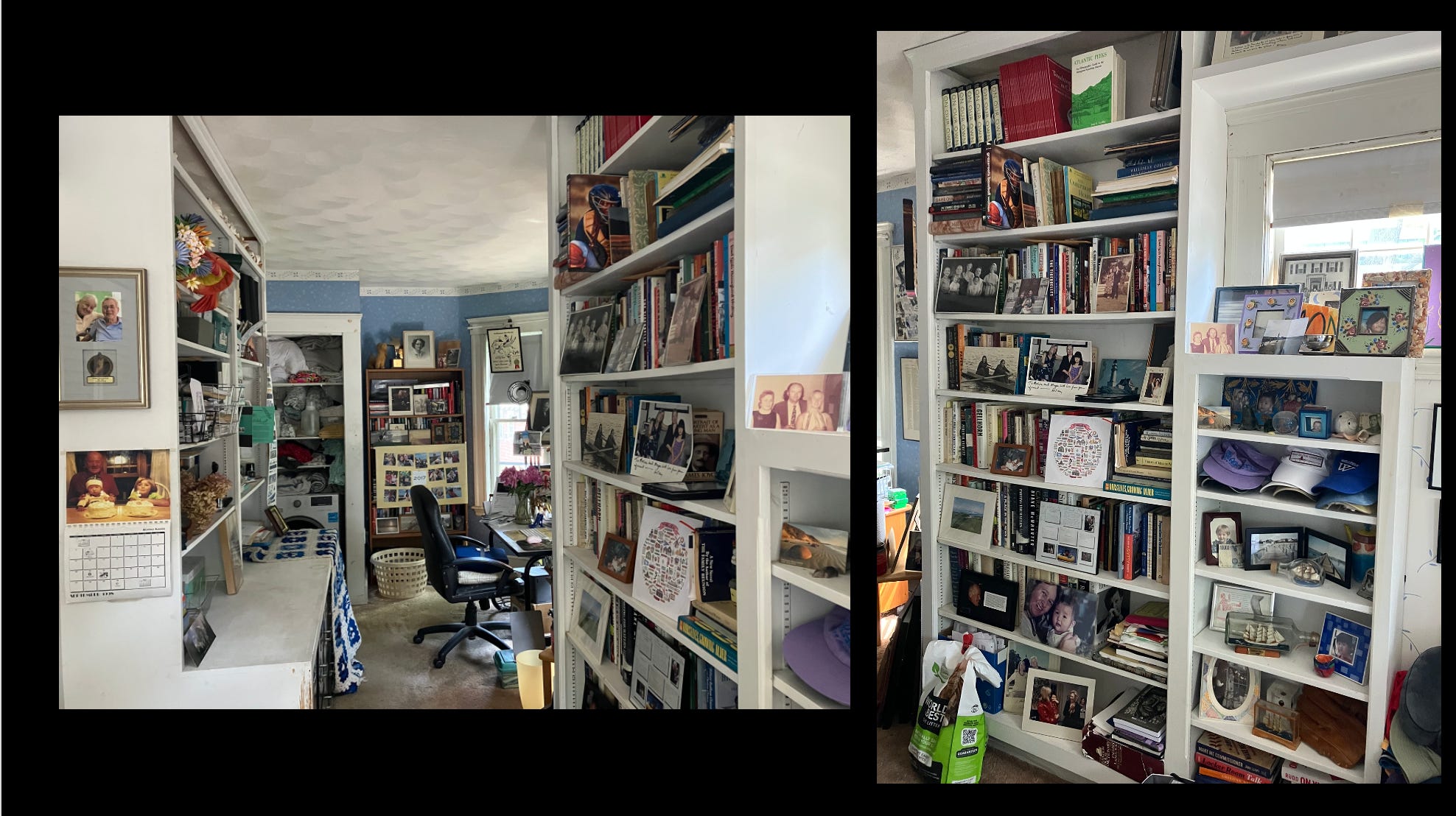
In all, Maya and I filled 14 large handled grocery bags with books, roughly 20-25 to a bag, so about 320 books. I donated them to the Wellesley (Ma) Free Library. It was one of the only places I could find that would accept even a single “used” book.
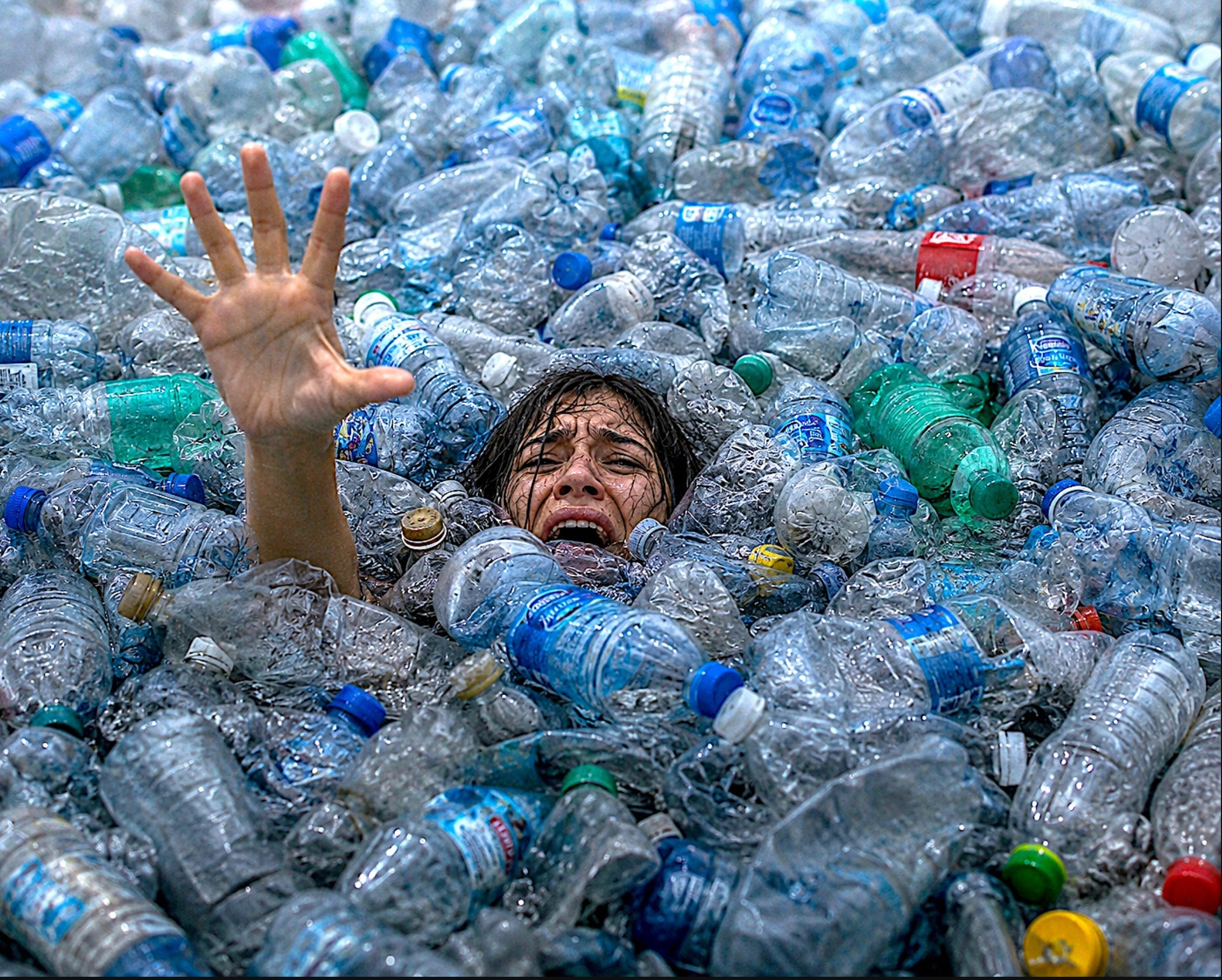
Books are among the hardest things to recycle these days. That is if, like me, you fear your “recycled” book might meet the same ending that 90% of that plastic that we “recycle” does. Buried in a landfill. Burned in an incinerator. Floating in oceans, and snaring ocean beings.
I couldn’t resist sneaking in this greenwashing warning for any of you who believe that the plastics you put in your recycling bin ever get recycled.
Quick fact: Only about 5% of US plastic is successfully recycled.
Leaving us drowning in toxic plastic waste — much of it used once and tossed away.
Reading books is over or not depending on the messenger
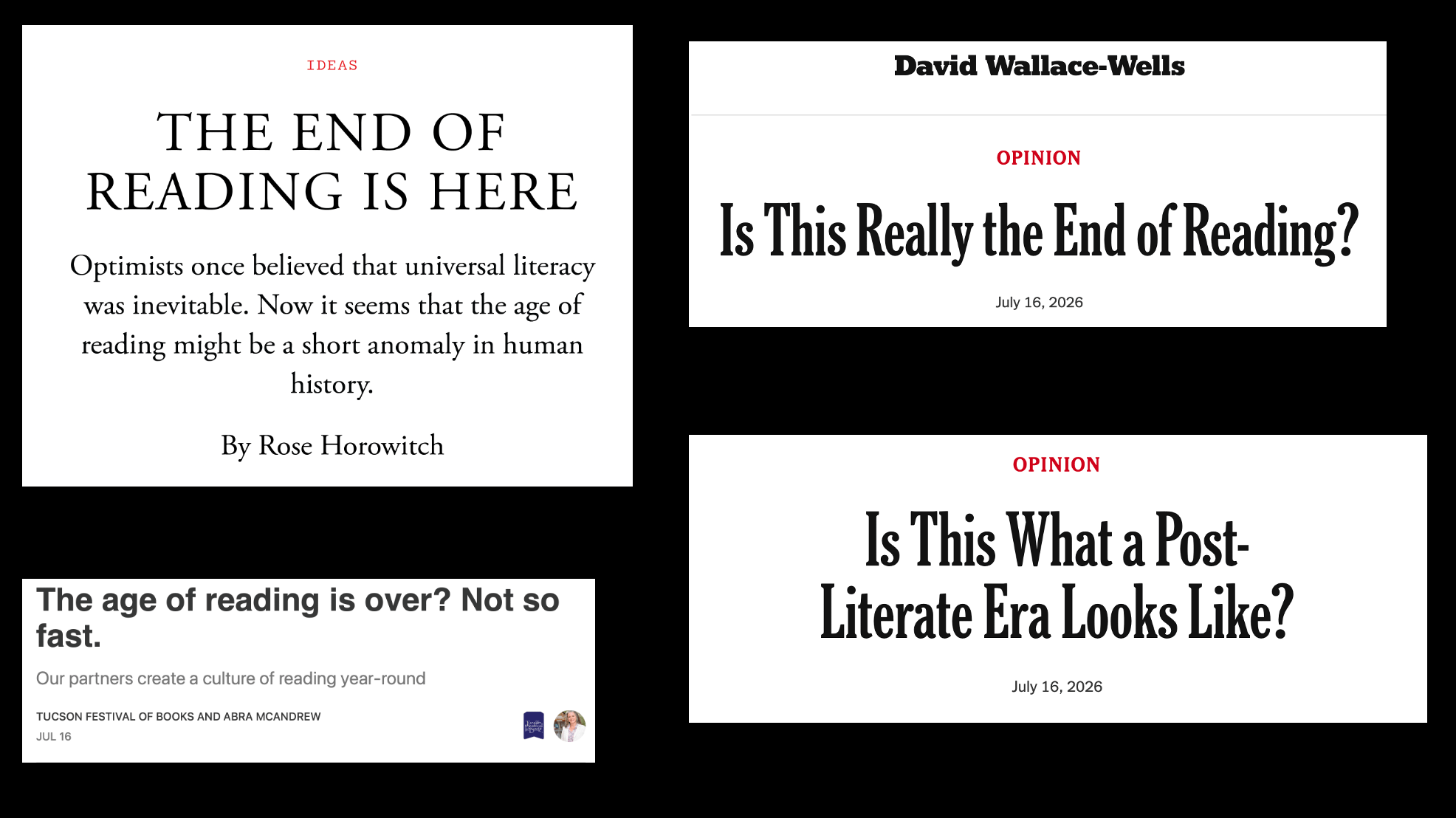
Here are highlights from these stories and others I read this week:
Teachers/professors no longer assign entire books for students to read due to their apparent inability and/or resistance to reading books. When students are assigned books, many choose to listen rather than read.
Screen time is more popular than reading time, not unlike what happened in earlier decades when the new screen was TV.
Many more women than men read novels. In all, only 38 percent of Americans read a novel or short story in 2022. And seven percent of all U.S. fiction sales last year were for books written by five romance writers, among them Emily Henry.
The recent drop in book reading is more precipitous among older readers than younger ones, largely because older readers were reading more when the study began.1
No one can predict what will happen next with books and reading, though trends generally point to us reading them less. Young people are tiring of screens and some are heading back to books. Old folks, like me, are doing the same.
What’s old might be new again!!!
It’s happened before. And it’s happening now with vinyl records and turntables. I handed my 1970s turntable to my daughter and Matthew, her husband, and when I visit they’re playing records. Not CDs. Not Spotify.
Still, it’s true that stats and trends about books and reading tell a disheartening story, especially for those of us who love books. But far beyond any book lover’s sadness is the diminishment of what books and our reading them contributes to our humanity.
And what we lose by not reading them, the “habits of our mind.” Like our ability to sustain our attention on an idea, concept and/or a story. Giving us the capacity to resist distraction rather than surrender to it. And our appreciation of the complexity of what constitutes true understanding as a book takes us far deeper than do fleeting headlines or a brief seduction by a meme that can leave us mistakenly thinking, “oh, yes, I get it,” when we don’t.
Reading books makes more muscular our reasoning and critical thinking, and it also restrains our trigger-happy reactiveness.
Books carry us into the hearts and minds of people’s lives; in novels, especially, we are ushered into character’s emotional lives, which builds empathy in us by enlarging our human understanding.
Books strengthen our imagination when they call on our participation to grasp the totality of the stories being told.
Books confirm, as little else can do, our understanding that ideas can’t be fully revealed in a short video or a social media post. Truer understanding can require prolonged attention, which can be hard to summon and tougher to sustain but can prove worthwhile in the end.
In expressing my concern about the potential disappearance of print books, I am not focused on the consequences to my experience with books. What I’d also miss is the sharing we do in reading books, such as in book groups. Or even in conversations like the ones I have with fellow book readers as we ready our crew shell to row.
In doing this, we increase our communal capacity for deeper, sustained engagement with ideas. At a time when civic involvement is vitally needed — with issues at stake profoundly central to our lives — we can’t afford to lessen this exchange of ideas and the sharpening of our thinking to be gained by reading and sharing books.
Johannes Gutenberg, and yes, the monks and scribes who came before him and copied books by hand, gifted us the greatest technology that we, as a species, have invented for cultivating the depth and dimensions of thinking that sets humans apart.
Jorge Luis Borges imagined paradise “as a kind of library.” By “library,” I imagine he meant the kind filled with books. If I’m right, then I think he’d agree that paradise on Earth exists in Riga, Latvia.
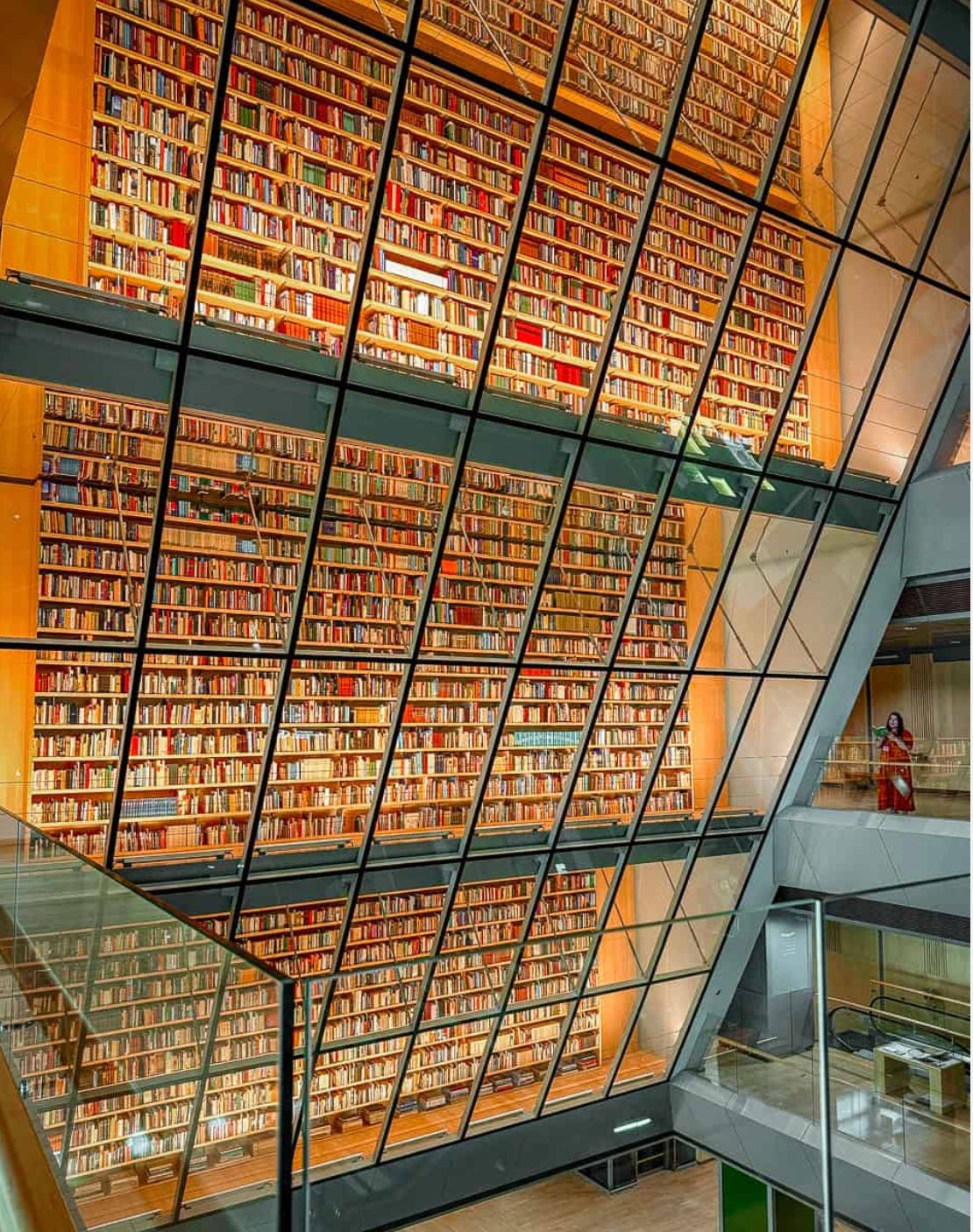
To my mind, this wall of books is the most beautiful wall humans have created.
We’ll never run out of books — courtesy of ChatGPT
ChatGPT’s book faucet is turned on and A.I. “books” are flowing from it.
None of which I intend to read. Including this A.I. generated biography of Kashmir Hill, who writes about technology for The New York Times. Hill wrote this week about what it’s like to find your life between two hard covers courtesy of A.I. after a new acquaintance texted her about this bio she’d found.
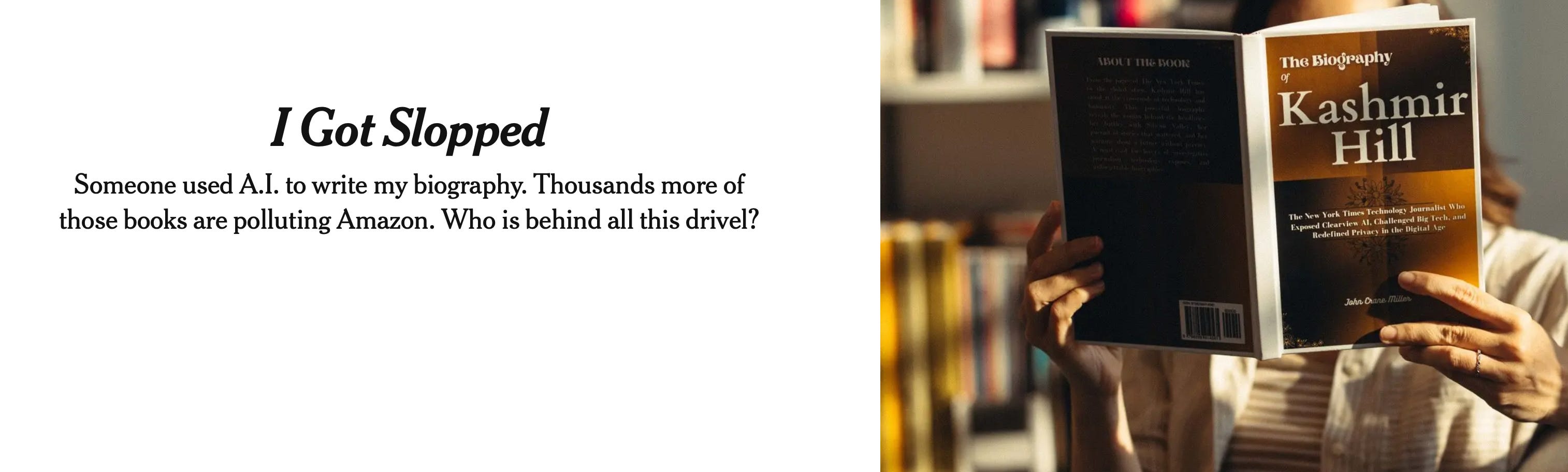
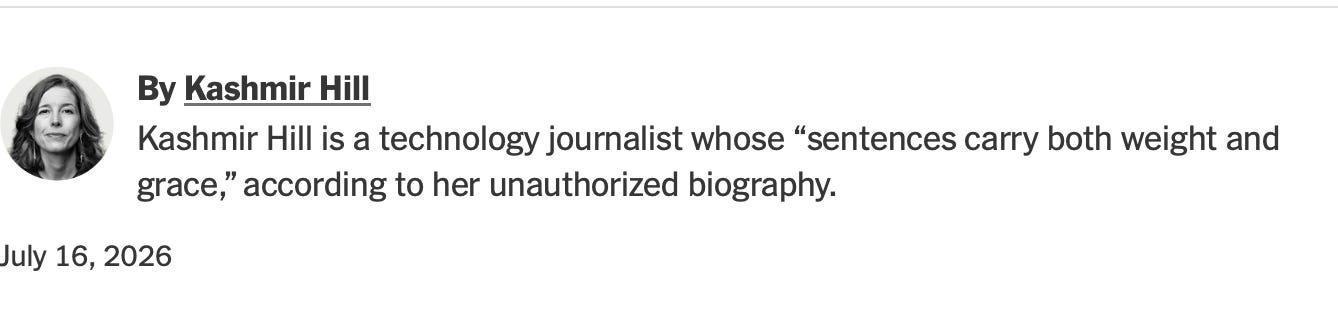
Well, here are some books I think you’d LIKE to read
I lovingly pass these books to you in honor of the fantastic growth experienced in women’s sports. This week New Yorkers set a jaw-dropping record as 42,000 + fans turned out for a professional women’s soccer game in Queens.
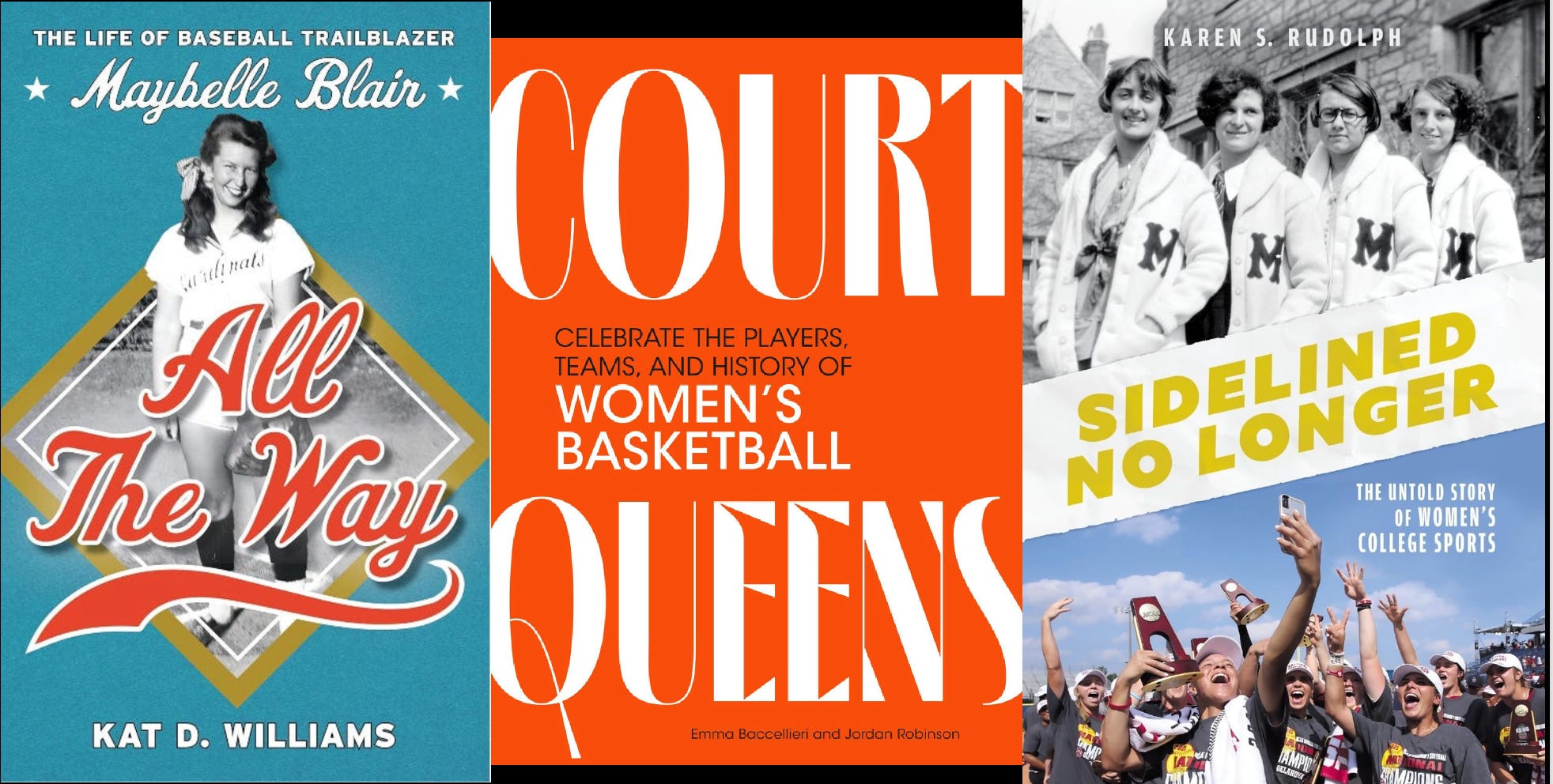
And in the Midwest, Women’s Baseball World Cup group stage games begin next week in Rockford, Illinois, the home of the All-American Girls Professional Baseball League — A League of Their Own — Rockford Peaches. And the Women’s Pro Baseball League debuts on August 1st in Springfield. Illinois. a

I throw out the ceremonial first pitch on July 25
In Polar Park, the home of the Triple A Red Sox in Worcester, MA,
My pitch — or should I say my throw toward the plate — happens at 4:00, after I talk about Locker Room Talk with team’s president Dr. Charles Steinberg at a lunch inside the stadium. If you are in or near Worcester that Saturday, join us. It’s one of only two “dog days” at the ballpark this season - Bark in the Park, with a dog parade around the warning track before I throw out the pitch.

For decades, at least, the bulk of the country’s reading has been done by Americans in their golden years. In 2003, older Americans read on average just under an hour each day — 58.5 minutes. By last year, that had fallen nearly by half, to roughly 32.4 minutes each day, a drop that represents the lion’s share of overall reading declines. [New York Times, David Wallace-Wells, July 16]
What a heartwarming mother-daughter bonding story. Please consider sending Maya over to my house. I need to declutter my closet and endless bookshelves, except of course for keeping our cherished copy of, "Locker Room Talk"!
I love this essay. I have been going through things, too, in preparation for a move. I gave two boxes and seven bags of books to a community Christmas store that has a huge and well visited book section. I was happy to know the books will find homes. Always a joy to read your essays, Melissa!