
Let's Row Together
America exists as an idea and experiment in self-government. On its 250th celebration of the colonies declaring independence from the British king, I'm replaying words of hope and a few with warnings.

In borrowing words from centuries and decades ago, I return to the document that birthed the American experiment of self-rule and set forth its enduring principles.
The Declaration of Independence.
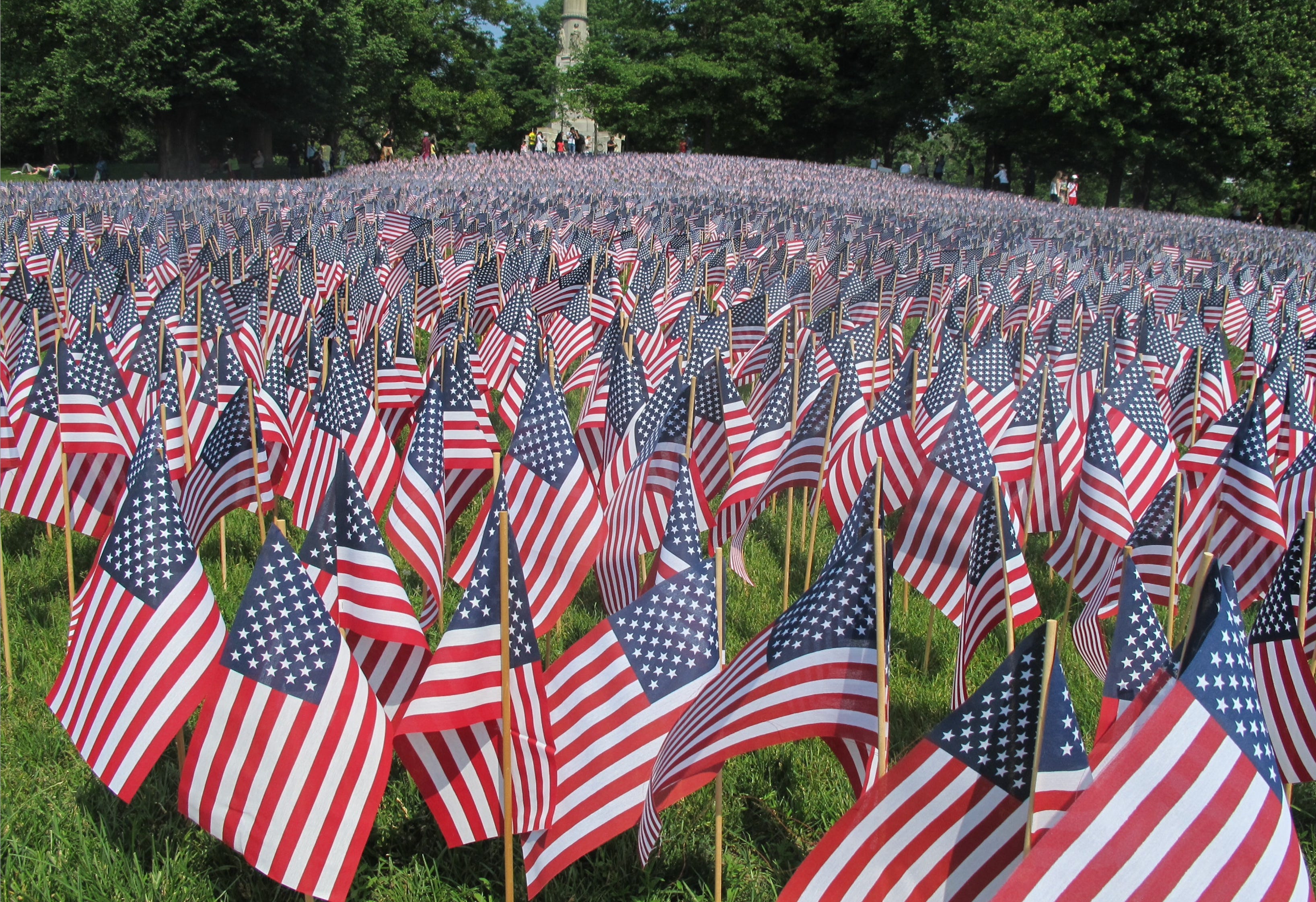
Memorial Day, Boston Common, 2012
In January 1776, Thomas Paine, a recent immigrant to Philadelphia, published his pamphlet, Common Sense.
“In the following pages I offer nothing more than simple facts, plain arguments, and common sense.” - Thomas Paine
“Where … is the King of America?” Paine asked. “I’ll tell you Friend … so far as we approve of monarchy … in America THE LAW IS KING. For as in absolute governments the King is law, so in free countries the law ought to be King; and there ought to be no other.
“A government of our own is our natural right … it is infinitely wiser and safer, to form a constitution of our own in a cool deliberate manner, while we have it in our power, than to trust such an interesting event to time and chance.
If we omit it now, some [dictator] may hereafter arise, who laying hold of popular disquietudes, may collect together the desperate and the discontented, and by assuming to themselves the powers of government, may sweep away the liberties of the continent like a deluge.”
“We have it in our power to begin the world over again.” Thomas Paine
Paine’s words resonated with colonists. Within six months the Continental Congress wrote and adopted the Declaration of Independence This weekend we celebrate its signing.
DECLARATION OF INDEPENDENCE, JULY 4, 1776:
“We hold these truths to be self-evident, that all men are created equal, that they are endowed by their Creator with certain unalienable Rights, that among these are Life, Liberty and the pursuit of Happiness. … That to secure these rights, Governments are instituted among Men, deriving their just powers from the consent of the governed.”
“Remember, all men would be tyrants if they could. If particular care and attention is not paid to the ladies, we are determined to foment a rebellion and will not hold ourselves bound by any laws in which we have no voice or representation.” — Abigail Adams, 1776
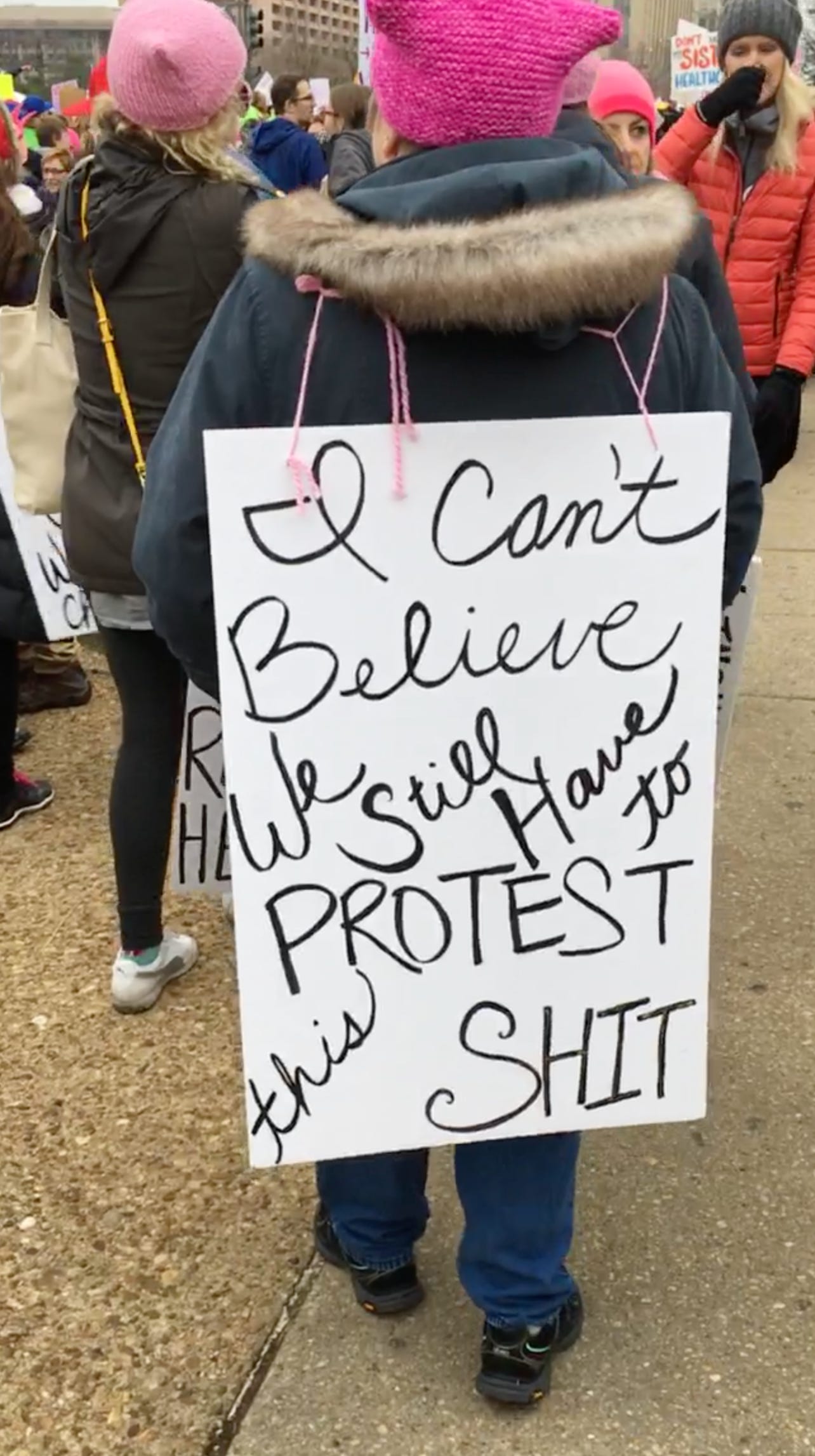
Washington, D.C. Women’s March, January 2017
Though we can’t be certain this happened, it is said that a woman stopped Benjamin Franklin outside the Constitutional Convention and asked what kind of government the delegates had made.
“A republic, if you can keep it.” - Ben Franklin
Seventy-six years later, on July 5, 1852, Frederick Douglass, delivered his speech, "What to the Slave Is the Fourth of July?" at a Rochester (NY) event hosted by the Ladies' Anti-Slavery Society.
“I have said that the Declaration of Independence is the RINGBOLT to the chain of your nation’s destiny; so, indeed, I regard it. The principles contained in that instrument are saving principles. Stand by those principles, be true to them on all occasions, in all places, against all foes, and at whatever cost.”
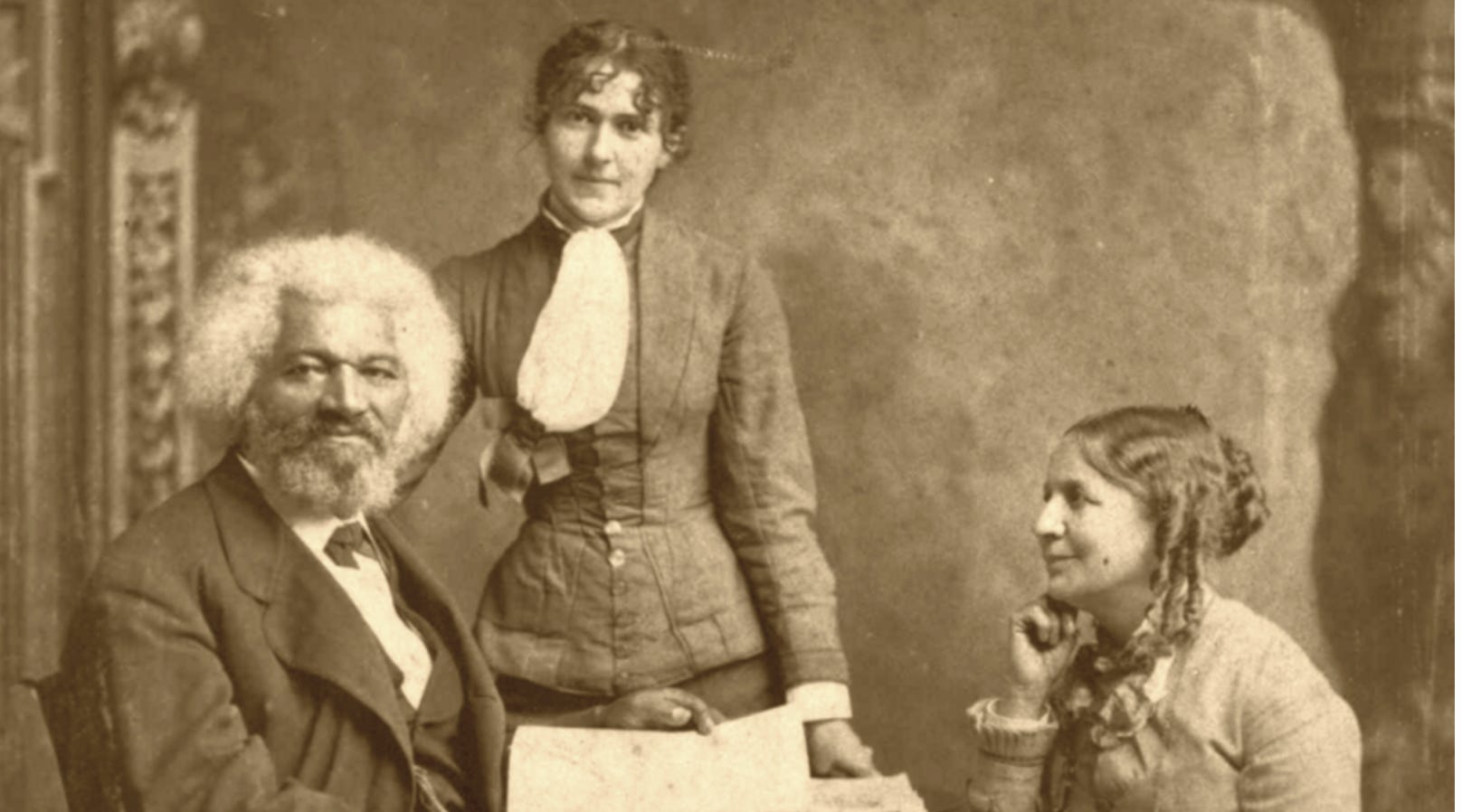
Frederick Douglass, his second wife Helen Pitts Douglass (seated) and her sister, Eva Pitts.
Douglass: On the White Men Who Wrote the Declaration of Independence
“They loved their country better than their own private interests; and, though this is not the highest form of human excellence, all will concede that it is a rare virtue, and that when it is exhibited, it ought to command respect. He who will, intelligently, lay down his life for his country, is a man whom it is not in human nature to despise. Your fathers staked their lives, their fortunes, and their sacred honor, on the cause of their country. In their admiration of liberty, they lost sight of all other interests.”
Douglass: On the “mournful wail of millions.”
“Fellow citizens; above your national, tumultuous joy, I hear the mournful wail of millions! whose chains, heavy and grievous yesterday, are, today, rendered more intolerable by the jubilee shouts that reach them. … My subject, then, fellow-citizens, is AMERICAN SLAVERY. I shall see, this day, and its popular characteristics, from the slave’s point of view. … I do not hesitate to declare, with all my soul, that the character and conduct of this nation never looked blacker to me than on this 4th of July! Whether we turn to the declarations of the past, or to the professions of the present, the conduct of the nation seems equally hideous and revolting. America is false to the past, false to the present, and solemnly binds herself to be false to the future.
Standing with God and the crushed and bleeding slave on this occasion, I will, in the name of humanity which is outraged, in the name of liberty which is fettered, in the name of the constitution and the Bible, which are disregarded and trampled upon, dare to call in question and to denounce, with all the emphasis I can command, everything that serves to perpetuate slavery—the great sin and shame of America! “I will not equivocate; I will not excuse;” I will use the severest language I can command; and yet not one word shall escape me that any man, whose judgment is not blinded by prejudice, or who is not at heart a slaveholder, shall not confess to be right and just. …
O! had I the ability, and could I reach the nation’s ear, I would, today, pour out a fiery stream of biting ridicule, blasting reproach, withering sarcasm, and stern rebuke. For it is not light that is needed, but fire; it is not the gentle shower, but thunder. We need the storm, the whirlwind, and the earthquake. The feeling of the nation must be quickened; the conscience of the nation must be roused; the propriety of the nation must be startled; the hypocrisy of the nation must be exposed; and its crimes against God and man must be proclaimed and denounced.” — Frederick Douglass
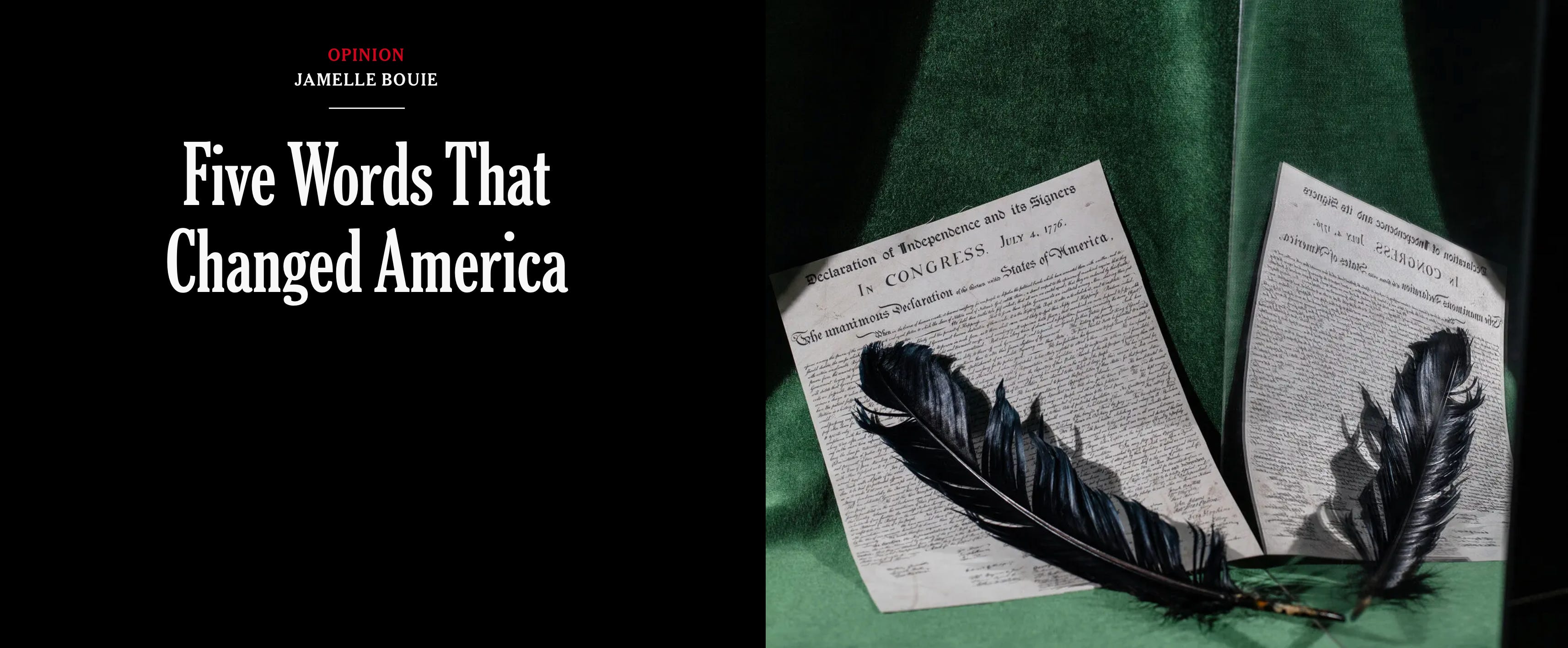
“It was in the hands of abolitionists, Black and white, carried over from Black Americans free, freed and enslaved, that the Declaration worked as both an indictment and a promise — the spiritual foundation of the nation and the standard that its institutions must meet. And it is this vision of the Declaration that Abraham Lincoln hailed as he ascended to political leadership in the 1850s, fending off Southern slaveholders and their apologists.” — Five Words that Changed America, by Jamelle Bouie, New York Times, July 2.,

In his twenties and serving in the Illinois House of Representatives, Abe Lincoln predicted that the gravest danger America would face would come from within. He also believed that “the Declaration, not the Constitution with its indefensible compromises on slavery, was the cause worth fighting for.” [Wall Street Journal, July 2, Our Freedom Still Needs Defending, by Paul Wolfowitz]
In 1854, Congress legalized slavery in the western territories legal. By doing this, Congress opened the possibility that the states formed out of those territories might gain majority representation in Congress. Lincoln responded to this action in writings and speeeches as he repeatedly asked Americans if they had forgotten what they had brought forth on the Fourth of July in 1776.
In 1855, he wrote: “When we were the political slaves of King George, and wanted to be free, we called the maxim that ‘all men are created equal’ a self-evident truth.” He observed that although the Fourth of July “has not quite dwindled away,” it is now good for nothing more than “burning fire-crackers!”
By 1857, Lincoln was wondering aloud what the point was in celebrating the Fourth of July if the Declaration was treated as “mere rubbish—old wadding left to rot on the battlefield?” [Wall Street Journal, July 1, 2026, “Abraham Lincoln Remade the Fourth of July, by Allen C. Guelzo]
In 1858, Lincoln delivered his “House Divided” speech after accepting the Republican nomination for President.
“A house divided against itself cannot stand." – Lincoln warned Americans that their country could not survive as “half-free, half-slave.”
As President, Lincoln called Congress into special session on July 4, 1861. He’d made clear by then that the Confederacy was a repudiation of everything the Fourth of July once stood for. The war, he told Congress, “presents to the whole family of man, the question, whether a constitutional republic, or a democracy—a government of the people, by the same people—can, or cannot, maintain its territorial integrity, against its own domestic foes.” [Wall Street Journal, July 1.]
On July 3, 1863, the Battle of Gettysburg — the bloodiest battle of the Civil War - ended with the Confederate troops decisively defeated. That November, Lincoln dedicated the Soldiers’ National Cemetery at Gettysburg by citing the Declaration of Independence’s assertion that “all men are created equal.”
The Declaration of Independence’s principles were worth fighting for.
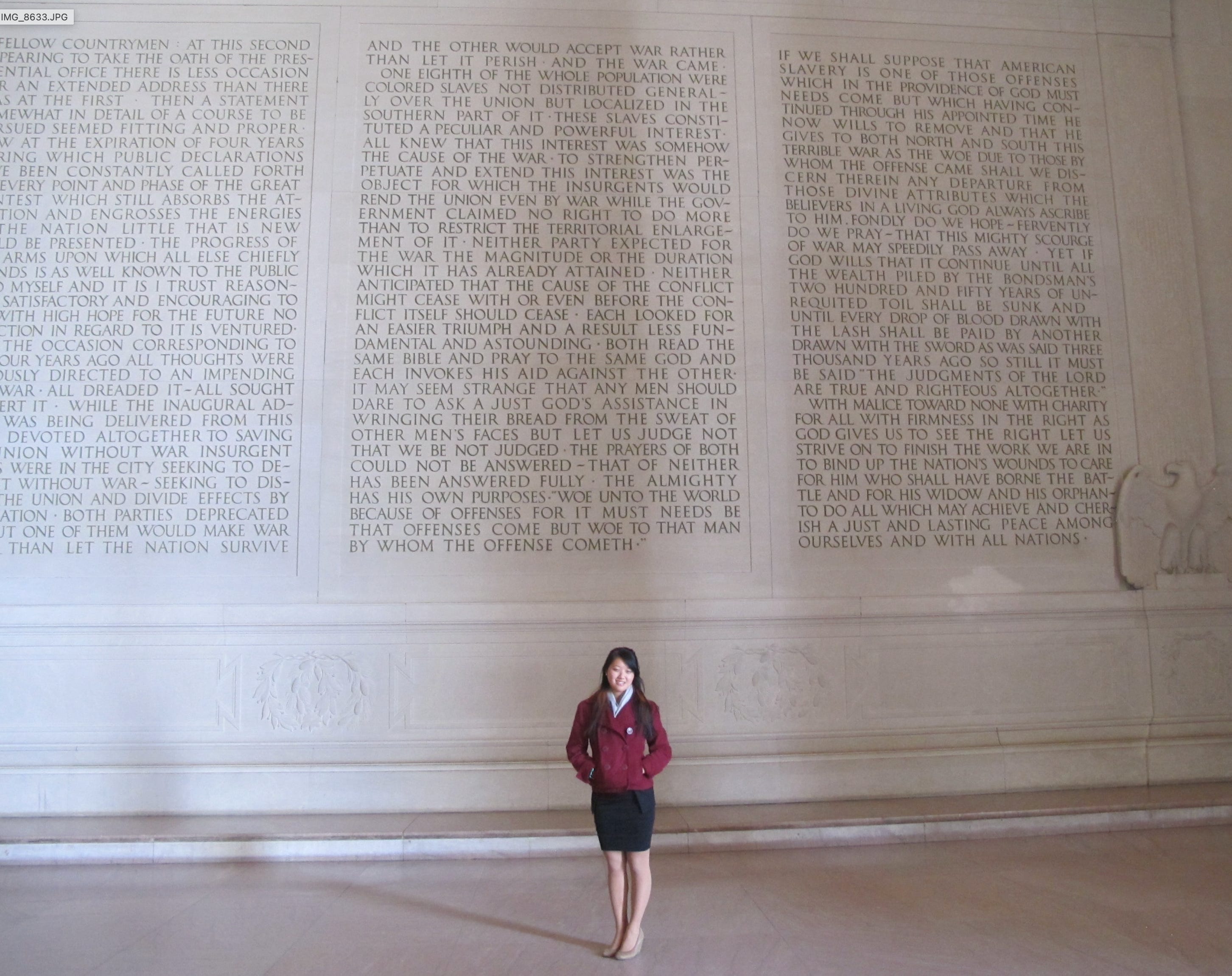
Maya stands in front of Lincoln’s second Inaugural Address, carved into the wall of the Lincoln Monument from which the statue of Lincoln looks out over the reflecting pool.
Lincoln ended his March, 1865 second Inaugural Address, given a few weeks before the South surrendered, with these words:
"With malice toward none with charity for all with firmness in the right as God gives us to see the right let us strive on to finish the work we are in to bind up the nation's wounds, to care for him who shall have borne the battle and for his widow and his orphan ~ to do all which may achieve and cherish a just and lasting peace among ourselves and with all nations." -President Abraham Lincoln
When he led America’s celebration of its bicentennial in 1976, President Gerald Ford echoed the admiration of his fellow Republican, Abe Lincoln, for the Declaration.
“The Declaration is the Polaris of our political order — the fixed star of freedom. It is impervious to change because it states moral truths that are eternal.” — President Gerald Ford
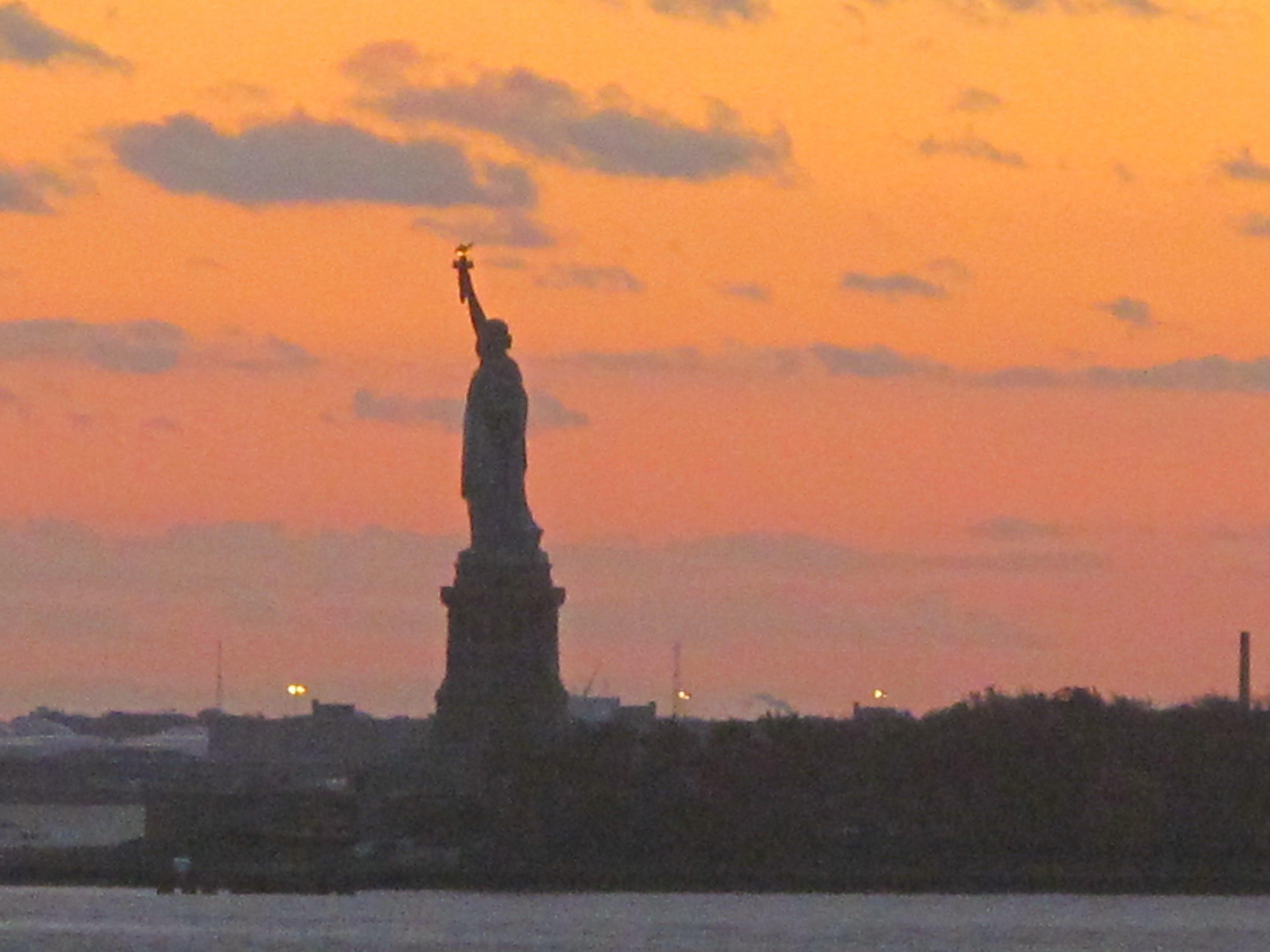
Democracy Matters: An exhibit at the New York Historical Society
“Democracy is audacious, fragile, hopeful, experimental—and definitional to the United States.” - Democracy Matters, on exhibit until Nov. 1, 2026
American Aspirations: Exhibition at Smithsonian Institution
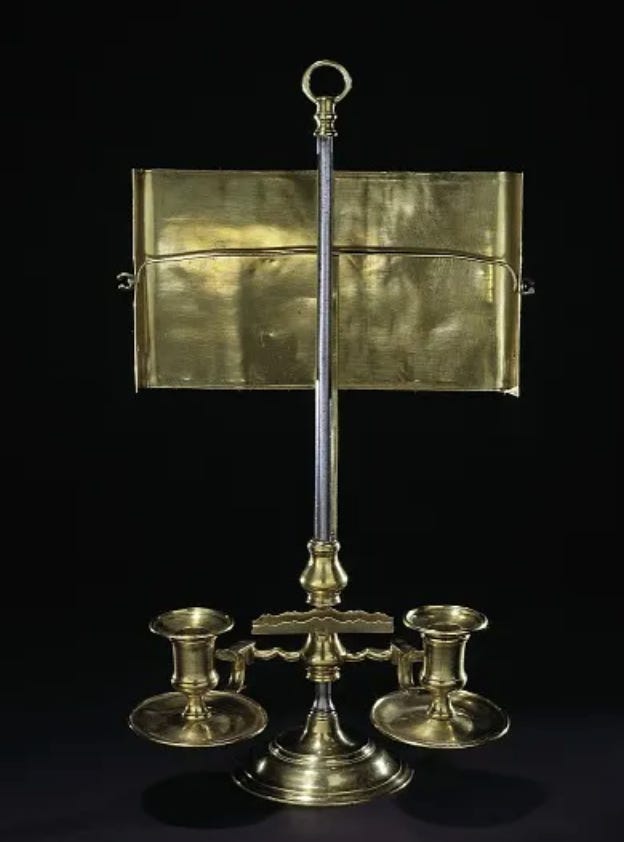
Washington wrote his 1796 Farewell Address by the light of this candle stand that is in the Smithsonian’s current exhibit, American Aspirations (until July 26).
In his address, Washington assured Americans he’d step down when a new president was elected.
“I should now apprise you of the resolution I have formed, to decline being considered among the number of those out of whom a choice is to be made.”
Let our first President’s example of peaceful transition of power light our way when we move on to the next one.

Love this, Melissa. I was intending to write about the Preamble of the Constitution on FB. Didn't get there yet. The speeches, publications, photos all mean so much. I will celebrate July (with kids!) no matter what!
Enjoy the 4th!!