
Let's Row Together
Don't we want to get to our mailbox and find a personal letter waiting for us to read? Of course, we do. So why aren't we writing them anymore?

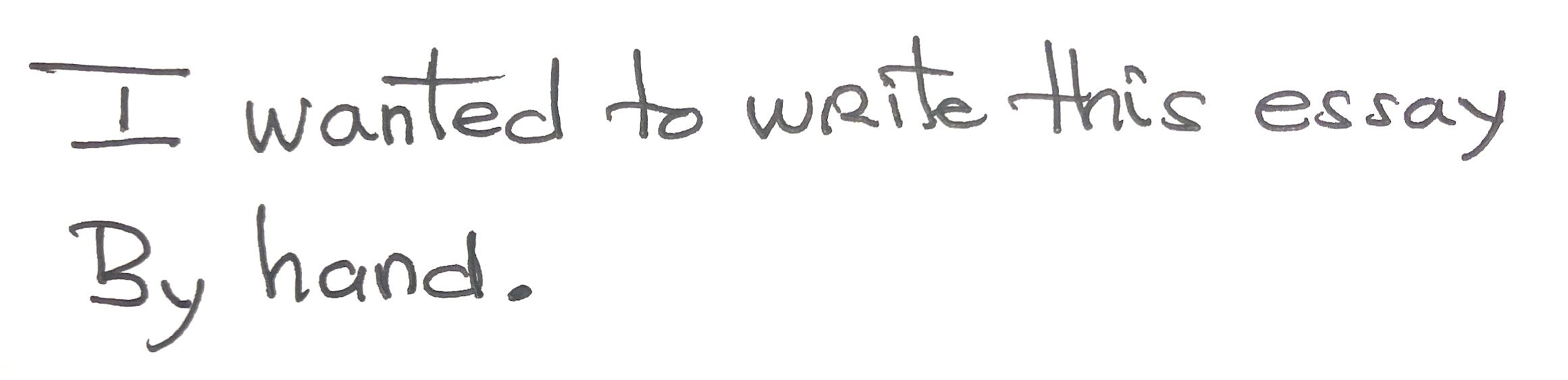
But I can’t since I write these essays on my keyboard.
Pressing keys to form words you’ll read on your screen.
Building in several degrees of separation in what’s meant to have a human “touch.”
Ironic, especially as I write today, since my words are about handwriting.
And what happens to us, as humans, and to our brains, as our thinking place, when hands and writing rarely meet.
As they did all the time, not that many years ago.
In the handwritten letters and notes we wrote one another.
Like the ones I’ve kept for decades in shoe boxes that I mostly store in my basement.
Though my more recent letter boxes live my bedroom.
Adding up to a fair number through the decades as I’ve transported each one of them from home to home in my many moves.
Never, for an instant, did I think of discarding them.
How could I toss the large box with my teenage “love” letters, mixed in with chattier ones from childhood friends I left behind when I went as a senior to high school in Rome, Italy, 4000 miles away from my hometown buddies in Amherst, MA.1
I’ve tossed very few letters. Instead I stow them away. First, in desk drawers or in piles held together with a rubber band.
Later, I transfer them into boxes. Keeping them close by. To dip into and reread letters when the mood strikes.
Or maybe I won’t ever reread some of them.
Doesn’t matter since the comfort they give me is in having them nearby.
As cherished companions.
Each a letter once opened and read. On some, the ink is fading though still readable. All are neatly folded and returned to the envelopes in which they arrived.
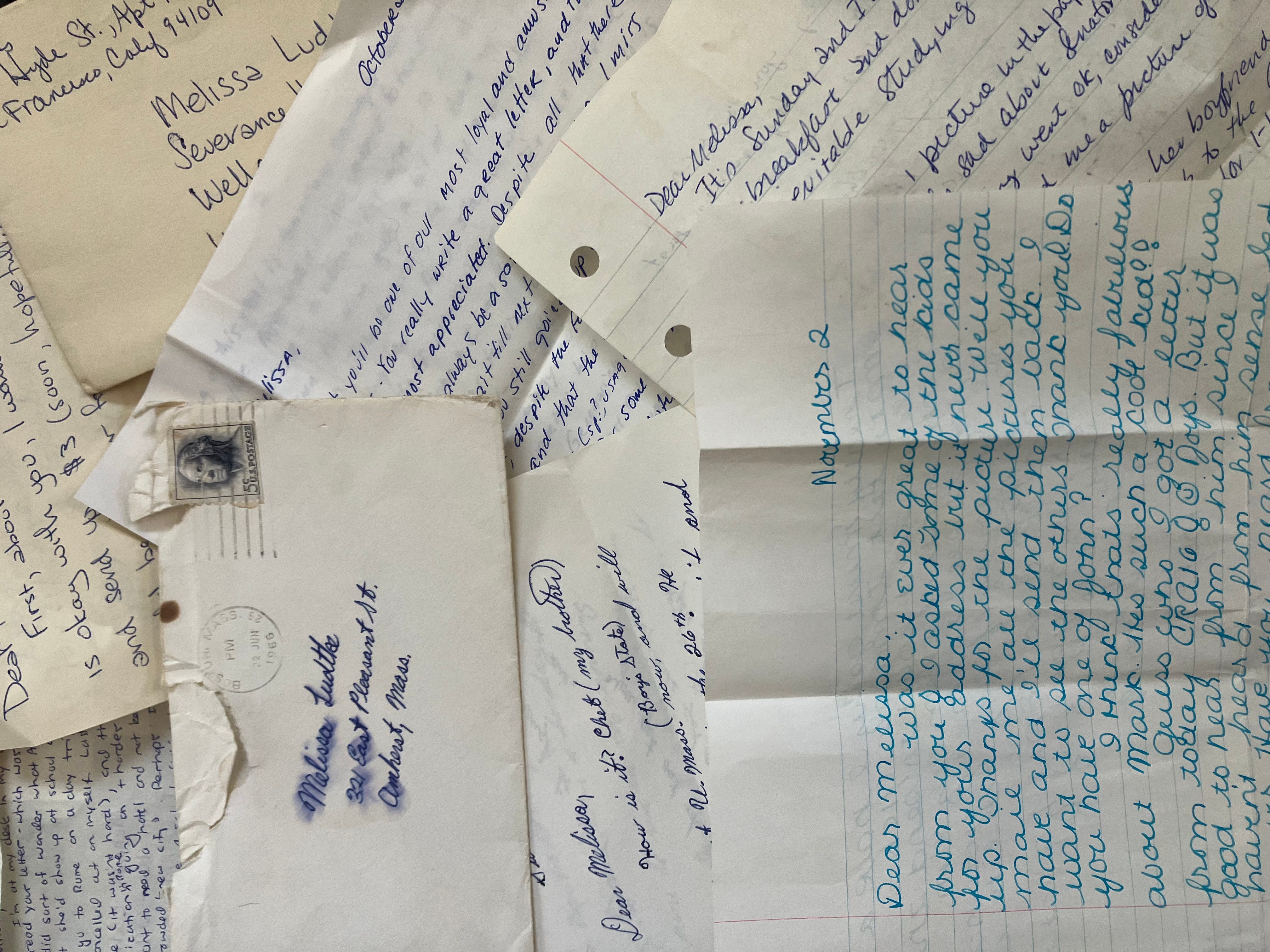
An assortment of letters written to me when I was young. By now, my shoe boxes (and other containers) are stuffed so high with letters that I have to tape the containers shut. The smudged address on the envelope held a letter sent by my 16-year old summer boyfriend, Mark, when he was at boarding school. He sent me lots of letters and when I found out that he’d died in his 50s, I reread some of them. In the lower left corner I can see my sister’s handwriting on an Aerogram, a relic in our time. She wrote small on a lightweight, foldable and gummed sheet of paper since her writing space was limited. She then folded the page of writing into itself, creating an envelope for international airmail. I have many Aerograms in my shoe-box collections.
For most of my life, letters reached me with greater frequency than they do now.
And even with that relative plentitude, I treasured each one.
I remember a crowd gathering in my college dorm at the time when the postal person sorted a big bunch of letters and slid them into our boxes, which had combinations to unlock them. These letters were precious.
And in contrast to those feather-weight Aerograms limited to words, forcing us to conserve space with concise writing, we are now awash in words.
Drowning in them, I’d say.
Space for words is unlimited today; what’s in short supply is the time to consume them.
In fact, that’s the most popular excuse people give as the reason they ignored the words you sent them.
Time, not space, imprints its value today.
As each of us decides how we’ll spend it.
So, for us to carve out time to handwrite a letter is an act of gift-wrapping one’s self.
By bundling feelings with news from your life.
By merging tales of a life journey with sympathy for the loss experienced.
Sent in letter written by hand.
A gesture that says you care before the recipient has read even one word.
Said without words merely by the act of doing.
And, of course, your recipient will look for a quiet place and time to read what you took time to write.
In fact, she’ll devour your words given the rarity of this human touch.
What Happens When We Write by Hand?
I can’t warm up to handwriting’s digital replacements– e-mails or texts.
In fact, I find it hard to let go of my ingrained letter-writing habits when I am writing emails. Which results my emails reading like letters.
In less than two decades, mails moved into the category of chores.
A handwritten letter is still joyful to write.
In ways that even typing one on a fresh sheet of paper is not.
Since in the act of handwriting, you foretell the joy in the person who will open what you’ve written to them – even if the topic itself isn’t joyful.
Not like email, is it?
An experiment done recently with college students supports my supposition.
When students wrote three letters that included an expression of gratitude, they felt happier by the time they’d sent the third letter.
And more satisfied with their own life.
Handwriting letters inherently taps into our wellspring of gratitude.
We’re grateful for the friendship that inspired us carve out time to handwrite a note.
Finding joy, too, perhaps in choosing a decorative notecard with its visual expressing an aspect of our friendship.
I’ll send cards with pictures of typewriters to my old journalist friends. Sail boats to my coastal ones.
After we seal the envelope, we chose a stamp befitting the recipient.
Each step in this process slows us down.
Just as the handwritten letter upon arrival calms its recipient.
Some – likely even a few among us – will label my words about letter writing quaint.
Pat me on the head and agree to move on with the way things are - and will be.
They’ll call me nostalgic for bygone days better left behind, while speed and efficiency and tech take over.
They’re doing a fine job, don’t you think?
Well, no, actually I don’t, especially as people turn to A.I. to “express gratitude,” i.e. write a thank you note.
I say, don’t bother sending it.
Handwritten letters let us touch our correspondent through the comforting familiarity of her script.
Reminds us that her hand — and not a mechanized one – touched this page.
Through her distinctive slant of certain letters, she comes alive, as she does in the predictable spaces she leaves for her words to breathe.
So I can inhale them.
And see in my mind’s eye the moments she recounts. As if I lived them.
We’ve surrendered too much in removing our hand from the touch of our words.
To be human is to desire human touch
When it doesn’t happen, especially at times when we expect that it will, it’s natural to feel crushed.
I was reminded of this feeling this morning in reading a friend’s social media post.
I just gotta get this off my mind… my [18-year-old-daughter didn’t get a single card on her birthday except from me. Nothing in the post [meaning mail]. Not one damn card from any family member. She hasn’t said anything but I can tell she’s a little hurt. I know we don’t have very much family left, but holy cow, 18 is a big birthday. I thought she’d get three or four at least. AITA for feeling awful for her? Like, I try to remember birthdays. … sometimes I fail. But an 18-year-old about to graduate … that seems worth the effort to remember … even just a nice heartfelt text. My heart sorta breaks for her.
[After the first comment, this mom replied] “Not a single call that I remember. No cards. A couple of text messages. I thought my family and my chosen family friends would at least text or send a card.”
Ask ourselves these questions: How will we celebrate occasions in a friend/a relative’s life - from a distance? How will we console them? How will we show them we care?
If no one has time anymore to read or respond to email or texts, and no one calls anyone anymore, and very few of us bother to buy stamps or stash notecards for special occasions or make time to write to someone because they matter to us …
Then how are we to retain what is human about us?

In 1987, Americans received a personal letter, on average, every two weeks.
Surveys tells us that roughly one-third of children have never sent a handwritten letter or received one. But 85% of children in one survey said they’d be excited to receive one - 75% of 15-year-olds and 93% of 7-year-olds.
I share two envelopes that caught my eye this week; the first, I saw online, the other, I received.
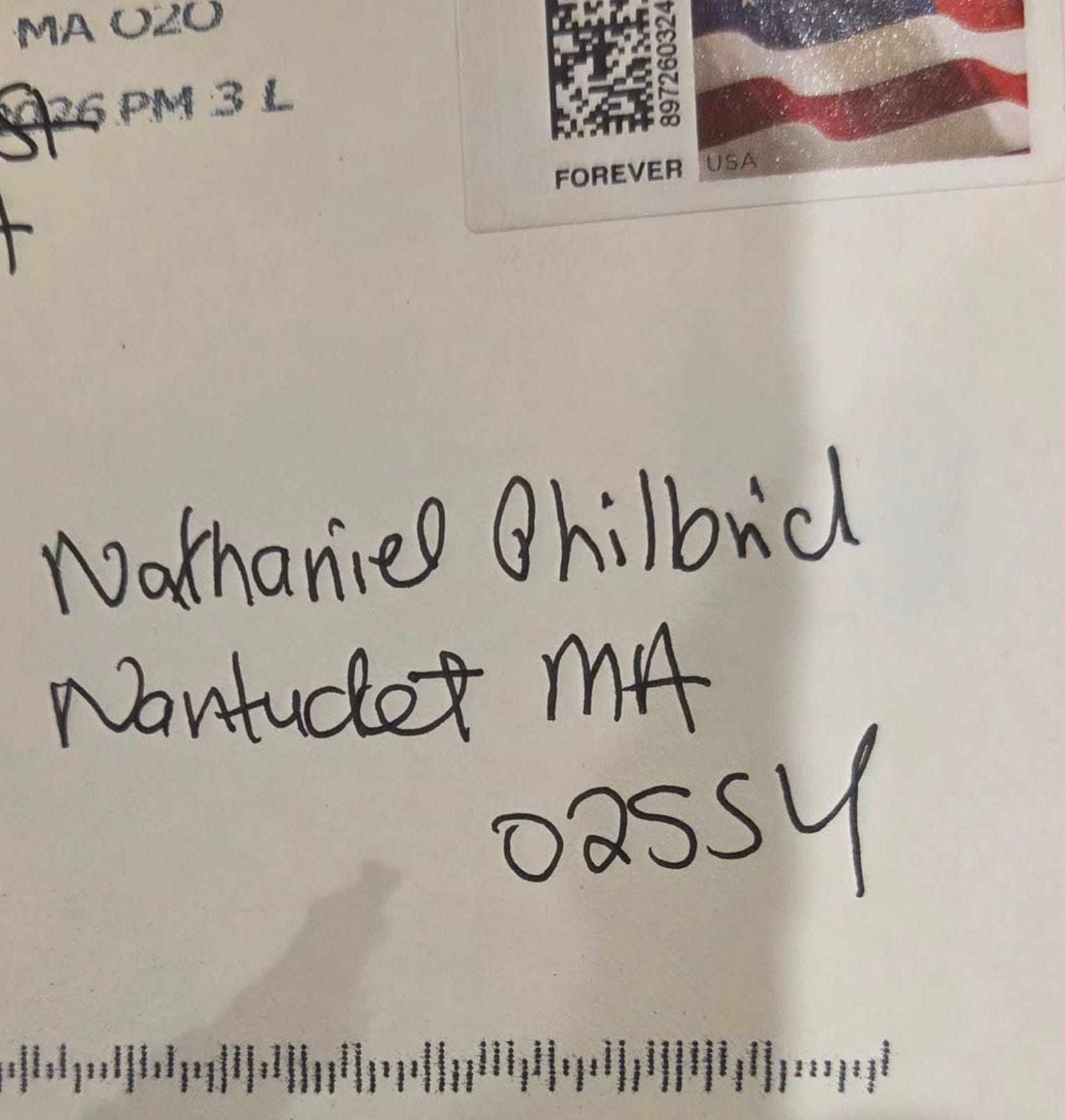
“Gotta love the Nantucket Post Office,” wrote best-selling author Nathaniel Philbrick when this letter reached him.
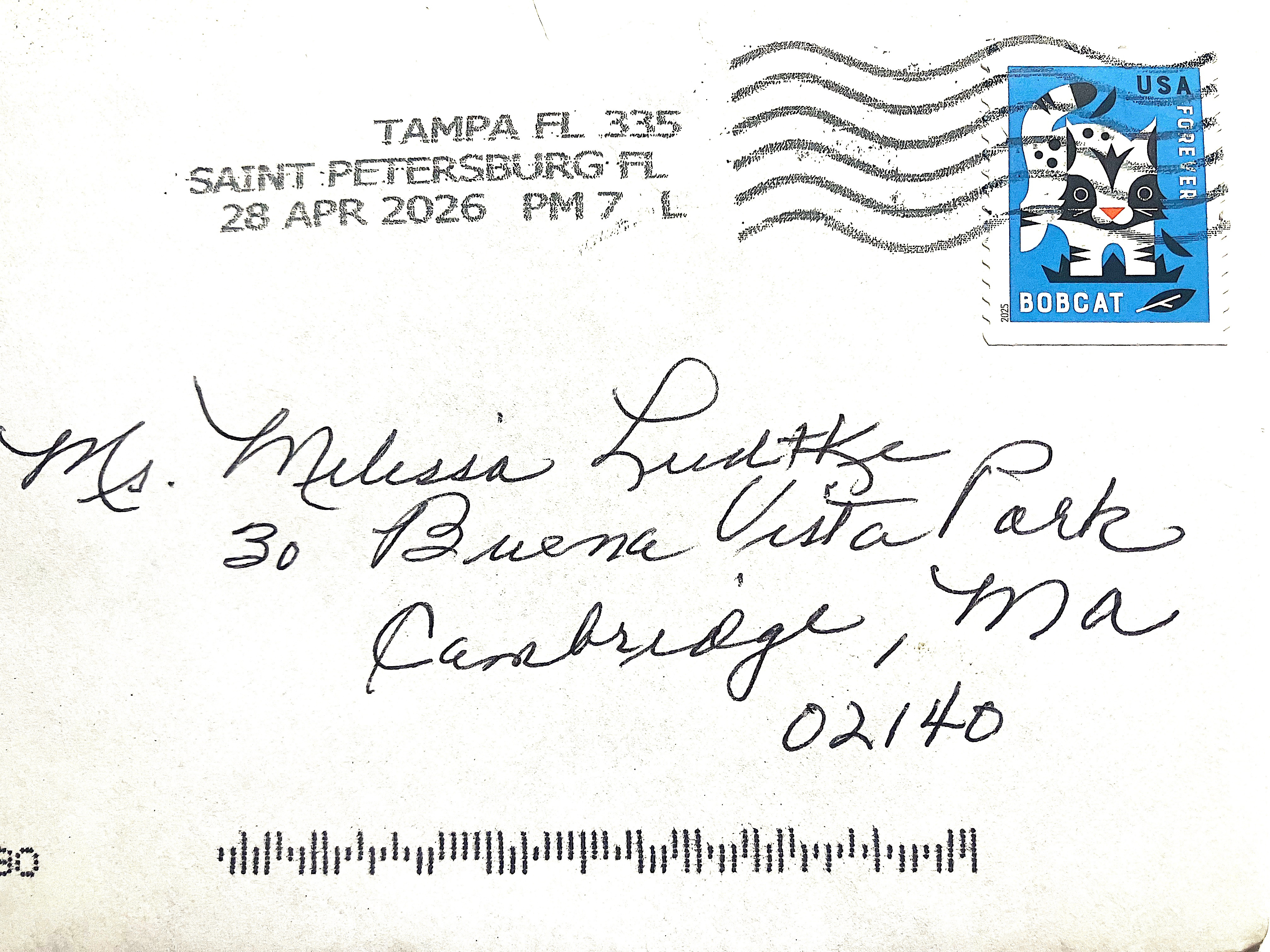
Before opening this letter, I paused to admire the classic cursive which spoke my name. My friend’s gorgeous handwriting is not a big surprise; she’s a woman in her 90s who was taught how to write cursive letters as a child when handwriting was valued and taught.
In 2010, the Common Core standards omitted the skill of handwriting. Today, more than two dozen states require cursive instruction in schools. A move in the right direction, I say, especially when I heard historian Drew Gilpin Faust discuss her story in The Atlantic “Gen Z Never Learned To Read Cursive,” on NPR.
Faust shared this startling exchange with students in her Civil War history class:
“Well, I was teaching a class, a seminar for undergraduates at Harvard, Civil War history. And a student was giving a report to the class about a book he’d read. And he said one of the great attributes of the book is it had many wonderful illustrations, including illustrations of documents from the Civil War era. But, of course, he couldn’t read those because he didn’t read cursive. And I said, what? What? Wait a minute. What do you mean you can’t read cursive?
And then it turned out that two-thirds of the students in the class couldn’t read cursive. And I was just stunned. I had no idea. So I set out to explore some of the implications of that for historians and for history, because I am a historian, but also more broadly, just what it means when you can’t read your birthday card from your grandmother and you have to have your mother translate it for you.”
Speaking of classrooms, let’s peek into what’s happening after only a few years after A.I. became the author of many students’ writing assignments.
Now, professors/teachers are trying to rein in tech’s grab. Why? Because many of them believe students should learn how to write — instead of learning how to give key words to A.I., then add their name and turn in the assignment.
“In a rapid shift, teachers are requiring students to write inside the classroom, where they can be observed. Assignments have changed too, with some educators prompting students to reflect on their personal reactions to what they’ve learned and read — the type of writing that A.I. struggles to credibly produce. [New York Times: How A.I. Killed Student Writing (and Revived It - gift link, by Dana Goldstein, April 30]
“[Students] are using generative A.I. to write before they learn how to write. They are reading ChatGPT summaries of a book before they have ever read a book. The result is a diminished population.” - high school English teacher Breton Sheridan
I’ll admit that few things are more challenging than being handed a blank page and told to write. Even when a prompt is given, the blank page looms large.
Is it any wonder that young people, who have the option, are turning to A.I.? Passing the baton to a machine to take on a tough assignment?
But those who are teaching them, who were taught how to write — and expected to write – see many downsides to surrendering to A.I., not the least of which is how its use diminishes our brain’s functionality. (When you don’t use it, you lose it.) They want to push A.I. aside, at least for the writing part of assignments.
According to this New York Times’ story, students transitioning from laptops to pens and pencils are expressing gratitude for having fewer “distractions,” calling this new approach “a relief.” Students describe greater connection with their classmates and they like how a return to writing actually makes them want to “communicate well.” [ How A.I. Killed Student Writing (and Revived It)]
When we leave writing to A.I.
A recent study with 600 participants revealed “a significant negative correlation between frequent A.I. tool usage and critical thinking abilities.”
Referring to this study, Cal Newport, a computer science professor, wrote: “Let’s consider exercise: the cognitive equivalent of aerobic activity is contemplation — the intentional focusing of your mind’s eye on a singular topic with the goal of increased understanding. Just as the sedentary lifestyles that emerged in the mid-20th century degraded our bodies, our current lack of contemplation is degrading our brains.” [New York Times op-ed, Technology Weakens Our Minds. We Can Fix This. By Cal Newport, March 26, 2026]
“To stave off disaster, we need a full revolution in defense of thinking, launched against the digital forces seeking to degrade it.” - Cal Newport, author of “Deep Work”
Discovering my friend’s art project
This week, I also stumbled upon my childhood friend’s art project. My eye became fixated on the handwritten letter my artist friend put in his art project. He wrote it, attributing it to a fictional Dutch relative in his story, and next to it he placed a pen and reading glasses.
This artist, Chris Demarest, wrote on April 8: “I realized the other day I needed to find something positive to focus on. Inspired by some 3D pieces seen at our local art museum [on Bainbridge Island], I thought I'd return to my love of toy sailboats and work on telling a story about a beloved toy boat through generations of small and large hands.
And finally the letter to complete the box. I made this project for myself, taking on a challenge knowing quite possibly it may never be displayed in public. Regardless, I will always enjoy opening it up now and then to relive 'Pieter's' life. - Chris Demarest
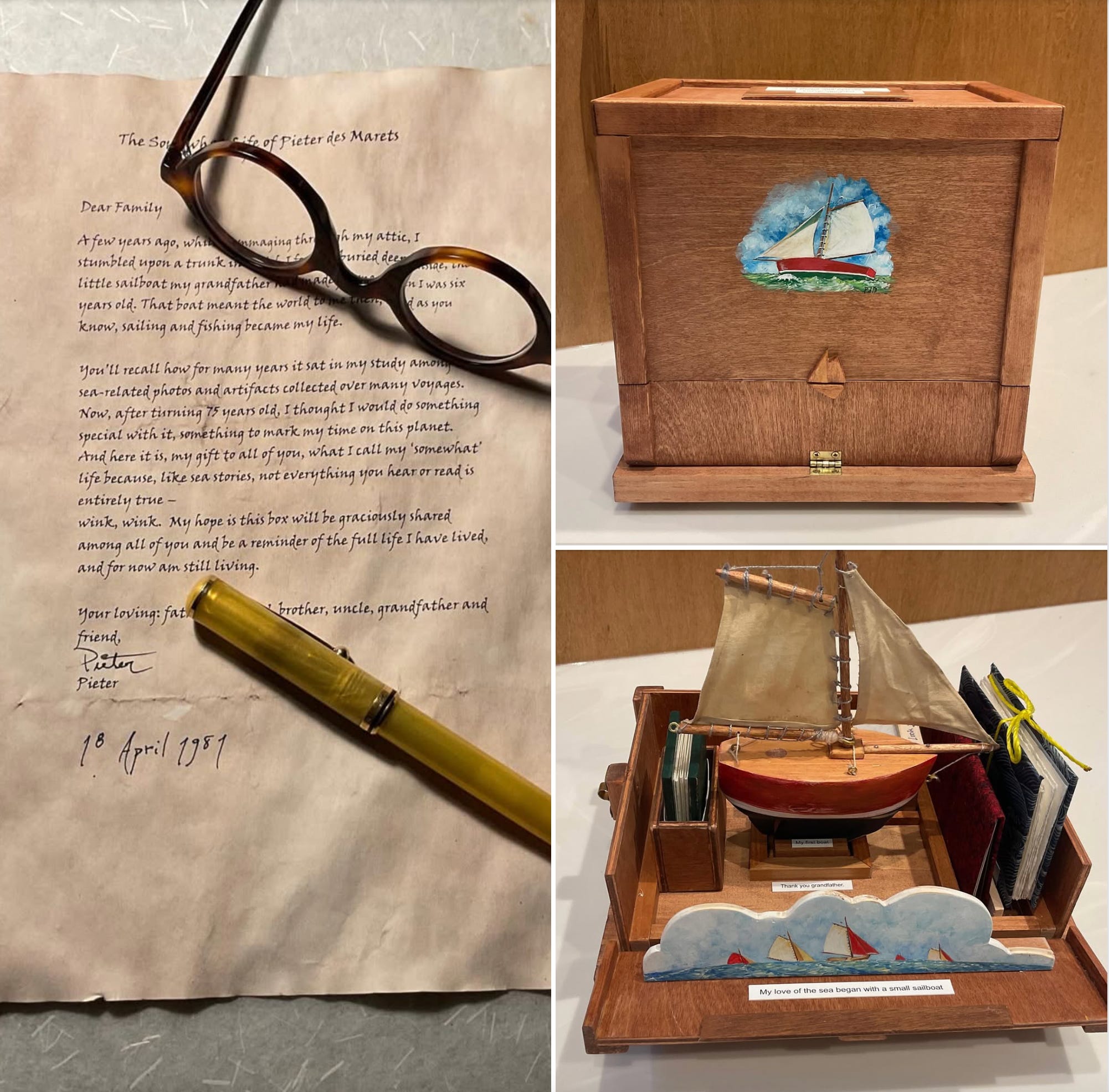
In addition to the boat and box is the story (fictitious) about the Dutch relative. And he included drawings (2 x 2 1/2) of family members, below, adding an image of his own son – as the fictional son – “because I can.” Then, he bound his drawings into an accordion-fold book.
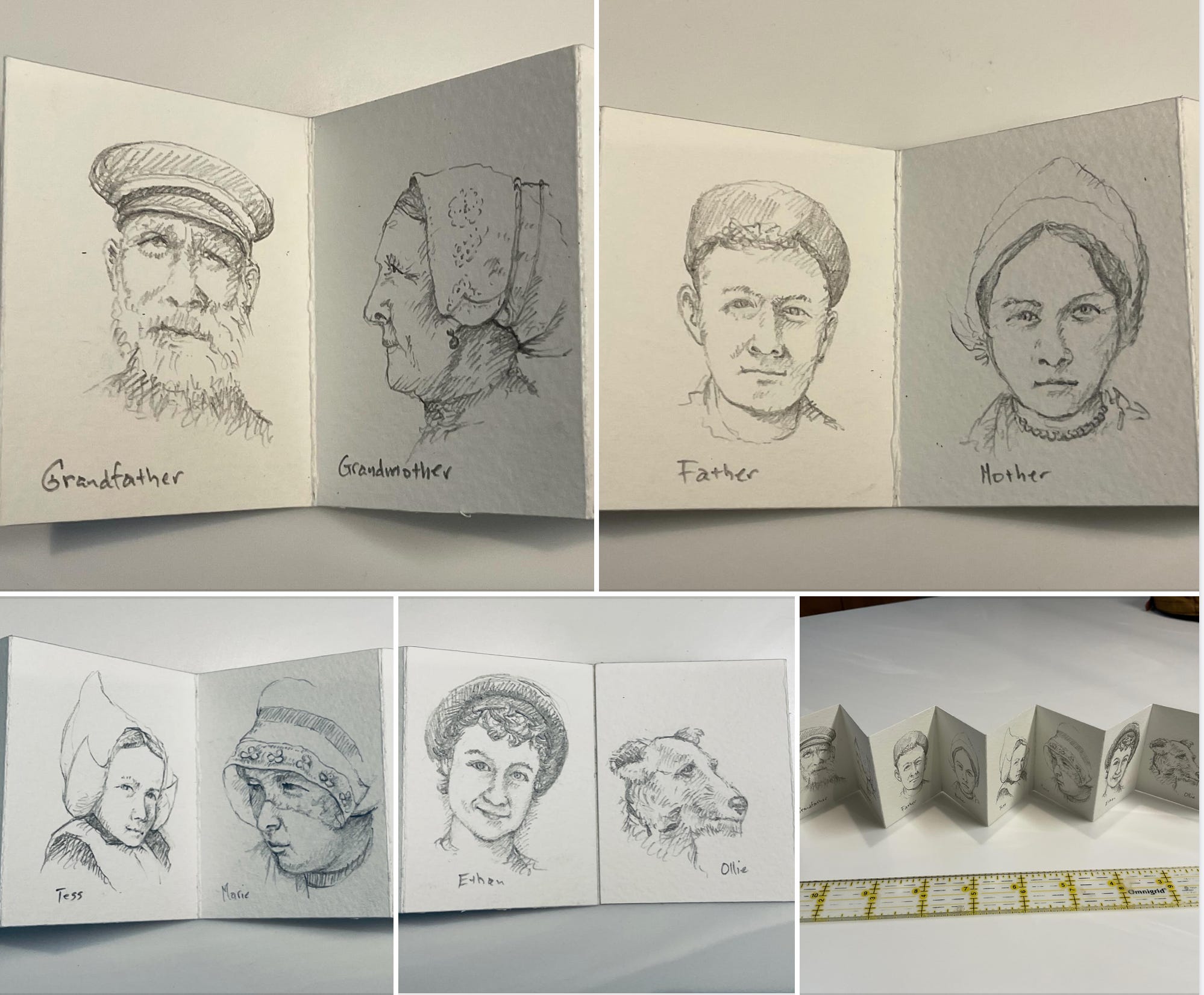
He undertook this project as he neared his 75th birthday.
This wooden box, what I refer to as a ‘time capsule’, came about from a small wooden sailboat I had made a few years ago. That boat became the catalyst to tell a story, using my Dutch heritage, of a fictionalized ancestor and his story of life at sea and, like myself, an artist.
Having recently reached the age of 75, I am using this ancestor looking back at his own life, to reflect on my own. In his story, through the building of this box, ‘Pieter des Marets’, inspired by the gift of a small sailboat built by his grandfather, shares his life as a fisherman, artist, and family man. As I built his memory, it became clear to me that it was also a reflection of my own life which included many adventures of my own.
As Pieter is dedicating his creation to his family, in many ways, this creation is also a thank you to those who inspired me, to my family and especially to my son, as he finds his own adventures a professional artist.
Chris Demarest, Bainbridge Island WA, 2026
My daughter Maya’s handmade notecards
As a child, Maya loved to draw and paint. Now nearly 30 years old, she draws and paints primarily portraits, turning them into notecards. She sells them at pop-ups and art exhibits locally and online at her Papaya Printing Studio on Etsy.
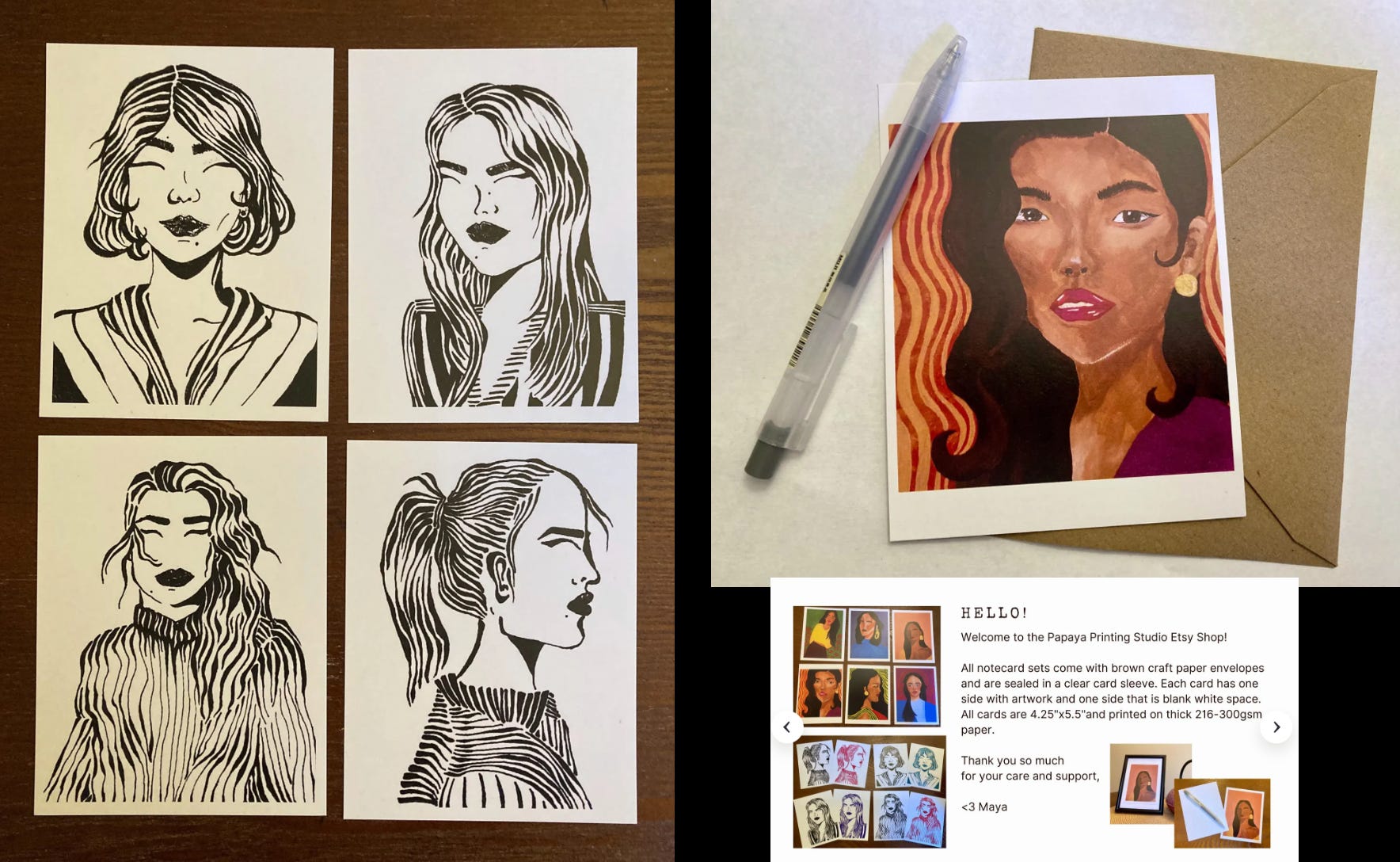
My final story: This week a high school friend from my year in Rome, Italy called me to say how much she loved receiving my thank you note. This was a rare phone call for us, so I was happy Maya’s notecard inspired it. I’d my handwritten note on a gorgeous card that Maya had painted. (I’ve purchased a hefty supply of her cards.) In this phone call, my friend asked me to request that Maya choose six notecards for her to buy. I mailed them this week.
If you want Maya’s notecards, you can let me know in your comments and I’ll arrange with the artist to get them to you.
We will need your mailing address.
As I would if I was mailing you this essay.
My father who was a professor was on his sabbatical year in England and gave me the choice of where I wanted to attend school in Europe. I chose Rome.
Just a great, thoughtful post, Melissa. So true, so incredibly true. Letters are so precious. Lovely work. Thanks.
Your post gets me thinking on a couple of issues, Melissa. I regularly use AI (mostly Gemini) with my Substack posts for three purposes: (1) researching my topic (much better than basic search) and (2) to fact and grammar and spell check my draft draft and (3) to invite challenges to the writing. By way of example, that fact check routinely spots dropped words and saved me in my most recent post by pointing out that I must mean 1919 as opposed to 2019. Gemini is also not shy about critiquing my writing. The app asks if I'd like it to draft a better version. I resist that in the interest of staving off the "cognitive surrender" that AI can inflict. But I do find AI to be useful in alerting me to my sometimes obtuse wording.