
Let's Row Together
I knew her as my mom's lifelong friend, but as layers of her life were revealed, I discovered uncanny connections between us – so eerily similar as to be downright spooky.

When I was a kid, I knew Marge as one of my mom’s dearest friends.
What I couldn’t know then was how eerily similar our obituaries would be.
Yes, though mine hasn’t been written, trust me when I tell you this will be so.
It’s inevitable given the odd coincidences of our working lives.
Marge and my mom were roommates at Wellesley College during the World War II years and were forever friends until Marge’s death due to cancer at the age of 61.
Nimble on the typewriter, these distant friends kept in touch by writing letters in the 1950s and 1960s, a time when marriage and motherhood defined their lives.
Keeping each close to home.
By the early 1960s, our family of seven squeezed into our Plymouth station wagon for the four-hour drive to Pelham, New York, where Marge lived with her family.
We did this so Marge and my mom could spend time together, though her husband Sam and my dad and us - eight kids in all - were there too.
On one of our visits. Marge took everyone except Sam to the Bronx Zoo. Sam had left after breakfast to take a commuter train to his office in New York City, where we’d meet him for dinner.
I was the oldest kid, maybe 10 or 11.
And one of the few tall enough for a camel ride.
Or was it an elephant?
I can’t remember the animal I rode, but I recall that a person led us around a circle while I sat high on its back.
Nor do I recall knowing anything about my mom’s friend.
Except that she was a mom, like mine.
Whatever her life — or my mom’s – had been before her husband and kids arrived, it wasn’t that anymore. At least when the kids were around, my mom and Marge didn’t talk about what had been.
Nor was I was curious enough to ask.
So it wasn’t until the evening of my dad’s birthday on March 4, 1963 that I came to know anything more about my mom’s friend, Marge.
That night I watched “To Tell the Truth” with my parents on our black & white TV. It was one of the more popular quiz shows of my teen-age years. The game involved four well-known panel members quizzing three contestants to determine which of them was really the person that each one said she was.
Marge had let my mom know she’d be on the show that night. And she wasn’t going to be one of the two imposters.
She was the REAL person – the one who’d done what the “affidavit” said she’d done.
After Marge and two pretend Marges came on stage, the host read her affidavit to the viewers and panel members.
Among the “real” Margery Welles’ achievements were these:
She was a recognized authority on professional boxing.
She wrote a biography of World Heavyweight boxing champion Joe Louis.
She was a sports columnist with the Christian Science Monitor for 15 years.
She was a boxing reporter for Sports Illustrated at the magazine’s founding in 1954.
She wrote the boxing entry for the Encyclopedia Brittanica, 1963
Though not mentioned in that affidavit, Marge was also the only woman reporter who Joe Louis permitted to join the male reporters in his locker room.
He’s once passed only this message to her:
“You tell Miss Miller that if she will call me in advance, I’ll be sure to be wearing my terry cloth robe and she can come back any time.”
Sound familiar?
It’s along the lines of what the L.A. Dodgers told me on the night that Commissioner Bowie Kuhn banned me from ever reporting in locker rooms, as the men did.
Fortunately for Marge, Louis ran his own locker room.
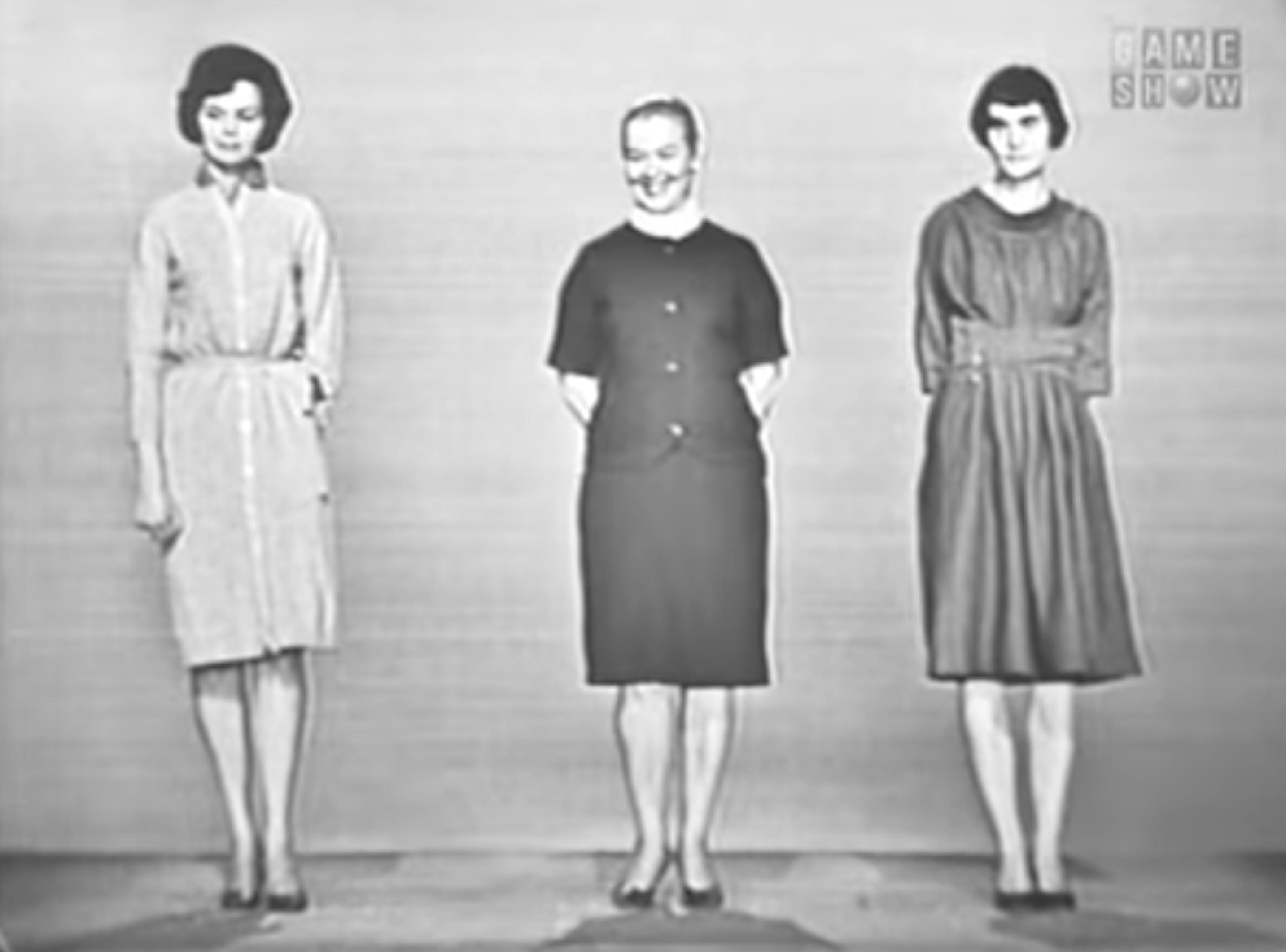
Marge (right) appeared on the popular TV show To Tell the Truth on March 4, 1963, my dad’s 39th birthday. VIDEO of the show is HERE. She was in the third segment of the show. To watch the back-and-forth questions, advance the video to 16 minutes.
The panel members easily decided that she was the real Marge Welles. The other women knew little or nothing about boxing and Marge’s answers flew out before the questioner took a breath.
Robert Q. Lewis, the host, then asked Marge when and how she became interested in boxing. Marge’s replied:
“At the age of 12, I saw Joe Louis as possibly being the Negro would who break the color line in boxing and eventually in all sports,” Welles explained to the panelists, studio audience, and viewers at home. “I began collecting material on Louis and then I found a great many characters in boxing. I like characters.”
I was definitely a so-called “Tom girl” by the time I saw Marge on TV. I loved every sport I could play.
Still, I had no clue that my path would follow hers – including as a reporter at Sports Illustrated.
Marge was brought back to mind yesterday when Arlene Schulman, a celebrated photographer and author1 and friend, published her story about Marge on Substack.


Arlene worked on her story for quite some time, writing it in her effort to reignite the campaign to have Marge inducted into the International Boxing Hall of Fame, an honor she rightfully deserves.
If successful, Marge would be the first woman to enter the fraternity of Observers: Print and media journalists, publishers, writers, historians, photographers, artists and screenwriters at boxing’s hall of fame.
I am joining Arlene in this new effort! And any boxing folks who might read this essay, please join us. Get onboard!
It’s a travesty that the Hall hasn’t recognized Marge’s immense contributions to its sport. After all, the Hall exists to give visitors a comprehensive historic overview of the lives of those whose contributions to the sport should not be overlooked.
Pause to consider that word, “overlooked.”
It’s the title The New York Times gave to the obituaries section it launched on International Women’s Day in 2018. That’s when the newspaper started to publish the obituaries of women and people of color whose deaths it had ignored. People whose lives merited a prominent obituary but they’d been denied their due because of the sexism and racism of their time.
Similarly, the International Boxing Hall of Fame does not distinuguish itself by its refusal to place Marge among her peers with this honor she deserves.
Instead, she’s overloooked and shut out.
Marge should have been inducted into the Hall with the class of 2012.
That was when her granddaughter, Donna Welles, sent her compelling nomination to the Selection Committee.
I am writing to urge you to include my grandmother, Margery Miller Welles, into the 2012 class of the International Boxing Hall of Fame.
Margery Miller Welles saw her first prize fight at the age of 15 when her father took her to see Joe Louis defeat MaxSchmeling in 1938. Although she was a woman, Joe Louis would later instruct the arenas in which he fought specifically to allow my grandma into the locker room along with the rest of the journalists. …
Humbly and Warmly, Donna Welles.
But she wasn’t inducted then.
Nor was she inducted after journalist Roy Peter Clark wrote about Marge’s boxing coverage in 2017,2 and then made phone calls and sent emails to the Hall’s executive director Ed Brophy.
Neither Clark’s story nor his personal entreaties moved the needle on her admission.
Not inducting Margery Miller Welles into this Hall of Fame is preposterous.
I’d hold this opinion even if the seletion committee based its decision soley on an evaluation of her astonishing and influential body of writing about Joe Louis and boxing.
But we need to add to this consideration the great odds she had working against her. We must weigh what she accomplished given that she was a woman who lived out her passion for telling stories about boxing in the 1940 and 1950s.
Doing this won’t diminish the splendor of her accomplishments. Just deepen our understanding of what it required of her to achieve them. At a time when no other woman was doing what she did.
After Roy Peter Clark wrote “Cauliflower and the Champ,” his 2003 story about Marge’s writing, he observed that she “overcame many jeers from unenlightened colleagues about her reporting from the locker room.”
Although I didn’t know her then, I can attest that it wasn’t easy going.
Even with passion and intelligence, gumption and persistence, working as a woman in a sports enviroment dominated by men is tough.
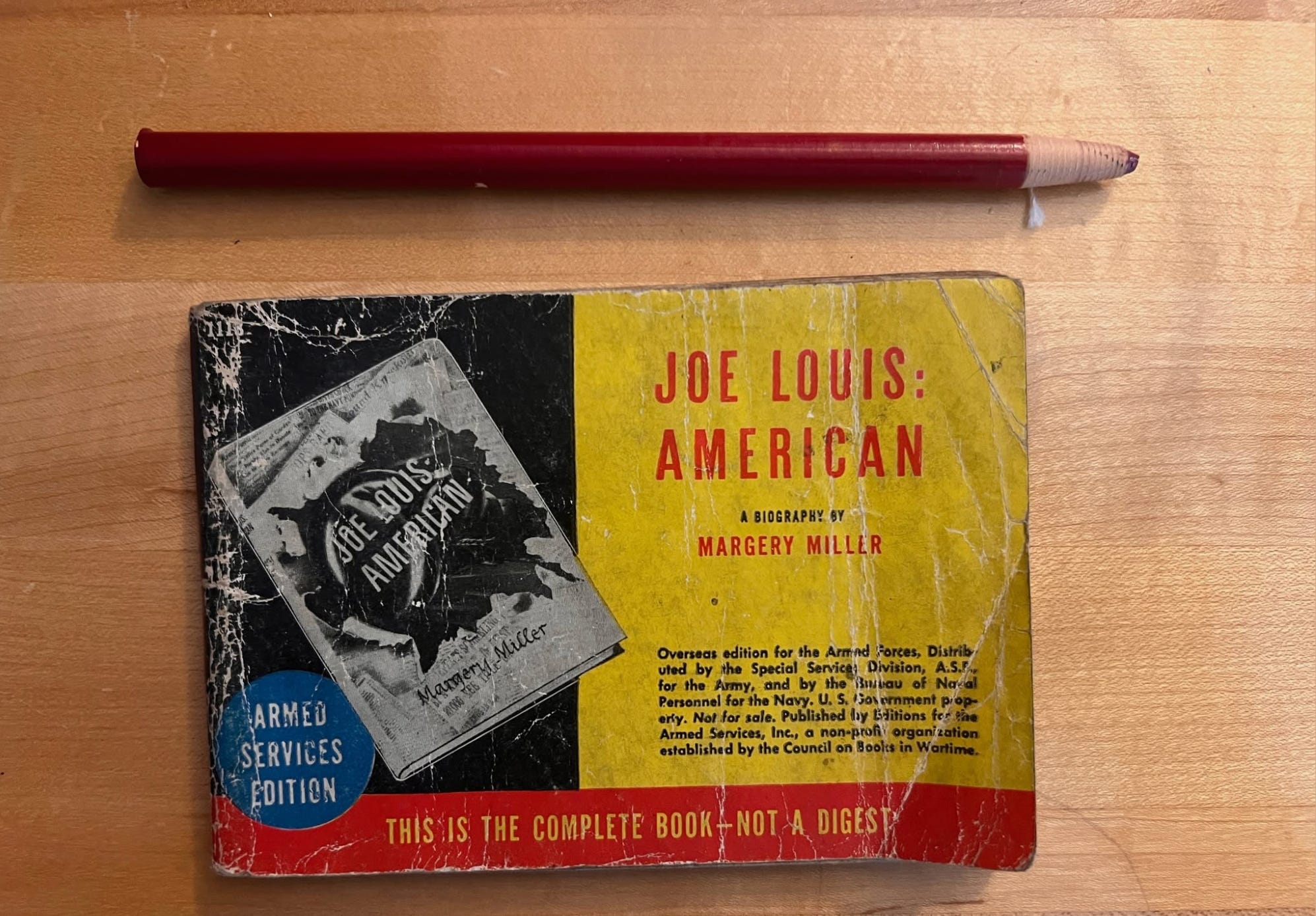
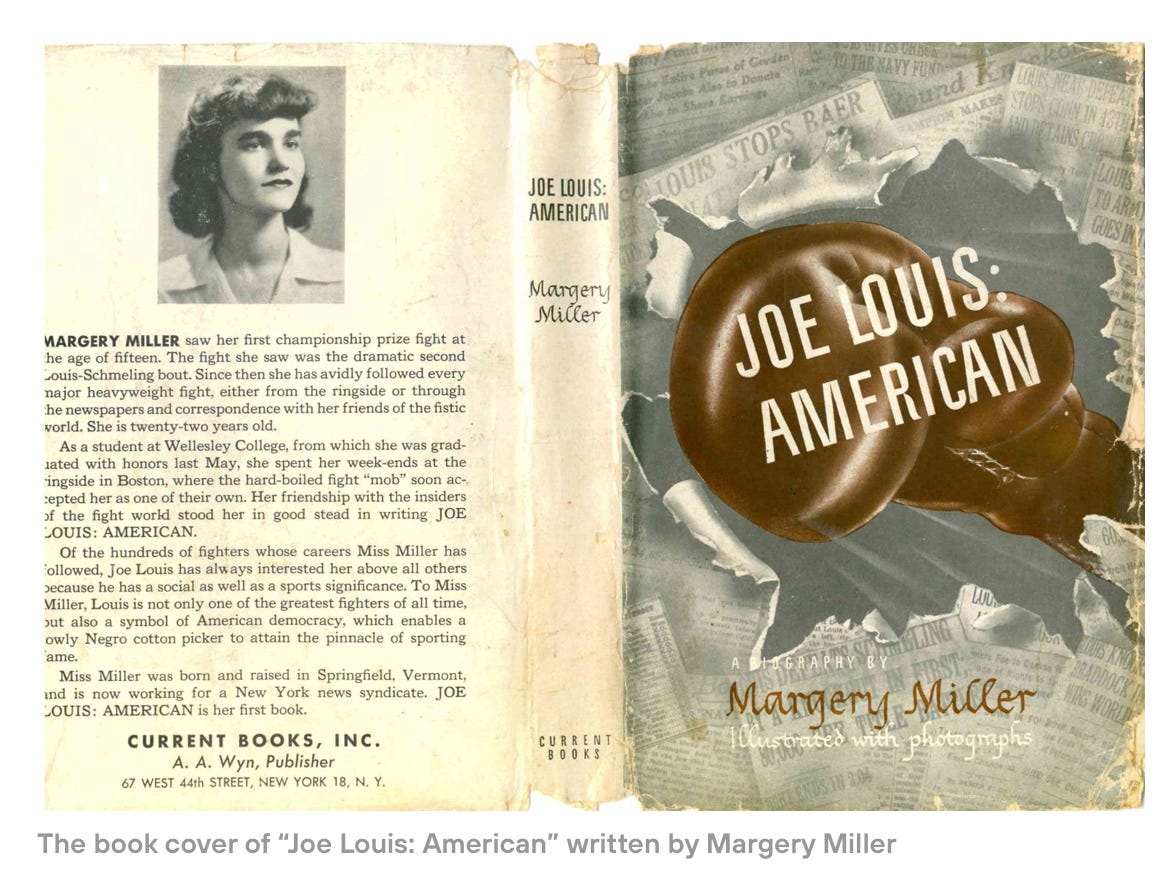
“Joe Louis: American,” was published in 1945, when Marge was 22 years old and a recent graduate of Wellesley College. Her book became a paperback sized to fit into soldiers’ uniform pockets. Marge wrote about Joe Louis for her college senior thesis, expanding that into a book that was published. Ten thousands books were printed, and each sold for $200, $37 today. It was translated into eight languages. [Arlene Schulman who set up this photo to show its scale.]
Former First Lady Eleanor Roosevelt reviewed Marge’s book to great acclaim in her “My Day” syndicated column after she’d stayed up until two in the morning to read it.
“. . . As I read, I realized that this was not the record simply of the boy who had reached the top in his particular sport. It was also the record of a man who, through his work in sports, wanted to win for his people, goodwill among the people of other races and religions with whom his people had to live. The story is simply told, without embellishments, but I believe many people who would not think of reading about Joe Louis, the champion, will be interested to read about Joe Louis, the man and the citizen.” [From Arlene Schulman’s Substack, June 25, 2026)
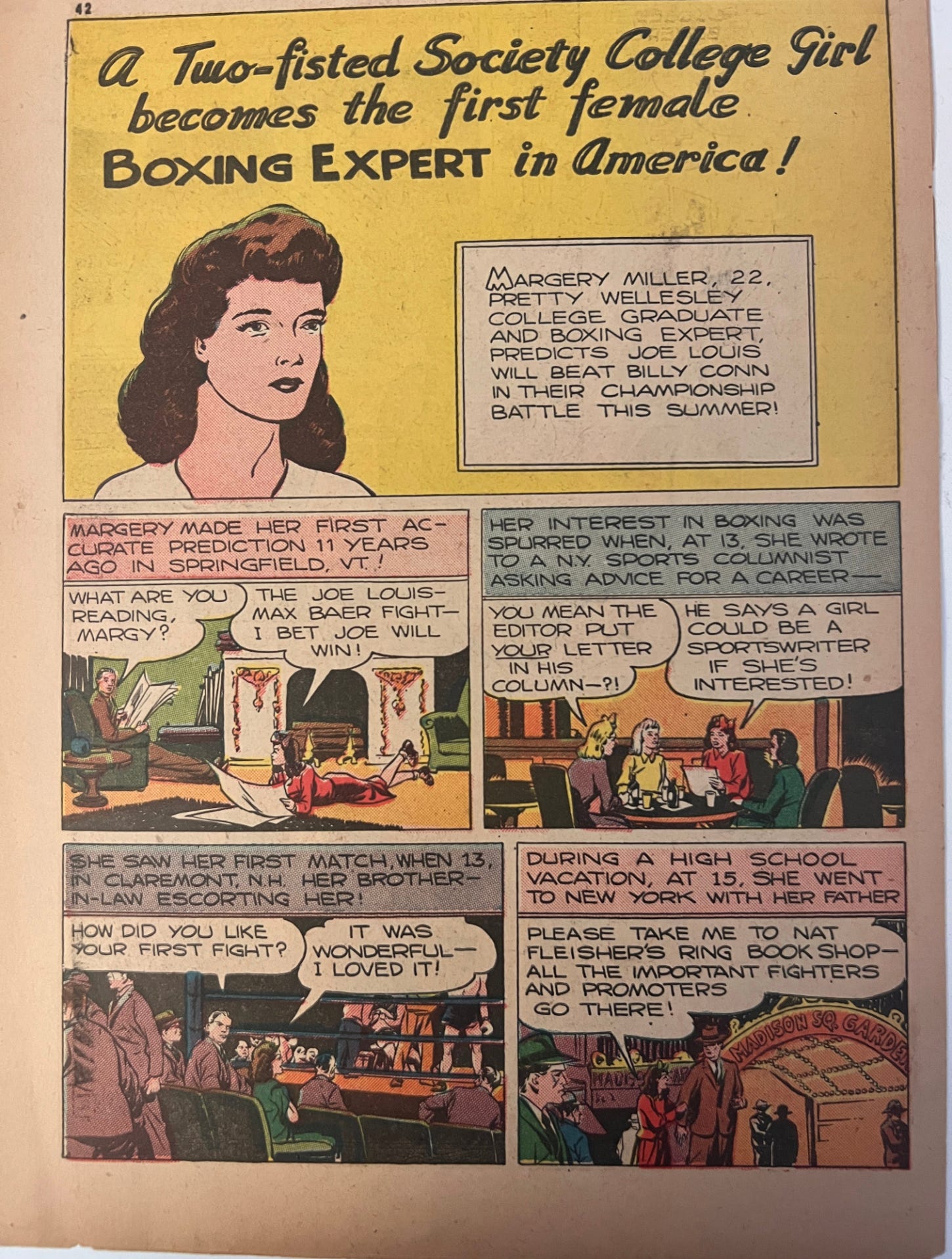
And then there is this cartoon about Marge that Arlene Schulman found on eBay.
And this cartoon about my locker room case, which I cut from a 1978 newspaper.
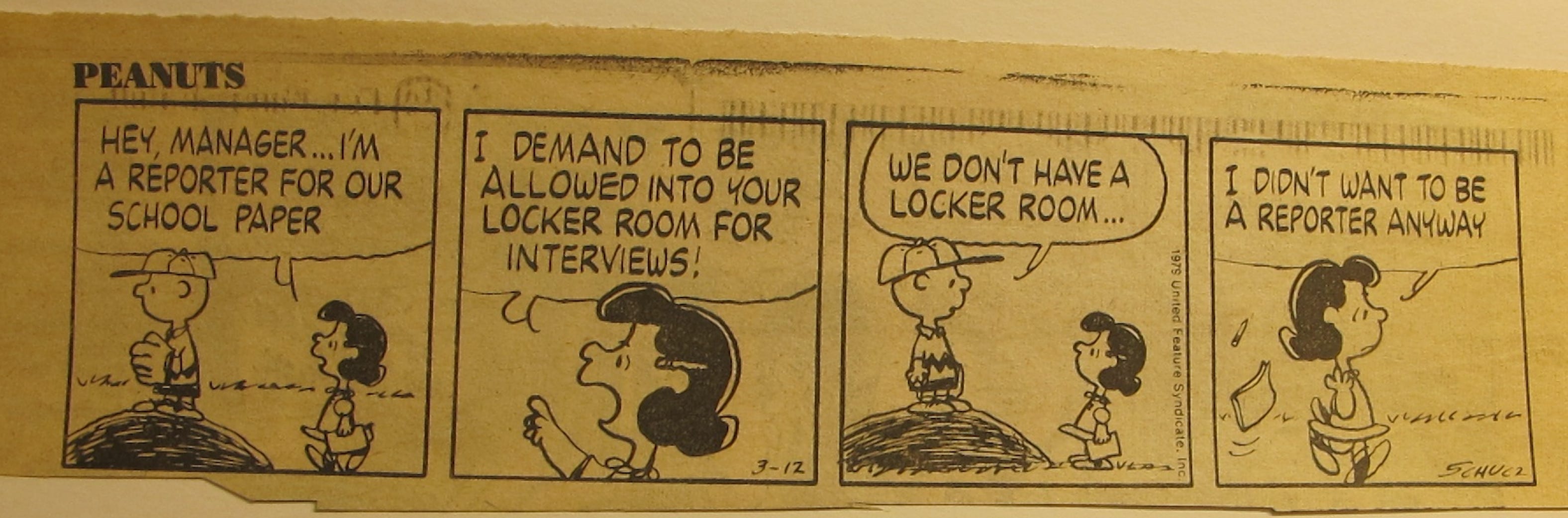
Oh, my. Marge and I are starting to overlap again!
Just like she and my mom did.
As Marge absorbed boxing, my mom soaked up everything about the Red Sox.
As much as Marge loved boxing, my mom loved baseball.
When she was teenager, my mom went to baseball games with her dad at Fenway Park and listened to Red Sox games on the radio when the team was on the road.
At her childhood home in Vermont, Marge read everything she could about boxing and she listened to boxing matches on the radio.
Then, one June day in 1938, when Marge was 15 years old, she went with her dad to Yankee Stadium to see American boxer Joe Louis avenge his Round 12 loss two years earlier to Germany’s Max Schmeling. Louis was the world heavyweight champion, but he’d declared, “I ain’t no champion ’till I beat Schmeling.”
With Adolf Hitler ruling the German government, the people lionized Schmeling.
And the American press portrayed the fight in broad geopolitical, with race mixed in, as they portrayed it was the German Nazi taking on the American Negro.
Louis knocked down Schmeling three times in the first round, and soon the fight was called for Louis. Just 2 minutes and four seconds into the round. Here what Marge wrote about the first heavyweight champioinship fight she witnessed.
“Schmeling went down three times. When he got up the third time, his legs were sand and his hands hung useless at his sides. He looked like a grotesque drunk who could neither think nor act … ‘Oh, Joe! Oh, Joe! Oh, Joe!’ The crowd now came near to having only one voice. It howled and shrieked. It stood on its chairs and tore its hats to bits. It jumped up and down in its frenzy. ‘Oh, Joe. Oh, Joe.’ It drowned out the formal announcement of Louis’ victory. Seventy thousand people had gone insane.”
Perhaps it’s not at all surprising that my mom and Marge cherished their friendship. For it was knitted together by a special trait which at a time wasn’t common in most young women’s lives: each was a passionate fan of a sport.
This glue in their friendship might well have gone unspoken. But I believe it was always at the core of their companionability.
Marge, my mom and me - a few words from my book
Closing this chapter about where our obituaries uncannily overlap
In this excerpt from my book, Locker Room Talk: A Woman’s Struggle to Get Inside, I wrote about that day when Marge took our family to the zoo before and we went into the city to the Time-Life Building to meet her husband, Sam, who was an editor at Life magazine, for dinner.
These paragraphs come at the end of a chapter in which I describe the steep learning curve I faced when hired as a researcher-reporter at Sports Illustrated in 1974. I learned quickly that my peers at the magazine were well-versed in sports coverage before they got there. I wasn’t.
“My starting line was way behind my Sports Illustrated colleagues. I had no sports writing or editing experience, nor had I taken even one journalism class, nor worked on any school newspaper. All my peers at SI had covered sports for their college or university newspaper. I played sports, so I could talk a good game, but I had lots of catch-up work to make up for my deficiencies that set me apart. But there was one special gift I had from a friend of my mom’s that helped me feel like I belonged in this place where I’d landed.
“My mom’s college roommate and close friend, Marge Miller, was the boxing writer at Sports Illustrated soon after the magazine was launched in 1954. Before being hired, she’d written about boxing for more than a decade, starting as a student at Wellesley College in the 1940s. One night on TV, when I was young, my mom and I watched Miller being questioned by the celebrity panel on “To Tell the Truth” at a time when women were not writing about boxing.
“When I was 10, Miller had taken my family to the Time-Life Building after we spent the day at the Bronx Zoo. Our elevator ride – my first – took us to a high floor where her husband, Sam Welles, worked as an editor of Life magazine. They’d met when he was a correspondent who’d followed a tip about a boxing scandal. To report this story, his editor had paired him with Miller to help with the investigation. Their romance developd, and that led to marriage, which was quickly followed by one pregnancy, then another, and eventually the birth of their three children. After she’d married, Miller left Sports Illustrated, as women did in those days, and she’d never returned to the magazine, nor to any fulltime job writing about boxing.
When she’d taken me on my first ride in that Time-Life elevator, I couldn’t have known that one day we’d have male athletes’ locker rooms in common.
“The next time I walked into the Time-Life Building I was 23 years old. Riding the elevator to the 20th floor for my first interview at Sports Illustrated, I remembered Miller, who had died by then. When she was 12 years old, she’d read about boxer Joe Louis, then listened to his fights on radio, just like my mom did with the Red Sox. Miller’s father went with her to see her first championship fight in Yankee Stadium when she was 15. That was the famous rematch that the press billed as the fight between the American Negro, Joe Louis, and the Aryan German, Max Schmeling. It was fought at a time when Adolf Hitler ruled Germany and the American Negro was ruled by Jim Crow.
“During the war, she was at Wellesley College and her friends lovingly nicknamed her “Cauliflower,” a reference to the deformed cartilage on boxers’ ears. This spoke to how much time Miller was spending with boxers training near Boston, including Joe Louis. “Joe Lewis: American,” her senior thesis, was published as a book in 1945, when she was 22.”
My huge thank you to Arlene Schulman for employing her words in the good cause of honoring Margery Miller Welles with her rightful place in the International Boxing Hall of Fame.
Included among Arlene Schulman’s seven books are these about boxing: The Prizefighters: An Intimate Look at Champions and Contenders which features an introduction by Academy Award winning screenwriter Budd Schulberg and Muhammad Ali: Champion.
Clark who is a senior scholar and vice president of the Poynter Institute for Media Studies, found a copy of Joe Louis: American in a used bookstore for $15 and wrote two articles profiling Welles, one in 2003 and the other in 2017., a senior scholar and vice president of the Poynter Institute for Media Studies, who found a copy of Joe Louis: American in a used bookstore for $15 and wrote two articles profiling Welles, one in 2003 and the other in 2017. His latter story was headlined, “Writer Margery Miller Welles deserves to be the first woman in the Boxing Hall of Fame, Author of the book ‘Joe Louis: American,’ she was a rare woman writing about sports and race.”
Such an interesting story, thank you for sharing!
Loved reading about Margery Miller and her accomplishments! Thanks, Melissa!