
Let's Row Together
Baseball and American Culture + Women. In writing my keynote address for Baseball Hall of Fame's Symposium next Wednesday, I'm mixing ingredients that years ago created a combustible mix.

The invitation arrived via email.
Fortunately I still open emails.
Especially ones with enticing headlines.
Like this one that arrived on February 9th.
Cooperstown Symposium - Keynote Invitation
I serve as co-director of the Cooperstown Symposium on Baseball and American Culture. This is one of our major events and brings together authors, researchers, and historians from across the nation. I would like to speak with you more about being our keynote speaker this year, as we think our audience would enjoy having the opportunity to hear you.
We allow the speaker to cover just about any aspect of baseball they desire. The presentation is made in our Grandstand Theater, lasts about 30 minutes and is followed by a Q&A session.
We examine music, literature, architecture, economics, race relations, family issues, etc. We also enjoy a Thursday evening town ball game, followed by dinner in the Hall of Fame plaque gallery. — from Cassidy Lent, Baseball Hall of Fame
I said “yes.” Wouldn’t you?
And as I did, I knew I’d add to this short list of topics another: Being a woman in baseball.
In my case, a young woman, in her mid-20s, pouring her heart and soul – and a ridiculous percentage of her waking hours – into reporting on and writing about Major League Baseball.
Only to have the baseball commissioner ban me from performing this job I loved.
This job I’d landed due to the miraculous hand of fate (and good luck) when I was 24 years old.
To be one of two baseball reporters at Sports Illustrated magazine.
This job that baseball’s czar, Bowie Kuhn, stole from me.
At the moment when I was finally at the first World Series I’d been assigned to cover.
The one I’d worked hard and long to earn the confidence of my editors to cover.
And in the middle of the first game of that series, Commissioner Kuhn robbed me of that opportunity.
For one reason.
My sex.
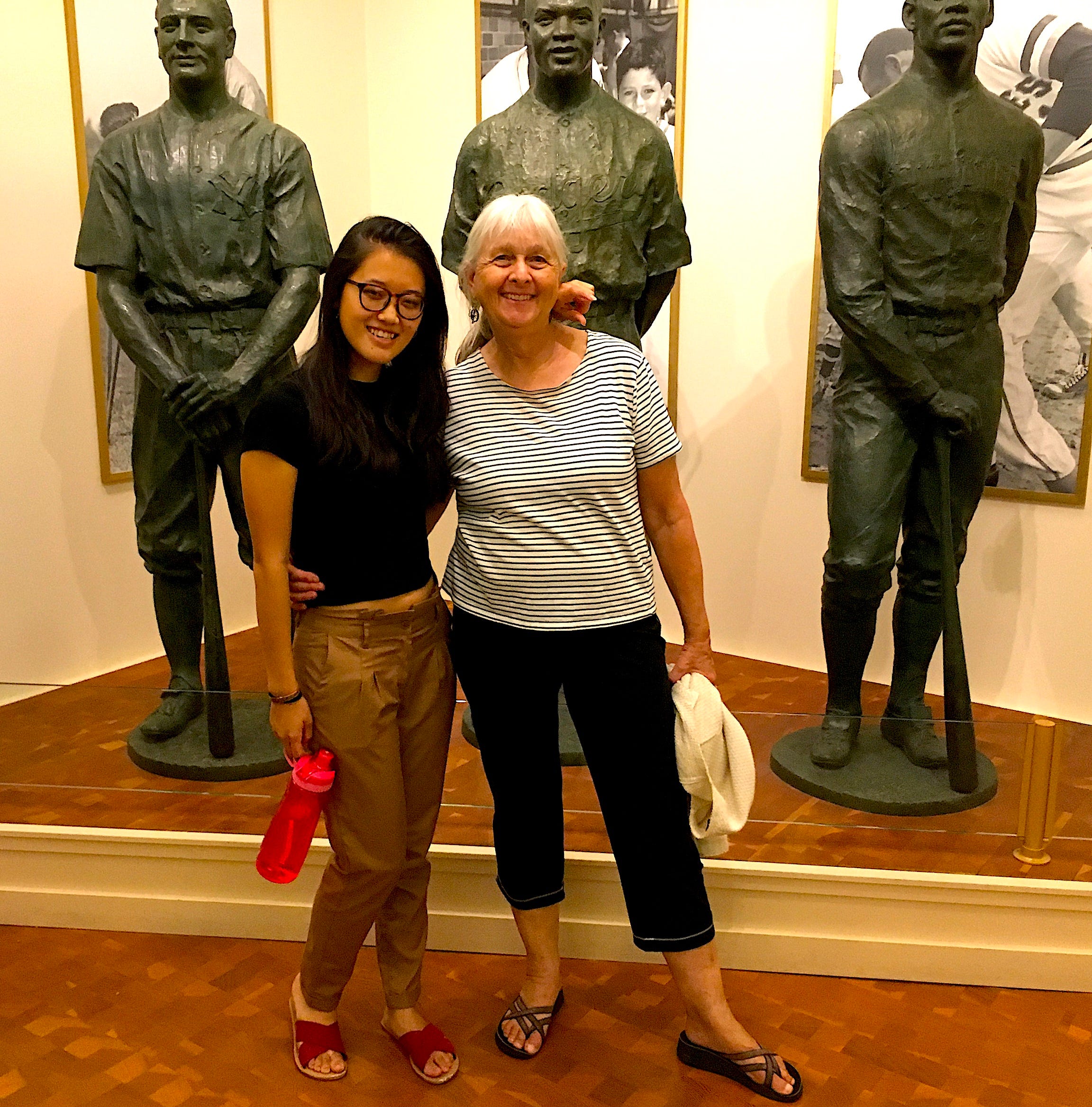
My daughter Maya accompanied me to Cooperstown in 2017 when my dear friend Claire Smith became the first female baseball writer to win the prestigious Baseball Writers of America Association Career Excellence Award.
Because some of you have read my essays on Substack.
Or been at a talk I’ve given about my book, Locker Room Talk: A Woman’s Struggle to Get Inside.
Or watched me speak about my case in videos like the one with Hillary Clinton at the 92NY.
Or heard me on a podcast like the one I did with Sarah Spain.
You know my story.
Just as it’s likely that many of 150 or so people who will be in the Grandstand Theater next Wednesday when I speak to them know it too.
So it’s incumbent on me to deliver more.
Which I’ll only succeed in doing by challenging myself.
Getting myself to stand outside of my own experience.
So I can capture for them the more expansive, scenic view encompassing the cultural shifts that my legal case represented.
And, to some degree, provoked.
If I hope to convey even a modicum of insight about the cultural dimensions of what it was to be a woman in baseball in mid-20th century America, I’ll need to connect my story with what baseball’s men were experiencing — and doing – in response to my audacious request for equal treatment.
While immersing us back in that roisterous decade of the 1970s in which the world as men had long lived it was being upended by women who were rattling and rolling our nation towards equality.
Which will help explain the harsh verdict the American public rendered about me.
Which I’ll contrast with the actionable order the federal court judge issued when she ruled in my favor.
Thereby, presenting a vastly different ruling than the people’s judgment.
While many Americans were appalled by the idea that I’d go into a baseball locker room to work alongside my male colleagues, the judge matter-of-factly reminded Commissioner Kuhn, a lawyer by education and practice, that the Supreme Court had ruled that “separate is not equal.”
The justices did that in their landmark Brown vs. Board of Education decision. \
Which was the case for which my judge, Constance Baker Motley, wrote its original complaint.
That Supreme Court ruling occurred four years after Kuhn graduated from University of Virginia Law School in 1950.
Perhaps he’d overlooked its significance when he said that separate accomodations that baseball teams offered me ought to suffice.
One big problem with fig leaf was that no such accomodations had ever been made for women sportswriters.
Even if they had, and players were brought to women outside the locker room, this arrange,ent would not have afforded us the same access to our sources that the men had.
Such as to a pitcher soaking his arm in ice in the trainer’s room after pitching a complete game.
This was the access we needed. Access we deserved to have.
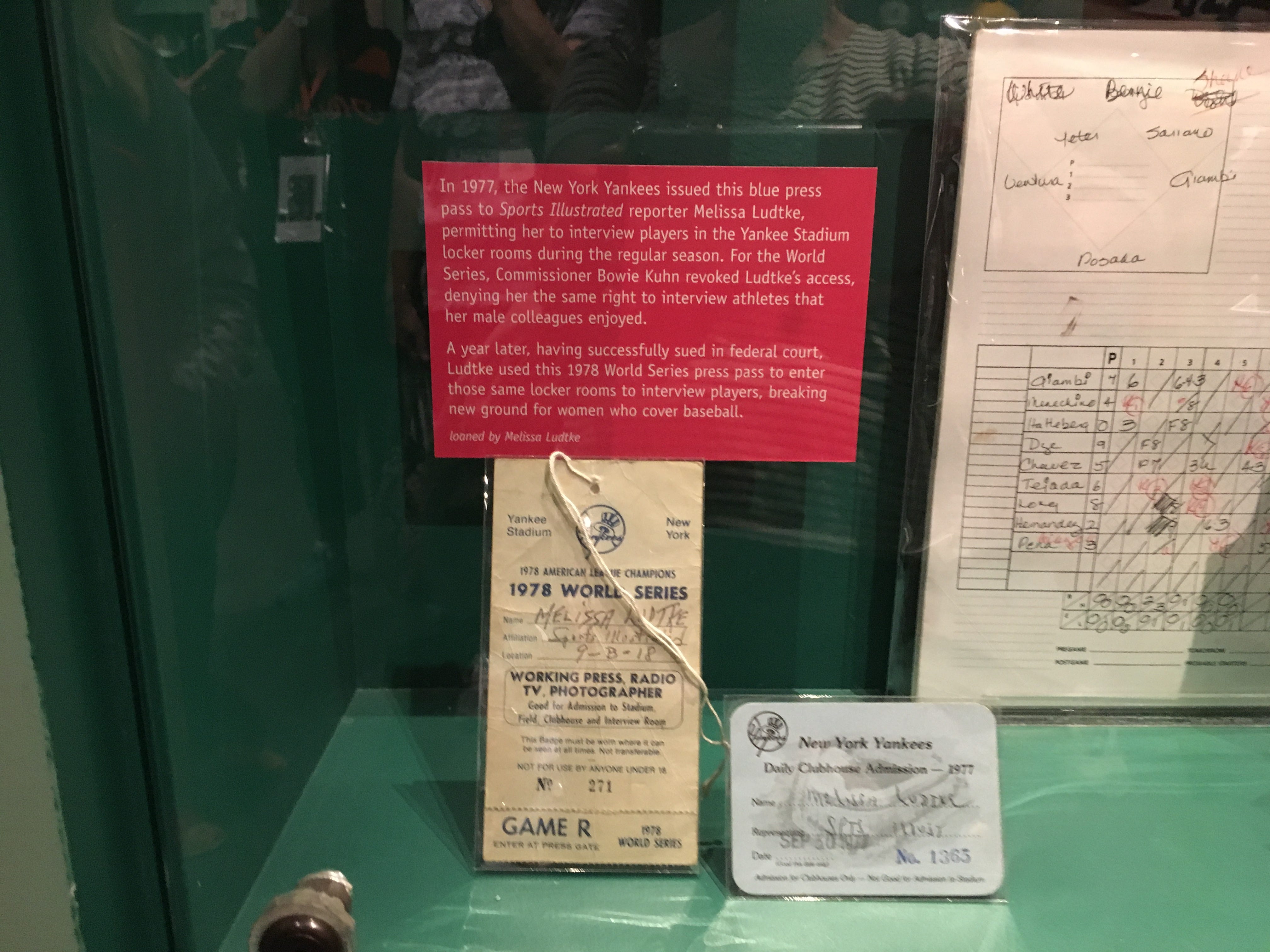
In a permanent exhibit called Diamond Dreams at the Baseball Hall of Fame, my Clubhouse Admission pass stamped September 30, 1977 is on display. That press pass gave me full and equal access to the New York Yankees’ locker room BEFORE the World Series in which Kuhn denied me access to every Major League Baseball team’s clubhouse. For two seasons, I’d spoken privately with Yankees’ media director Mickey Morabito about my need for clubhouse access, which no team gave to women reporters then. By the end of the 1977 season, Mickey left for me this clubhouse press pass which I used to report on the final two home games of that season, then on the American League Championship series. Also on display is my 1978 World Series press credential; to cover the 1977 World Series, I was issued the same press pass that granted me access to both teams’ clubhouse. But Commissioner Kuhn revoked my access in the first game of the World Series, even though the Los Angeles Dodgers had also okayed me reporting in their locker room.
I don’t think many of you will be at Cooperstown next Wednesday.
On the day I celebrate my 75th birthday by delivering this keynote address.
In a place the 25-year-old me could never have imagined being invited to be a half-century later.
Back then, the men in the press box at Comiskey Park were shocked to find me sitting among them. So, they went to Roger Kahn, the baseball writer with whom I’d walked into the press box, assigned by S.I. to report with him to complain.
That is a moment that Roger wrote about in his 2003 book, October Men: Reggie Jackson, George Steinbrenner, Billy Martin, and the Yankees’ Miraculous Finish in 1978.
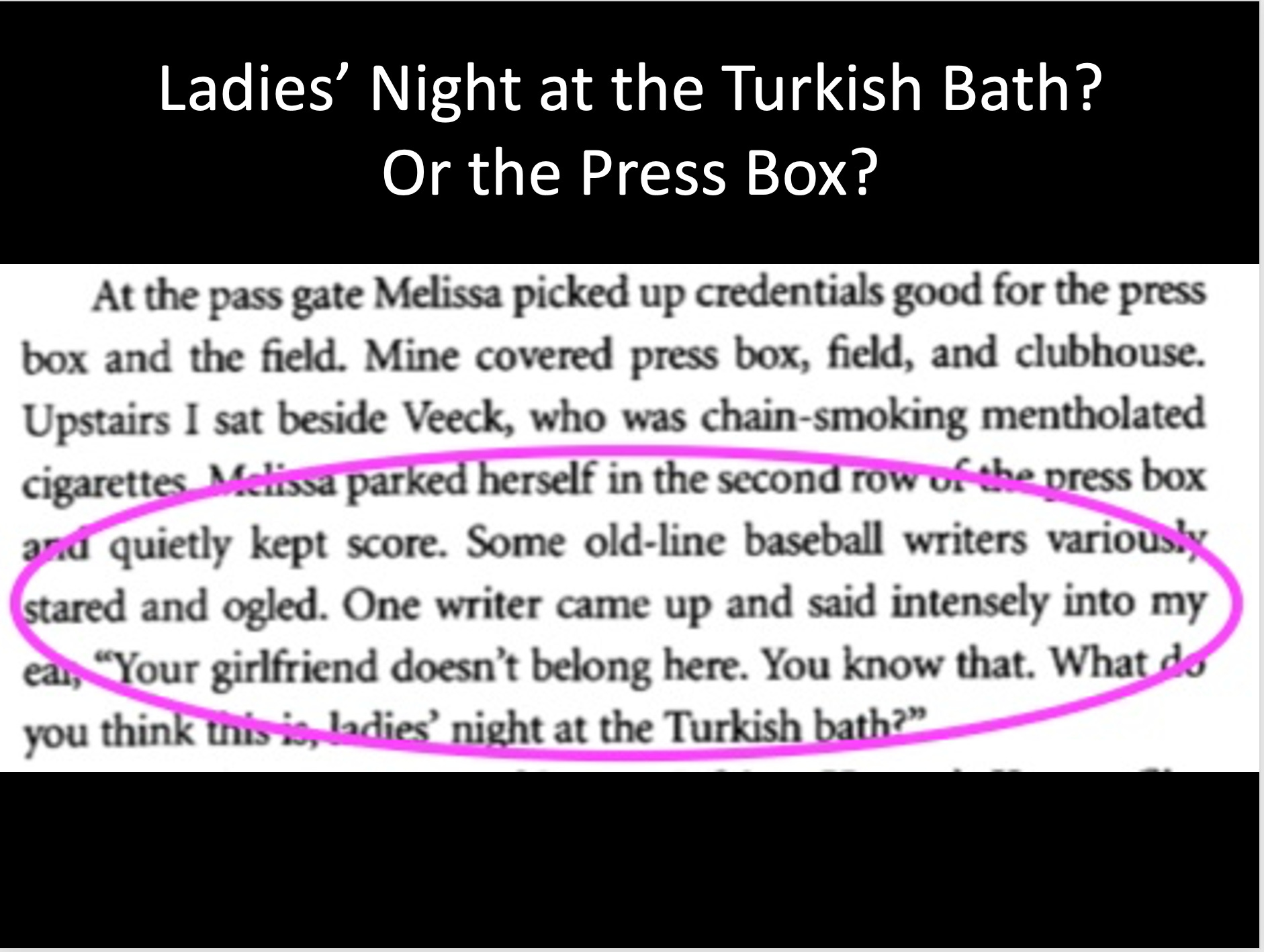
I often use this as a slide in talks I give so I highlighted what Roger wrote.
Roger Kahn gave this keynote address at the Hall of Fame Symposium in 2000.
He was sandwiched between 1999’s spearker, Eliot Asinof, author of Eight Men Out, the classic nonfiction account of the 1919 World Series and its “Black Sox scandal, and 2001’s speaker, George Plimpton, who never met a sport he couldn’t master nor lacked in finding words to describe how he did it.
I’ve not asked to read what these men – or any other Symposium speaker – said when it was their turn to do what I am about to do.
Heck, I’m intimidated by just seeing those three names as predecessors, along with Stephen Jay Gould, Ken Burns, Marvin Miller, Jonathan Eig, Frank Deford (my friend and colleague at S.I.), Paul Goldberger, Howard Bryant, and last year’s symposium speaker, Joe Posnanski, a friend who wrote for Sports Illustrated long after I had left.
Lest you think I’m the first woman doing this, rest assured that I stand on muscular shoulders of dear friends and a woman I admire enormously.
Carla Hayden, Librarian of Congress, fired by Donald Trump, whom I hold her in high esteem.
Claire Smith, my longtime friend and the only woman to ever be awarded the Career Excellence Award by the Baseball Writers Association of America.
Jane Leavy, another longtime friend and best-selling author of baseball biographies; her most recent book is Make Me Commissioner: I Know What's Wrong with Baseball and How to Fix It.
Janet Marie Smith, my long-distance friend, and ballpark architect extraordinaire, who directed and planned the modern redesign of Fenway Park, along with several other ballparks including one of my favorites, Camden Yards.
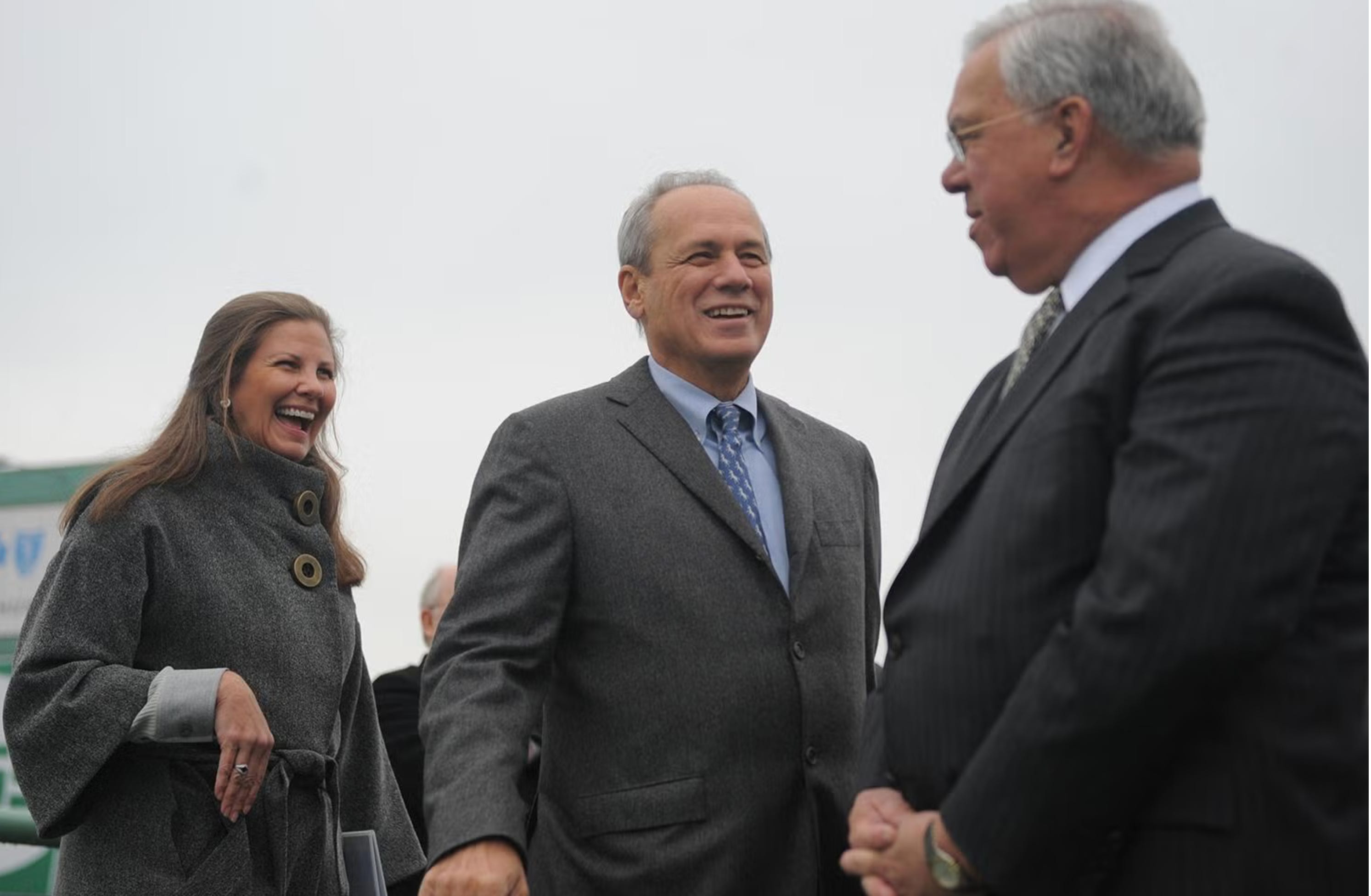
Janet Marie Smith on the roof of Fenday Park with then-Red Sox CEO/President Larry Lucchino (center) and then-Boston Mayor Tom Menino.
Early this month, the Baseball Hall of Fame sent out this announcement:
The 2026 Symposium will officially begin on Wednesday, May 27, at 1 p.m. with the Larry Lucchino Keynote Speaker Melissa Ludtke, who helped blaze trails for women covering the major leagues. The Lucchino Family Foundation is generously supporting the Symposium by naming the annual keynote speaker in memory of the late Larry Lucchino, who served as CEO of the Baltimore Orioles, San Diego Padres and Boston Red Sox.
In honoring Lucchino, the Baseball Hall of Fame published a tribute to him in April 2024, when he died.
“John Henry and Tom Werner became the owners of the team back in 2002. But it was Lucchino, as president of the Red Sox the way he had been president of the Orioles and the Padres before that, who set the tone for everything that happened after he got to Boston. It was Lucchino who did the most to create a culture that changed everything for a team that hadn’t won a World Series since 1918.”
New York sports columnist and author Mike Lupica wrote this about Larry Lucchino — and he also was the first sportswriter to come to my S.I. office on the afternoon that Judge Motley issued her court order on September 25, 1978 in Ludtke v. Kuhn.
Mike and I, who knew each other well, talked. And the next day his column was on the back page of his tabloid newpaper.
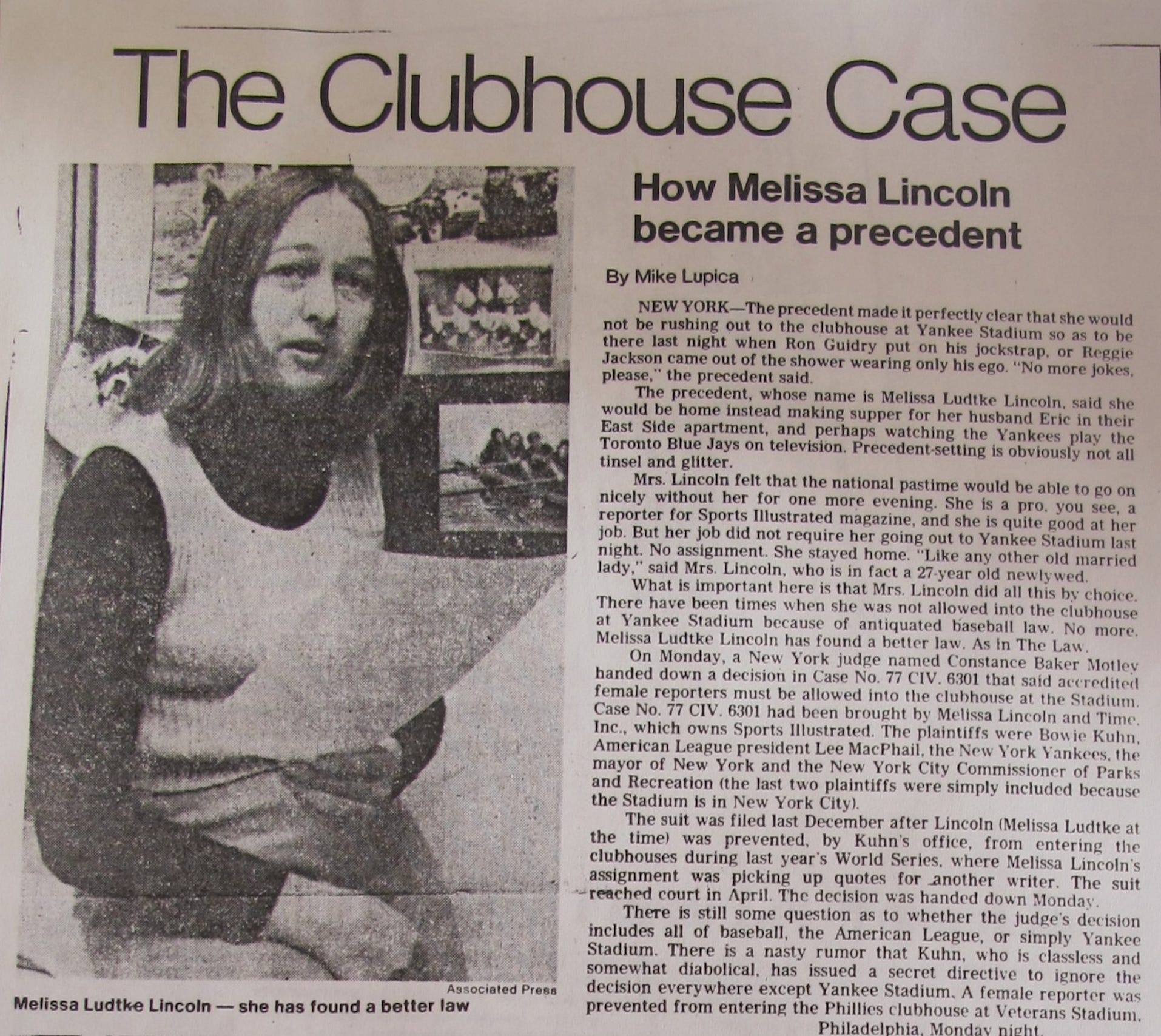
Its headline writers used a name I didn’t— my husband’s, and Lupica opened his column by portraying me as a dutiful wife.
The image Mike drew of me was quite a departure from the customary coverage of me as a lascivious woman libber with roving eyes. But on this occasion, Mike decided to show me staying home on an historic night so I could cook dinner for my husband.
A very differnt image of the girl who sued baseball so she could see men naked.
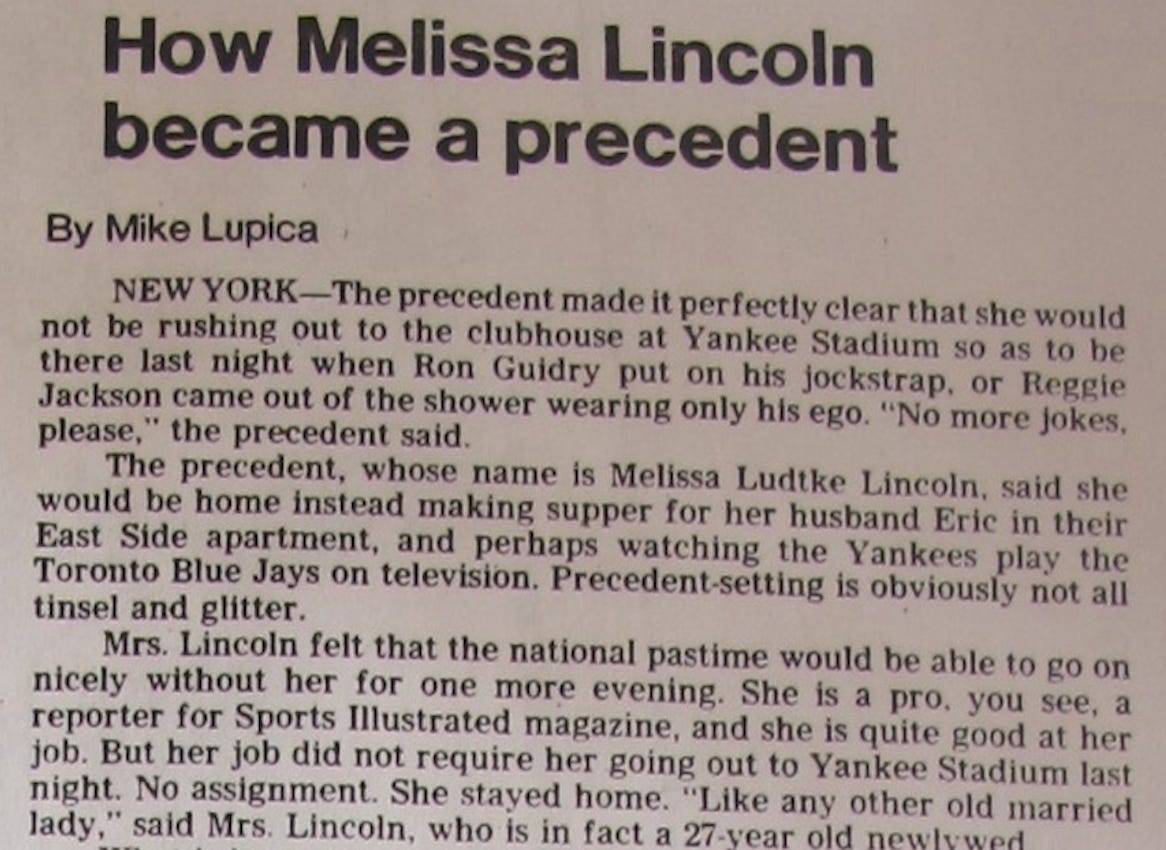
Staying home to make supper for Eric was as nonsensical as the idea that I’d ever be in the locker room when Ron Guidry put on his jockstrap. Ballplayers dressed in the locker room before batting practice and without media present. Only after batting practice were members of the press allowed into the locker room. Even then, with ballplayers in their uniforms, I was kept out — as a woman – despite no player undressing at that time.
All of which highlights the absurdity of baseball’s primary excuse for keeping me out — to protect the '“sexual privacy” of its players.
And since there was no sexual privacy to protect, it was crystal clear that banning me from having access then wasn’t about protecting players from me seeing them nude.
It was a reminder of baseball men’s persistent habit of doing all they could, for as long as they could, to exclude women from entering this line of work.
After all, men aren’t naked when they watch the games from the press box.
And yet baseball’s men told women they couldn’t sit there with them.
No women allowed!
I didn’t go to Yankee Stadium that night because I knew it would be a media circus, and I didn’t want to be the trick elephant.
With the judge’s decision handed down, every TV station in New York, New Jersey and Connecticut would send a woman reporter who’d never covered baseball to the game. They’d go into the locker room with TV cameras rolling to get clips of them asking ballplayers how they felt about them being there. That wasn’t my story, nor was it one in which I wanted to appear. I waited until the first night media hoop-la ended, and then I went in the Yankees’ locker room to my job of reporting on the final games of the Yankees’ 1978 season. Only one other woman was there, doing a story about the winning pitcher, Ron Guidry.
I won’t be telling this story in Cooperstown. I’ve got too much else to say given the task I’ve been presented.
So, I’ll close this essay with a sneak preview at a section of my keynote speech that I’ve written — but with no guarantee that if you are there on Wednesday that I will say these words.
Writing this speech is an ever-changing salad of words, which I toss regularly.
So here goes, with words chosen from the section of my talk in which I offer up some provocative words about a cherished sportswriting legend — Red Smith, who was the most influential sports columnist of my day.
In 1976, his plaque went up in the Baseball Hall of Fame. The writer’s wing.
Forty-one years before the first, and still the only women, Claire Smith, joined him and the many other men whose portraits hang there.
From my speech, as it exists on Friday afternoon:
The media floodgates opened immediately after my case was filed on Dec. 29, 1977, when The Associated Press sent news out on its wire service.
But the heat intensified for me after the dean of the sporting press published his widely syndicated column on Jan. 9, 1978.
He’d won the Pulitzer Prize for commentary in 1976, the year before my case was filed.
That same year his plaque joined the “Scribes and Mikemen” exhibit in this building in the year before my case was filed.
HIS opinion mattered.
So, when he ridiculed my case and derided me, he also handed out permission slips to other sports columnists to do the same.
Which they did.
This columnist’s name is Walter Wellesley Smith.
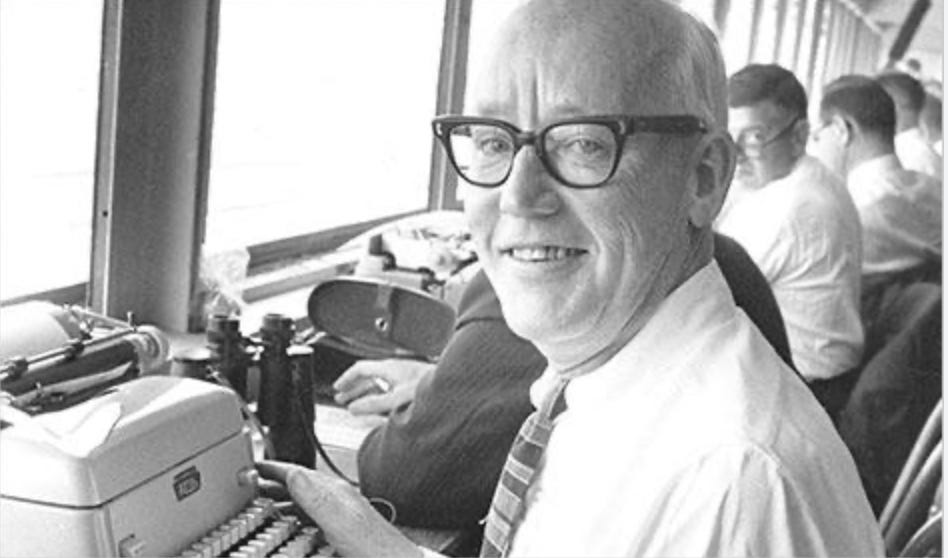
And he’s the only man I’ve known to have my college alma mater in his name:
Not “Smith.”
“Wellesley.”
Everyone knew him as “Red,” and his New York Times columns under that byline were reprinted in newspapers across U.S. and Canada.
So, when Red opined that my legal case “struck a saving note of low comedy” in an otherwise serious sporting year, the rest of the sports writing fraternity joined in.
By playing my request for equal treatment for laughs, too.
Red also turned derogatory words on me by inventing scenes like this one:
If the ballplayers enjoy exhibiting their manliness to some bit of fluff they’ll seldom lack for opportunities, but they should not be required to do so, and they shouldn’t have to wait around with their pants on until the last damsel quits the premises.”
That “bit of fluff” was me.
Oh, and the “damsel,” too.
Once Red ridiculed my legal case and me, I saw other sportswriters parrot his tone and accusations.
All of this was a heyday for headline writers as they got to merge sexual puns with baseball lingo.
In Seattle, when a writer opposed the NBA Sonics opening their locker room to all writers, the headline was “Fluff in the Locker Room.”
I wonder where that came from?
Even when the rare columnist was favorable to my cause, sex still held top billing.
In Philadelphia’s Evening Bulletin, when Rich Ashburn wrote that my case rested on solid legal ground, the headline writers went with a more enticing angle:
“The Naked Truth: Melissa Has a Case.”
And even though Ashburn explained why he thought Kuhn would lose in court, he could not resist revealing his own “naked” truth with his parting words.
“It will only be a matter of time before women will know for sure that all men aren’t created equal,” he wrote
Pivoting to the popular notion that if women writers were in locker rooms, they’d use their roving eyes to stare at the men’s naked bodies.
The Baseball Hall of Fame graciously agreed to have my book, Locker Room Talk, for sale at its Symposium, in case anyone wants to read more about baseball, women and American culture.
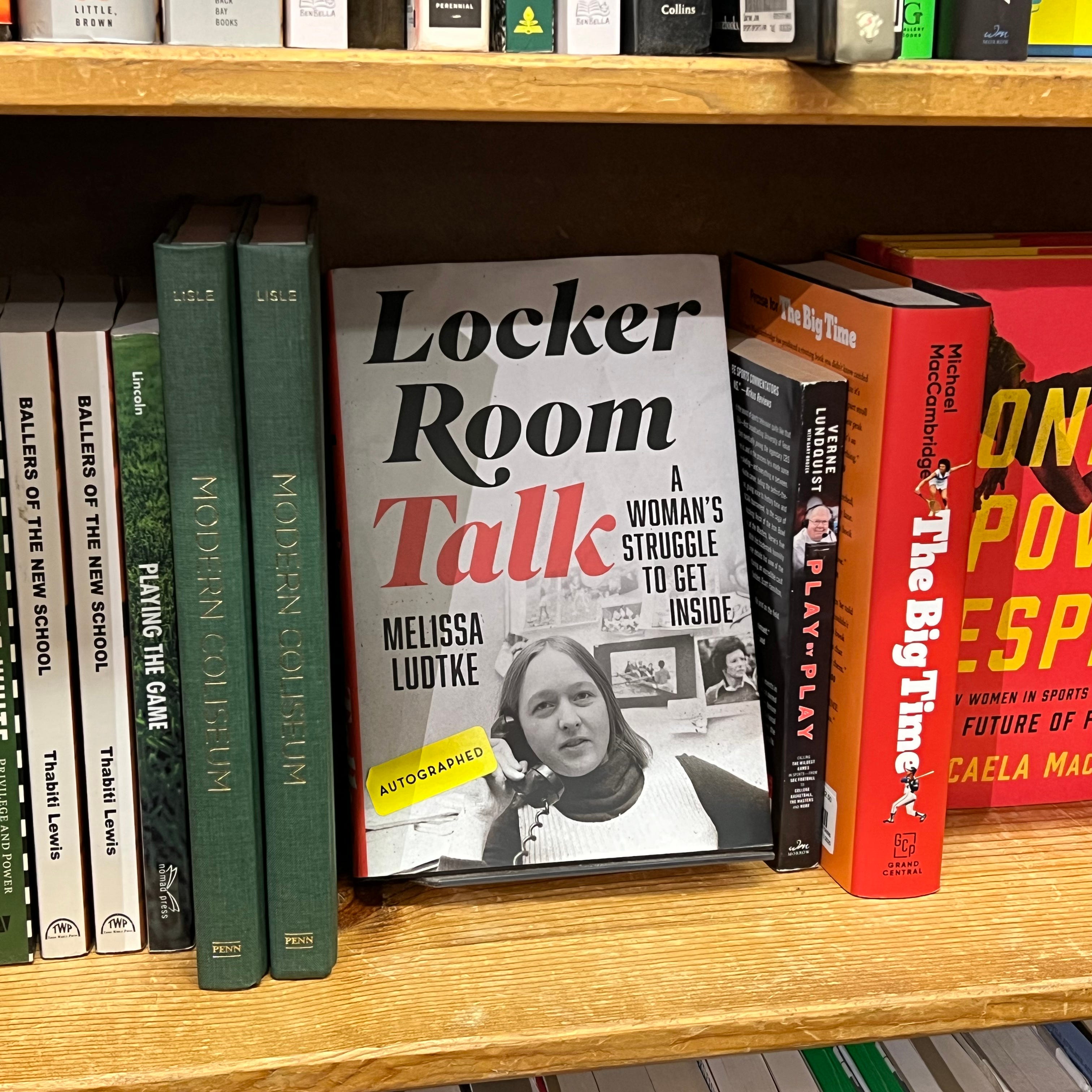
I will NOT write my usual Friday essay next week since I will driving home from Cooperstown.