
Let's Row Together
Losing my dad to a brain tumor was tough. I wasn't yet 50, he was the age I am now, and he was my rock. On Sunday, B.J.'s Team rides for the 22nd year to fundraise to find a cure. We've lost too many!

Two days after celebrating Christmas together, my father had a seizure.
The morning had begun like others did for my mom and dad.
By then, they were empty nesters living year-round in our Cape Cod home.
My dad had parked himself in his chair in the corner of the living room closest to the ocean.
And piled his reading materials high on a side table.
He depended on the light streaming in through the large windows to either side of him to read The Wall Street Journal.
As he read, he would call out items of possible interest to my mom who was reading and writing in a nearby room.
Then, just before lunch, my mom walked to the post office to mail a package.
Gone less than five minutes, when she returned she called out to my dad.
Like she always did.
Only this time, he didn’t answer.
At least not with words she recognized.
Heading to him, she saw him slightly slumped in his chair. His newspaper had fallen into his lap.
He was trying to respond verbally but with only nonsensical sounds.
Once the seizure passed, their worries escalated.
When my mom called me, I was frightened by what she told me.
My dad had never been sick. Never missed a day of teaching finance at the University of Massachusetts in nearly fifty years of being a professor there.
He was in such good shape he still fit into Navy uniform from World War II.
Immediately, I started making calls.
I reached out to friends who I knew had a family member who’d recently been treated for two brain tumors at Mass General Hospital (MGH).
By that evening, my dad had an appointment to see Dr. E. Antonio Chiocca.
The next morning at MGH.
I drove from Cambridge to the Cape that morning to pick up my mom and dad.
As we headed to Boston, I became increasingly concerned when my dad was still having a hard time putting more than a few words together.
Even stumbling with those, though we understoo that he wanted our help in repeating the alphabet that he’d written on the card he held.
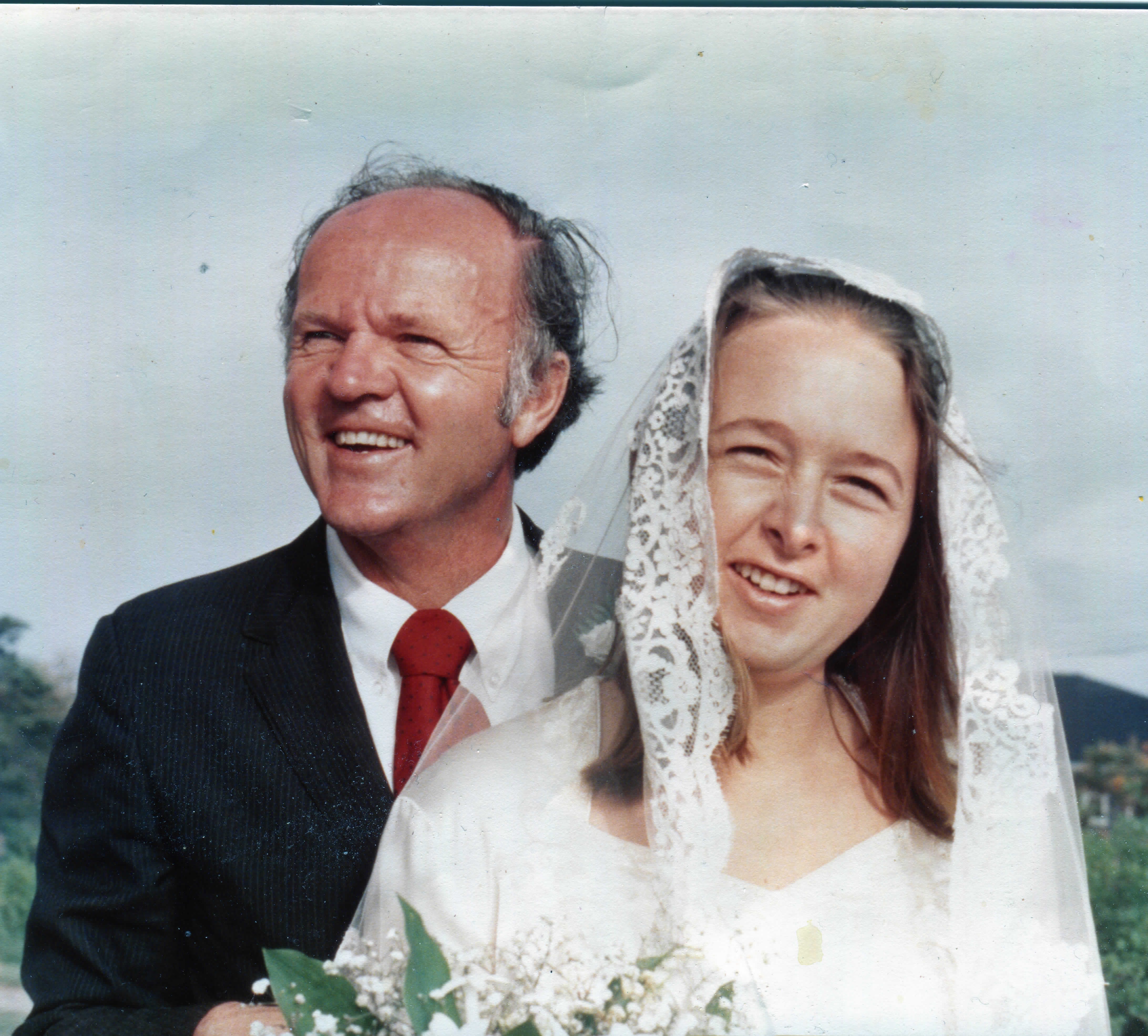
My dad walked me down the aisle in May 1978. Decades later, I expressed my gratitude for his constant love and counsel, especially during my tumultuous younger years in an essay I wrote on Medium.com in 2015. Titled “Cushioning My Landing”, its subtitle summed up my core message: “My dad walked me down the aisle, but his advice a few years earlier built the foundation I needed for the life I ended up living.”
He was my rock.
So, to hear him struggling to say the letters of the alphabet — letters he’d taught me to say when I was a child – was a reversal for which I was not emotionally prepared.
By day’s end, an MRI had confirmed that my dad had a brain tumor.
A fact none of us wanted to acknowledge or talk about as I drove to Cape Cod, and then drove myself back to Cambridge that night to pick up Maya who was with friends.
By the next day, my dad was scheduled for a tumor biopsy.
And that biopsy confirmed that he had a glioblastoma tumor in the speech area of his brain.
The prescribed treatment began with its surgical removal.
Still, we knew from the doctor that the tumor would grow back.
Surgery was followed by radiation at Mass General and chemotherapy, which he could do on the Cape.
This regimen of treatments was done to buy him quality time.
While naturally we hoped that maybe our dad would be the exception to this tumor’s deadly toll.
Maybe he’d be among the tiny, single-digit percentage of glioblastoma patients who live past five years.
Given his age, 74, his doctor responded, when my dad asked, he’d probably gain a year or more by these treatments.
For the first, his five-hour long surgery, my dad had to be awake.
While the surgeons cut into his brain.
His surgeon wanted to remove as much of this invasive tumor as he could but, as he told my dad, he didn’t want to cut out too much and render him unable to speak.
When my dad awoke from surgery, I was with him, feeling buoyed by the surgeon’s report of success in removing much of the tumor.
Still, we were well aware of this tumor’s tentacles that we knew going in the doctor could not remove. And their presence in my dad’s brain would be a constant reminder that his was the most unforgiving of brain tumors.
No longer could I avoid the reality of what he — what all of us – were facing.
My dad died 22 months after his tumor was diagnosed.
On November 3, 2000.
By then, he was confined to the hospital bed that my mom had put in the living room.
Only steps away from his favorite chair.
With a hospice nurse there as we sat with him, talking and holding his hands.
Before he was incapacitated, my dad lived large in the time the treatments gave him.
He never asked “why me?”, at least aloud, and he lived each day to its fullest by saying, “I will.”
After the radiation and restorative speech treatments were over, my parents traveled to Germany and the Czech Republic, visiting dear friends while enjoying time away. My dad flew alone to say goodbye to his two brothers in the Southwest, and when I took him to the airport and walked with him to the gate [yes before 9/11], I discovered a friend was on his flight and agreed to help my dad at the other end — comforting me, as I left. Between chemo treatments, my parents took the trip they had to cancel when he was diagnosed in January – their longed-for boat journey through the Beagle Channel at the tip of South America.
Also on my dad’s bucket list was a visit to Pearl Harbor. He served in the Navy and felt it his duty to honor those who died there. My mom went with him.
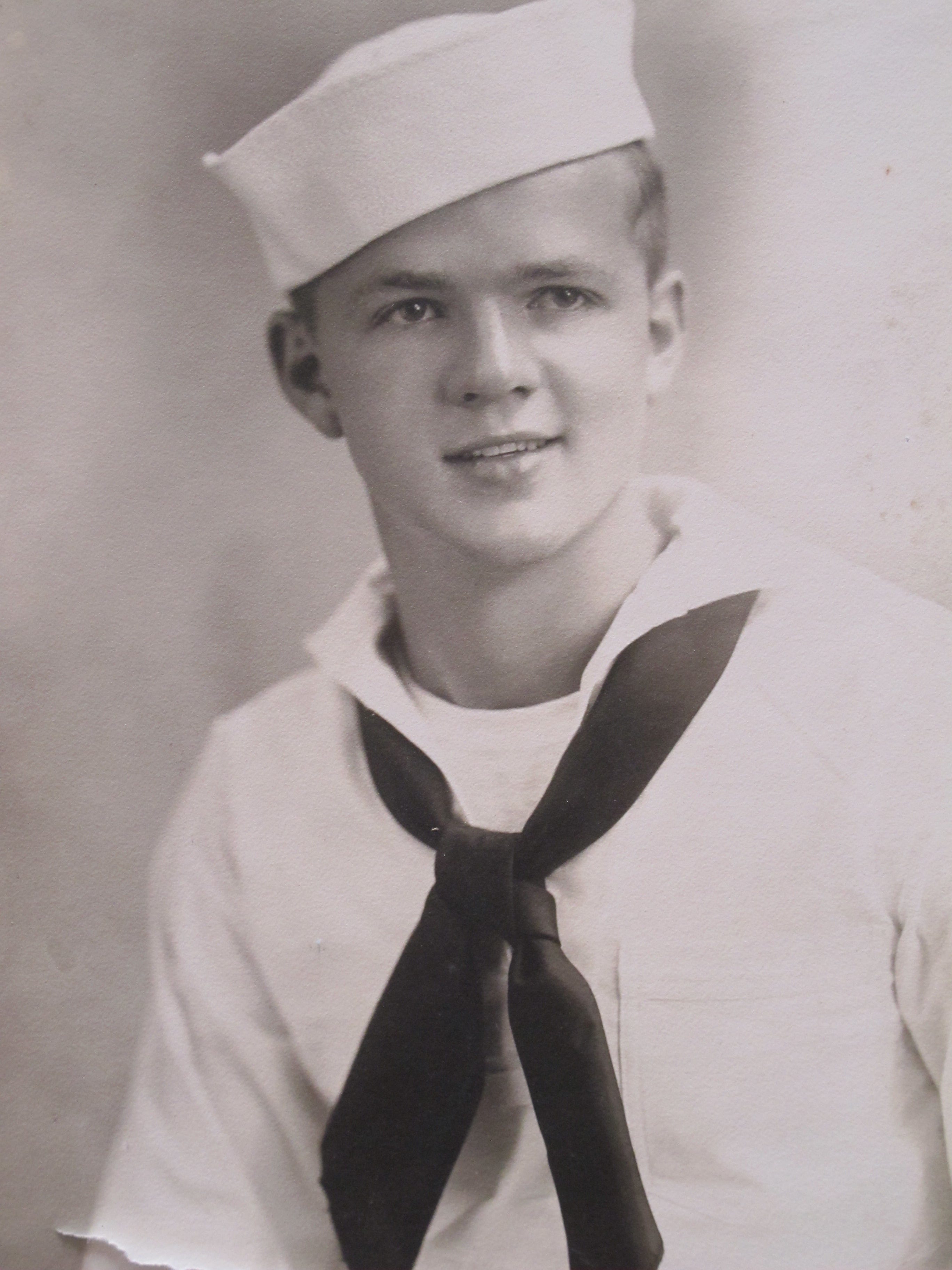
My dad was 17 years old when the U.S. entered World War II. Soon, he joined the Navy, attended officer training and served on a battleship.
After my mom and dad listened to “Tuesdays With Morrie,” together, they let all of us know that they wanted to celebrate our dad’s life on his birthday in March. All of us knew, by then, it was unlikely he’d be with us to celebrate another.
And so we did. All of us, the five children and three grandchildren (then) showed up to be with him on his 76th birthday.
Remembering my dad with our bike rides to help others
This Sunday morning, B.J.’s Team — the team I created to ride on behalf of the National Brain Tumor Society to raise funds for medical research – rides for its 22nd consecutive year.
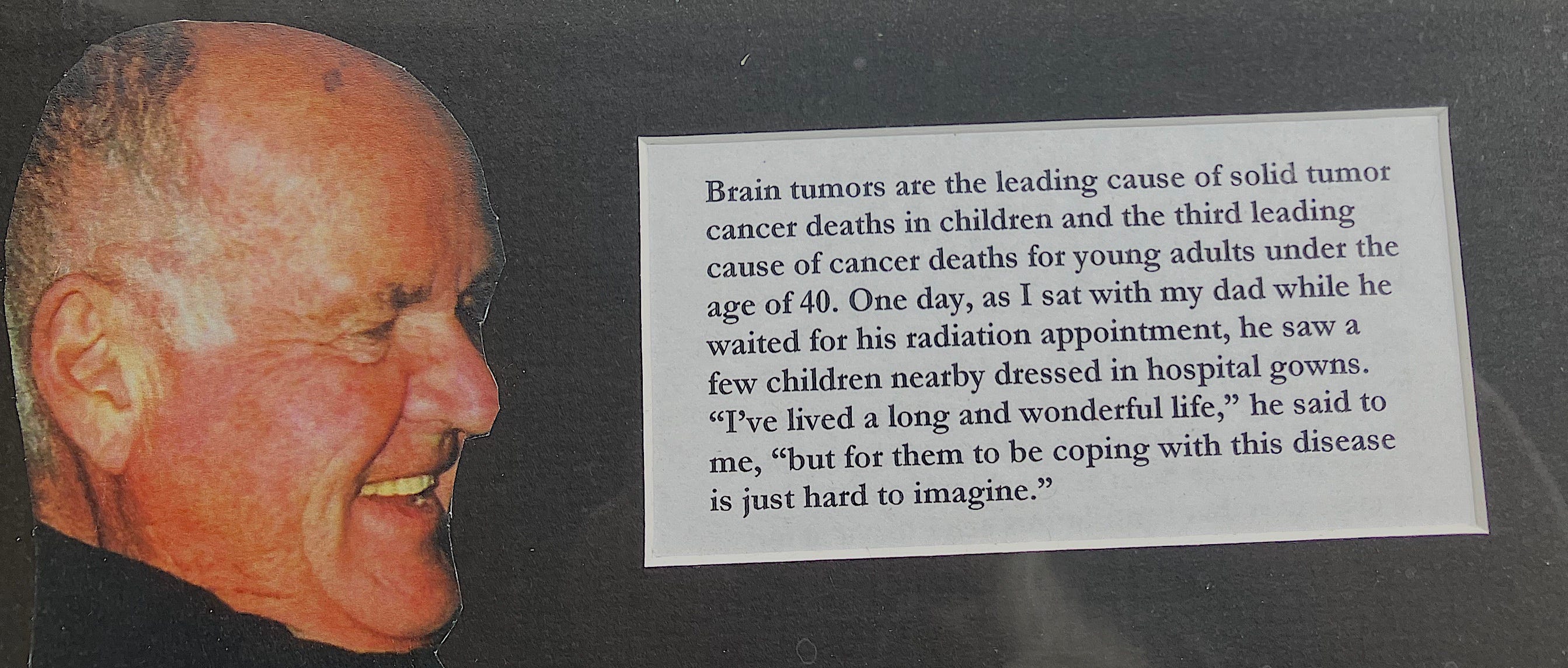
In the early years of B.J.’s Team, I often sent out paper invitations, and my mom had part of my message framed with my dad’s wonderful smile. She gave it to my brother, Mark, and after he died, I brought this framed picture and words home to keep in my bedroom.
Through our 21 years of riding, B.J.’s Team has raised roughly $300,000 due to the incredibly generous individuals who “ride” with us each year — either on the road [13 riders this year] or “in spirit” with their donations. This year, we’ve raised $18,232.86 - and counting!
To each who has contributed to B.J’s Team this spring, I sent a personal thank you.
For me, it’s a big deal when someone takes the time and shows the heart to contribute to a cause they know means so much to me. Just as it might to them since many of our team’s riders and contributors have also lost a family member to a glioblastoma tumor.
So, I never cede my opportunity to say thank you to a “template” response. Or to A.I.
This spring, in some thank-you messages, I wrote about my dad in ways I had not done before. I’m not sure why but this year I felt a strong desire for B.J.’s Team members to know the man I love so dearly – my dad who played a pivotal role in my making my life the grand adventure it’s been.
And he still does play a role given the values he instilled.
My dad was my biggest supporter and the person I always turned to when I faced tough times, which I did a lot! He would help me through one crisis, and then he’d be ready for the next, always doing whatever he could to help me find the inner strength I needed to work myself through them. His faith in me gave me the strength I needed.
His brain tumor robbed me of many years we could have had, as well as the time he could have had to be an extraordinary grandfather to Maya and his six other grandkids, four of whom he never had the opportunity to know.
His heart was huge and he was among the best of storytellers.
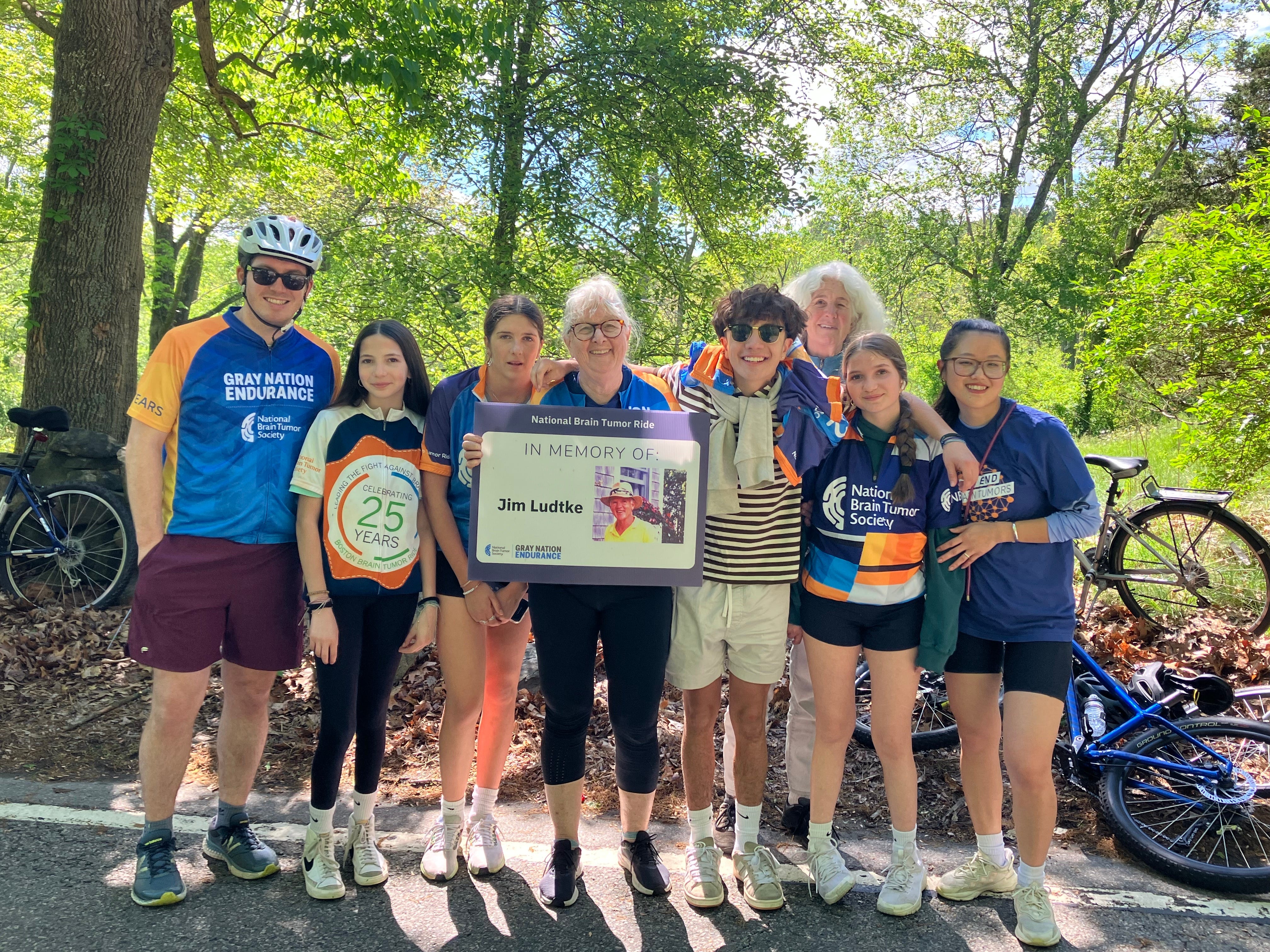
Our family members gathered last May near the end of our bike ride to spend time with B.J. at his “In memory of” sign. From left to right: Matthew (Maya’s husband), and his grandchildren, Sophia, Anya, Nate, Augusta and Maya, me holding the sign, and the cousins’ mom Betty slightly behind us.
To our 152 contributors to B.J’s Team’s ride this Sunday, we say THANK YOU!
If you’d like to donate to B.J’s Team for our Sunday ride, you can do so at this link:
http://www.braintumorcommunity.org/goto/BJsTeam2026
Remembering Jason Collins
A courageous leader and beloved man who lost his battle this week against his glioblastoma
I first knew about Jason Collins when he played for the Boston Celtics in the 2012-2013 season.
In April 2013, the Celtics traded him to the Washington Wizards.
But he was back in Boston in June to march in the city’s Pride Parade.
By then, he had publicly claimed his sexual identity, and in doing so he became the first active professional male athlete to do so.
Later, he said he felt envioius when he saw his Stanford University roommate Joe Kennedy III marching in the 2012 parade.
That was before Collins found the courage to say he was gay.
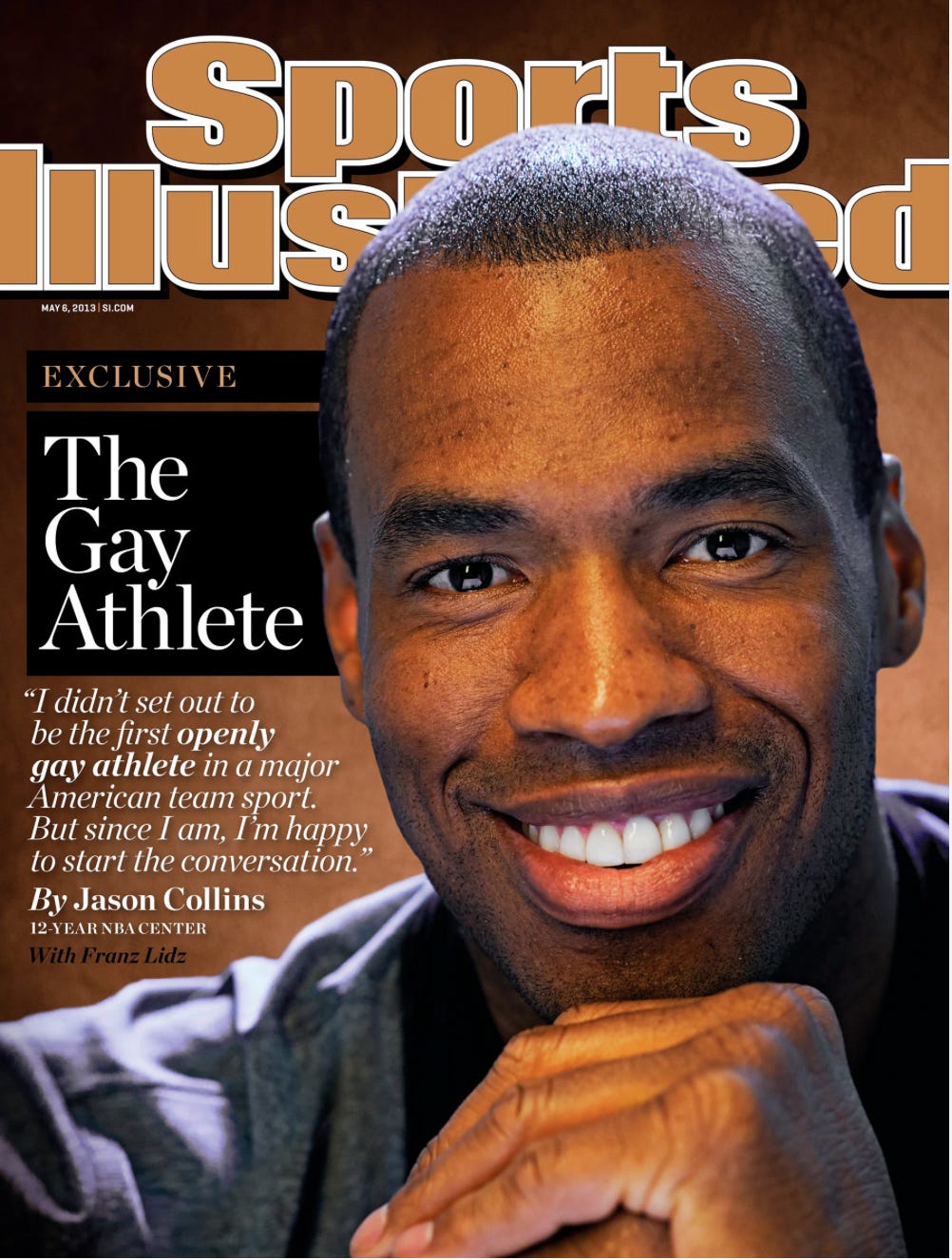
Of course, Billie Jean King and Martina Navratilova, along with seven notable WNBA players had come out publicly by 2013, as a few of them reminded the headline writers when they pegged Collins as the first athlete in a MAJOR team sport to do so. To this day, I find that sportswriters and columnists get around crediting top women athletes by inserting the word “major,” as if professional women athletes don’t play what are considered “major” sports.
In December 2025, Jason Collins went public again on ESPN, this time to talk about his glioblastoma diagnosis:
“But now it’s time for people to hear directly from me.”
I have Stage 4 glioblastoma, one of the deadliest forms of brain cancer. It came on incredibly fast.
In May I married the love of my life, Brunson Green, at a ceremony in Austin, Texas, that couldn’t have been more perfect. In August, we were supposed to go to the US Open, just as every year, but when the car came to take us to the airport, I was nowhere near ready. And for the first time in decades, we missed the flight because I couldn’t stay focused to pack.
I had been having weird symptoms like this for a week or two, but unless something is really wrong, I’m going to push through. I’m an athlete.
Something was really wrong, though. I was in the CT machine at UCLA for all of five minutes before the tech pulled me out and said they were going to have me see a specialist. I’ve had enough CTs in my life to know they last longer than five minutes and whatever the tech had seen on the first images had to be bad.
According to my family, in hours, my mental clarity, short-term memory and comprehension disappeared -- turning into an NBA player’s version of “Dory” from “Finding Nemo.” Over the next few weeks, we would find out just how bad it was. …
My glio is extraordinary for all the wrong reasons, and is "wild type"-- it has all these mutations that make it even more deadly and difficult to treat. What's that mythical creature where you cut off one head, but it learns to grow two more? The Hydra. That's the kind of glio I have. …
As an athlete you learn not to panic in moments like this. These are the cards I’ve been dealt. To me it’s like, ‘Shut up and go play against Shaq.’ You want the challenge? This is the challenge. And there is no bigger challenge in basketball than going up against prime Shaquille O’Neal, and I’ve done that. …
When I was making my decision to come out publicly, I remembered a scene in the movie “Moneyball” where Red Sox owner John Henry (Arliss Howard) says to Billy Beane (Brad Pitt) that the first person through the wall always gets bloodied.
I feel like I’m right back in that position now, where I might be the first person through this wall. We aren’t going to sit back and let this cancer kill me without giving it a hell of a fight.” [Jason Collins: I have Stage 4 glioblastoma, Dec. 11, 2025, ESPN]
He fought hard, including travelling to Singapore for an experimental immunotherapy treatment. He did this not only for himself but in the hope that he’d add to medical knowledge about his “wild” type of tumor. Perhaps his experience would help medical researchers advance their research so as to one day give others who will confront this same diagnosis a fighting chance.
“Because my tumor is unresectable, going solely with the "standard of care" -- radiation and TMZ (chemo), the average prognosis is only 11 to 14 months. If that's all the time I have left, I'd rather spend it trying a course of treatment that might one day be a new standard of care for everyone.” - Jason Collins
That’s the same reason why I know my father would have wanted us to ride and raise funds for the research that one day will lead to finding a cure. It’s why he donated his brain to Harvard Medical School, hoping researchers learn something by examining his tumor. Perhaps even discover something that will help others.
Listen as Jason tells of his startling diagnosis and how he, his husband and family members, including his twin brother Jarron, came together to research and decide how he’d fight it so they’d have the time with Jason that they longed to have.
On Sunday, B.J.’s Team rides in memory of my dad
and we ride in memory of so many others
All of whom were loved by people who contributed to our 2026 ride.
John’s wife, Beth Pfeiffer, my Wellesley College classmate; Bill’s two brothers; Jen’s sister; Jane’s sister; Adele’s son-in-law; Parrish’s brother; Peg’s partner; Betty’s son; Eric’s brother; Nancy E.’s father; Nancy N’s father and cousin; Anne’s husband and my friend; Pattie’s beloved friend; Suzyn’s friend; Mary C.’s friend; Liz’s friend’s dad; Lauren’s friend, the father of one of her children’s classmates; Kathryn’s friend; Adrienne’s friend; Barbara’s mother-in-law; Dave/Jen’s classmate; Barbara’s dear friend.
We ride knowing of the devastating sadness so many families have felt when their loved ones died due to a glioblastoma. And here I turn to public figures since we know how they died. Obviously, so many other families have faced this loss as well.
Senators Ted Kennedy and John McCain, Beau Biden, drummer Neil Peart, singer Tom Parker, Tim Conway, Johnnie Cochran, Cecile Richards, Bobby Murcer, Tug McGraw, Ethel Merman, Micheal Tilson Thomas and Bert Convy.
If you haven’t read my book, you might want to!
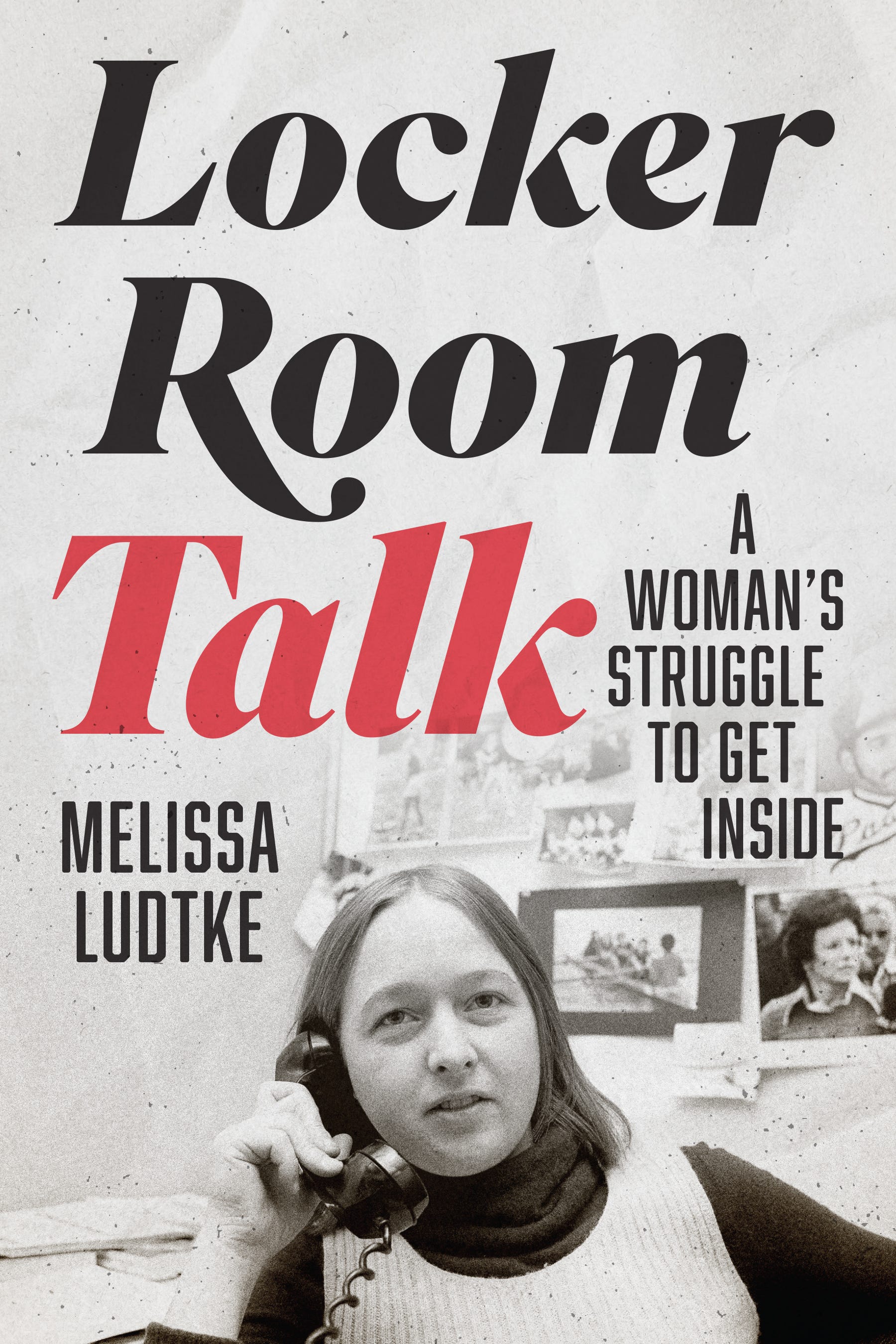
On Amazon, Locker Room Talk is selling for less than $20.00. New.
Honored to be a rider in spirit for B.J.’s team. Proud supporter for 22 years. Each rider is a champion of hope, strength, and compassion. Every mile and every dollar brings us closer to a cure.
Congratulations on your ride today! Your tribute to B.J. - in words and action - would have made him so proud!