
Let's Row Together
If only decency mattered! But like the penny, it's been devalued and discarded. So what's the hook to get us out of the mess we're in?

Seventy-two years ago – on June 9, 1954, while 20 million Americans watched on TV – Joseph Welch, a Boston lawyer changed the course of American history.
With the few words he spoke.
Have you no sense of decency, sir, at long last? Have you left no sense of decency? - Joseph Welch to Senator Joe McCarthy
His unforgettable phrase galvinized Americans.
For in uttering these words when he did, Welch, who was the chief special counsel for the U.S. Army, pulled back the curtain to reveal the mortal flaws of a man who’d been holding the nation in his thrall.
Not unlike what happened to the huckster/magician who was the wizard of Oz.
However, in this case, the words he said as a nation watched were powerful enough to take down a U.S. Senator drunk with power.
They vanquished a man who was bullying Americans by his intimidating misue of governmental power.
A boorish man who until that moment seemed unstoppable, as he held the nation in his terrifying grip.
For several years, Senator Joe McCarthy had waged his reckless and vindictive assault on citizens who he claimed harbored ideological sympathies to Soviet Communism.
Leading, he said, to Communist subversion within the U.S. government and military.
Many he’d summoned before his committee were wrongfully accused.
But to him that was beside the point.
His was a campaign of intimidation, and McCarthy felt no need to produce actual evidence to prove the veracity of what he said or the charges he made against those he forced to testify.
He relied instead on sensationalist rhetoric and unsubstantiated allegations.
Masquerading as his “truth.”
Evidence wasn’t necessary as long as intimidation worked.
Roy Cohn, who later served as Donald Trump’s attorney and mentor, joined McCarthy in this pursuit as his investigative subscommittee’s special counsel.
The men radiated arrogance.
Historians decribe McCarthy’s “dreary insistence on his own righteousness,” and his “lack of respect for those he persecuted.” And they label Cohn as being the “destructive architect of modern political ruthlessness” and use descriptive phrases like "legal executioner” to sum him up.
These two men, united in “bloody-minded callousness” worked side-by-side.
And in damaging their prey, they disregarded the protective rights granted to citizens by our Constitution, especially by its First and Fourteenth Amendments.
They treated the hundreds of Americans who sat at their witness table as bit players in their show.
Demonstrating no decency.
What befell those “players” and their families mattered not at all to these men who cared only about holding center stage.
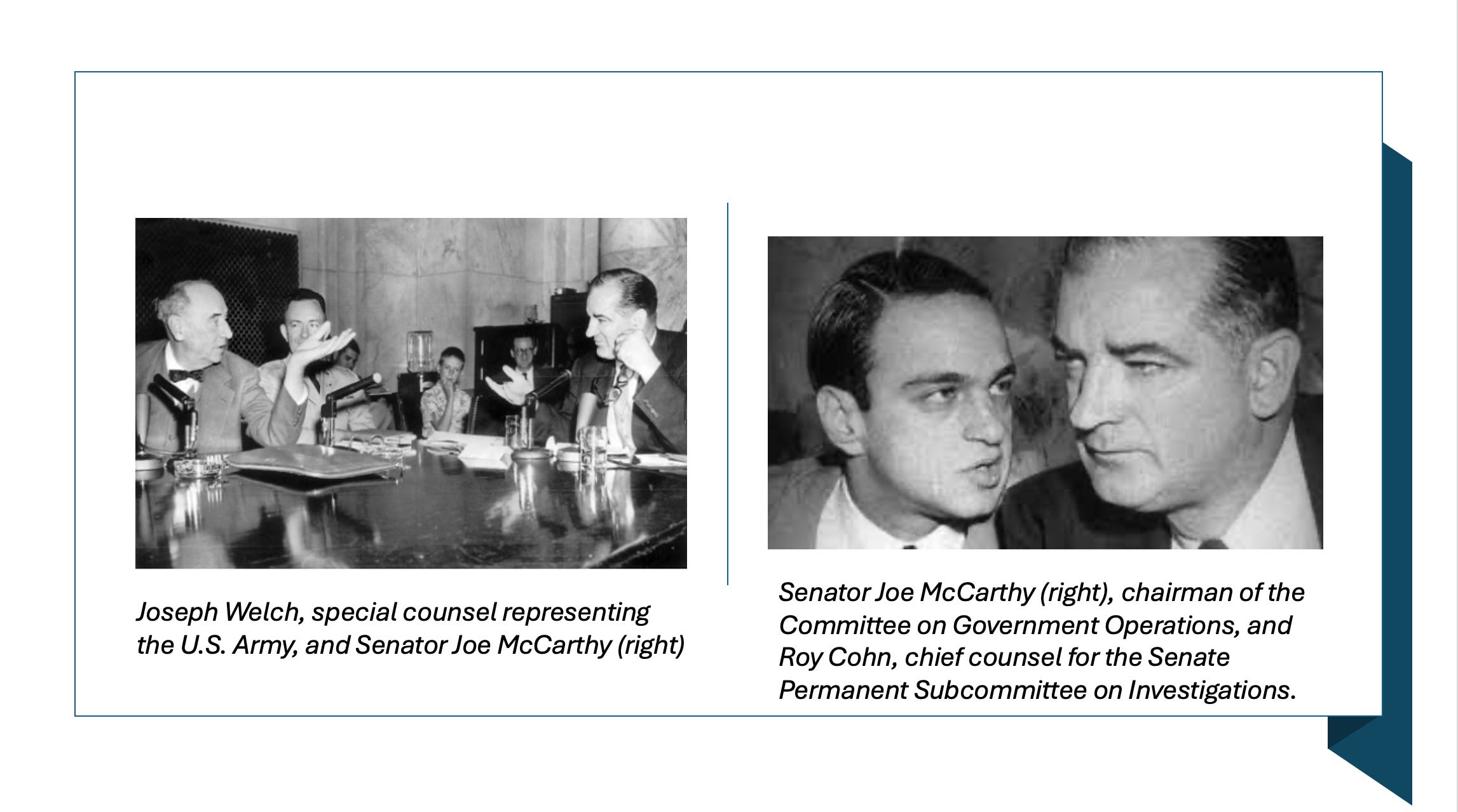
Sound familiar?
On Tuesday morning, I was reminded1 of the anniversary of this earth-shattering moment.
Wanting to refresh my memory, I decided to read accounts of McCarthy’s hearings in 1954, when he and Cohn turned their attacks on the U.S. Army.
In a fateful decision, driven by his arrogance and hubris, McCarthy had invited TV cameras into his hearings. And, on an average day, 20 million Americans tuned in.
Witnessing in real time McCarthy’s bullying as he yelled angrily at witnesses.
I watched film clips of that fatefull June 9th moment when Welch turned the table and put McCarthy on trial in the court of public opinion.
Charging him with possessing “no sense of decency.”
Welch was compelled to utter these words when McCarthy verbally assaulted one of his fellow lawyers at his Boston firm. The Senator named this man on TV, accusing him to having ties to the “legal arm of the Communist Party.”
“Until this moment, Senator, I think I never really gauged your cruelty or your recklessness,” Welch said. “Have you no sense of decency, sir?”
Welch’s rebuke seems mild when compared with the career-ending accusations that McCarthy made against so many.
So, what was it in Welch’s words that made them stick when so many others had not?
Perhaps it was his decision to use a word that upheld a shared and valued human trait — one that every American watching that day hoped their children (and they) would live by.
This universality empowered the word with an authority that few other words had.
But whatever explains the potency of Welch’s accusation, we know that later that year, the U.S. Senate finally found the courage it had lacked when it censured McCarthy, condemning his recklessness.
Stripped of power, he was ostracized by political colleagues and ignored by the press.
Three years later, at the age of 48, McCarthy died “a broken man.”
Not unlike the life course of many of those whose names and reputations he’d ruined when he used his power to break them.
On June 9, 1954, Joe McCarthy experienced his Humpty-Dumpty moment, as his tumble from the political stage began.
This video fills in facts of this story which the prior video did not address. Watched together, they tell a fairly complete story of what ended the cruel, all-consuming reign of Joe McCarthy, who accumulated power by bullying and harming others and held onto power until members within his own party stopped him.
Will Words Be Enough, Now?
As I read about and watched the 1950s-era hearings, questions came to mind.
Are words still capable of delivering the blow necessary to turn our nation away from the cursed course set in motion and propelled by our president?
Millions of words have questioned and detailed many more personal attributes than this man’s “decency.”
Yet, the center holds, even if cracks in the foundation are starting to show.
Will words even be what eventually loosen this man’s firm grip on power?
If not words, then what?
And, what role, if any, will words play in awakening elected leaders whose fear and cowardice leaves them unwilling to speak or act in the face of present dangers?
Like it was with McCarthy, the terror unleashed by this man’s callous disregard for the people he harms alarms many Americans, including me.
As does his disdain for our Constitution upon which our nation’s future depends.
Trump’s ravenous appetite for vindictive retribution, like McCarthy’s, is fueled by incessant acts of intimidation.
A strategy learned from Roy Cohn.
Trump’s arrogance, bundled into narcissism, presents us with a man who is unbound from every rule and habit of political discourse.
A man whose survival, accumulation of wealth, display of gold and legacy are all that matter to him.
And securing these seems his only thrill despite holding the mightiest job on Earth.
The rest, he admits, bores him.
Including, perhaps most of all, the presidential performance of customary acts of decency.
A quality of character he’s likely never possessed nor wants to acquire.
For this reason, and so many more, the words Welch said to McCarthy 72 years ago seems quaint today.
Hopelessly devalued.
Like the penny, decency has slid to being a worthless currency in an economy fueled by greed and selfishness.
Leaving Welch’s words a mismatch for what this moment in our history demands.
In 1954, decency was a valued currency.
And Joseph Nye Welch was smart enough to center this word in his confrontation with a bully at the moment that he knew was being televised to America.
Welch was born as the youngest of seven children to English immigrant parents in 1890. He grew up in town in northwest Iowa so sparsely populated that his immediate family accounted for almost two percent of its 519 residents.
His childhood was likely untouched by dominant rule of America’s “oligarchs” whose exorbitant wealth meant that the top one percent of families owned more than half of the country’s real and personal property.
Sound familiar?
But by the time Welch enrolled in Grinell College in Iowa in 1910, then graduated from Harvard Law School in 1917, muckraking journalists were publishing stories they reported about massive monopolistic corruption.
What mattered was that American people believed what these journalists reported, which led to huge shifts in public opinion. Soon, the voters had swept America’s Progressive Movement leaders into office with their promises to break up corporate conglomerates, protect consumers and improve conditions for working Americans.
Which they did. With the American people’s support.
Will this history repeat for us? And if so, what will light the spark?
American Moments: Memorable Words and Visuals
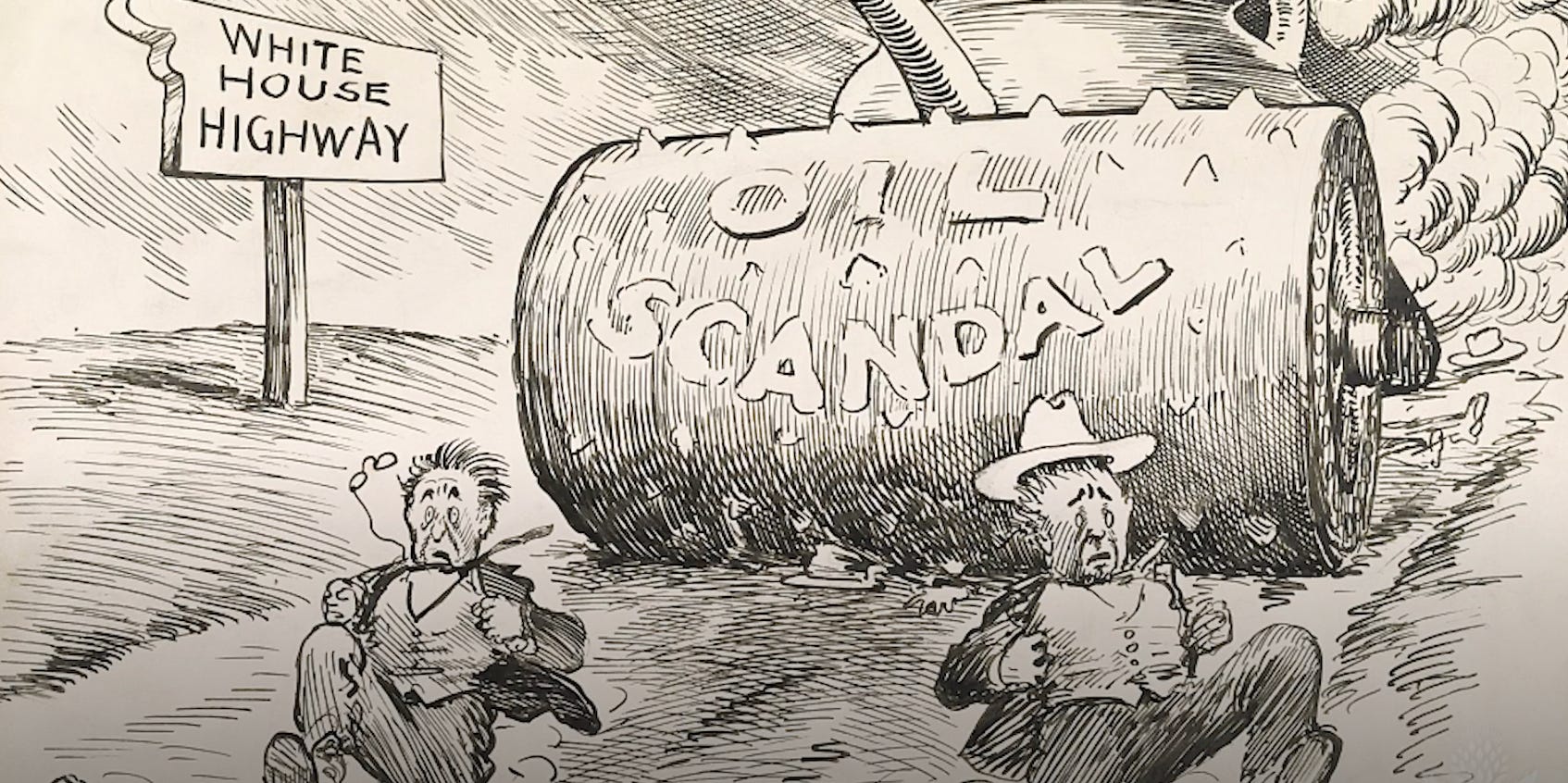
“You can’t convict a million dollars.”
This famous phrase of the 1920’s Teapot Dome bribery scandal picked up on the reality of how wealth was shielding people from accountability. The Secretary of the Interior Albert B. Fall went to jail for accepting their bribes, but juries acquitted the wealthy oil tycoons who had bribed him. These judicial outcomes sparked national outrage about wealth and privilege.
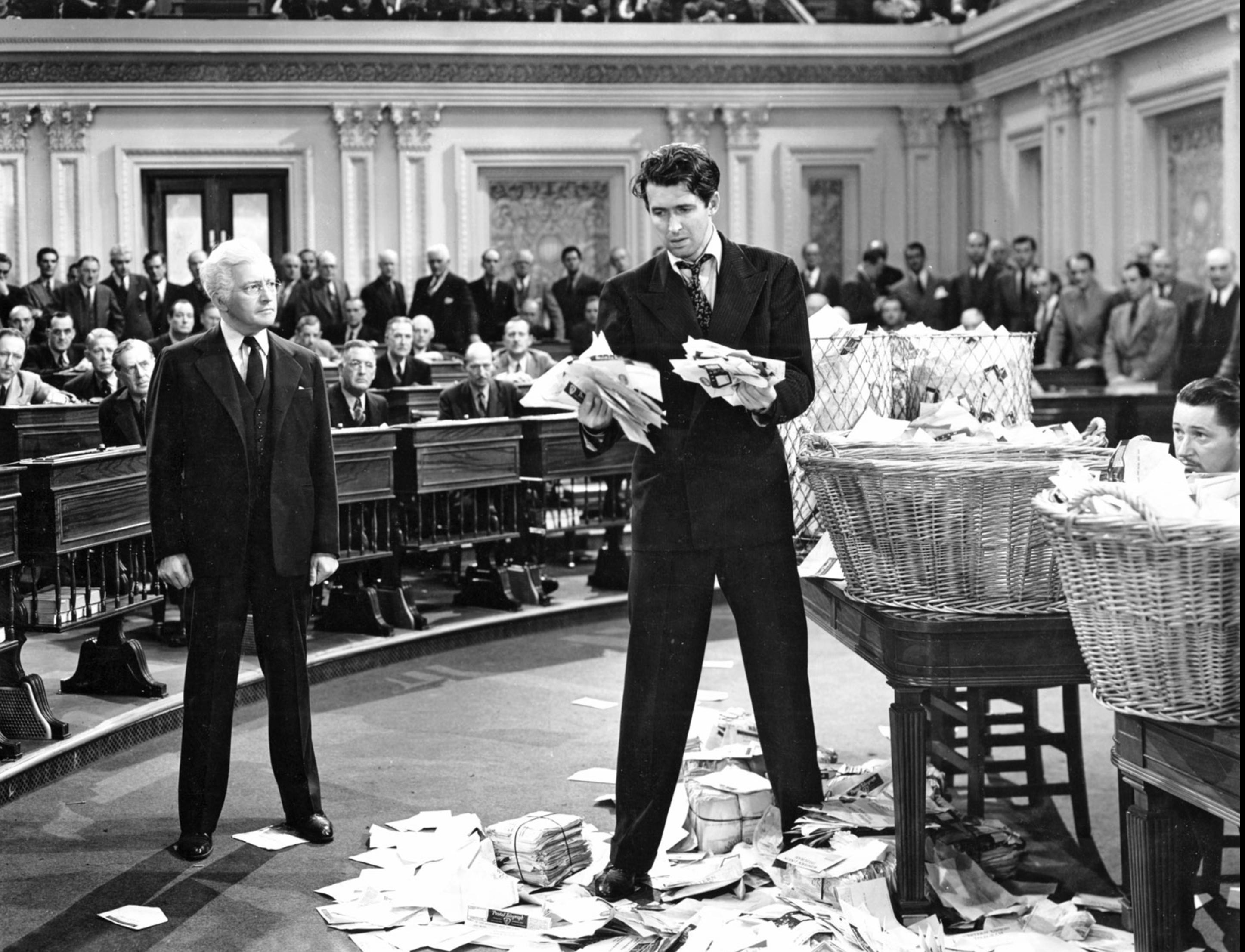
"You think I'm licked. You all think I'm licked. Well, I'm not licked. And I'm gonna stay right here and fight for this lost cause."
In the 1939 popular film, “Mr. Smith Goes to Washington,” Jefferson Smith arrived in Washington to fill a Senate vacancy. There, his idealism collides with “corruption at home and subterfuge from his hero in Washington,” but he forges ahead by delivering a filibuster speech in which he refuses to give in to political corruption. In the end, he prevails.
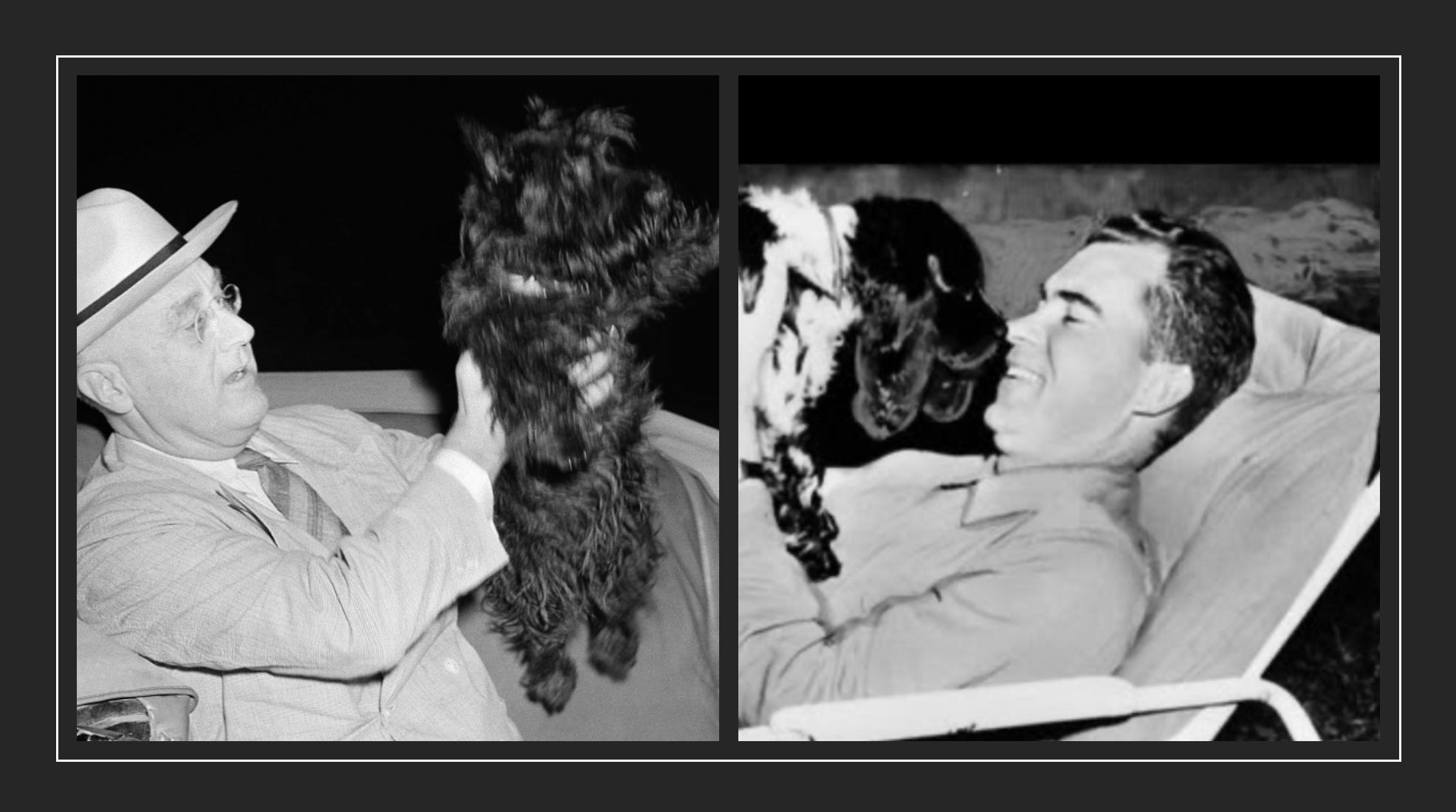
“Well, of course, I don’t resent attacks, and my family don’t resent attacks, but Fala does resent them.”
President Franklin Roosevelt (left in photo) defended Fala, his Scottish Terrier, against Republican’s false charges that he’d accidentally left his dog on the Aleutian Islands and had sent a Navy destroyer to retrieve him at taxpayer expense. After Orson Welles ad-libbed the Fala joke for the president, Roosevelt adopted this humorous approach in his Sept. 1944 speech, defusing this brewing scandal. Presidential biographer Doris Kearns Goodwin observed that “The Fala bit was so funny, one reporter observed, that ‘even the stoniest of Republican faces cracked a smile.’”
“We’re gonna keep it.”
In September 1952, then vice-presidential candidate Richard Nixon (right in photo) delivered his “Checkers speech” on national television when he defended himself against allegations of improper campaign funds by denying that his wife, Pat, owned a mink coat: “Pat doesn't have a mink coat. But she does have a respectable Republican cloth coat.” He did admit that his family did accept one gift — Checkers, a Cocker Spaniel. His daughters loved the dog, he said, and they were keeping Checkers. That fall he was elected Vice-President.
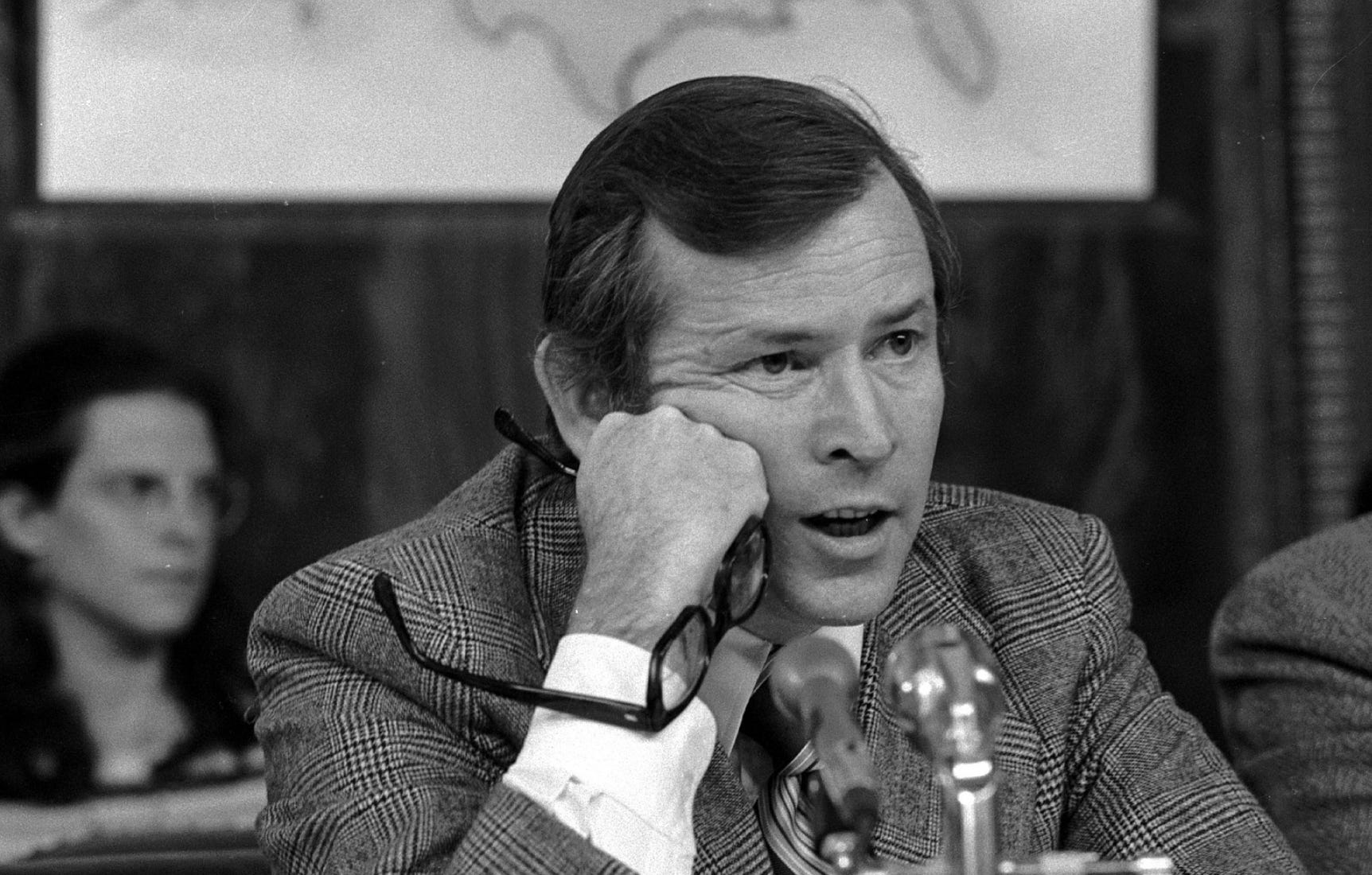
“What did the President know and when did he know it?”
In June 1973, as Vice-Chairman of the Senate Watergate Committee, Republican Senator Howard Baker posed this memorable question to a witness, John Dean, the former White House Counsel in the Nixon administration. What he asked elicited a response in which Dean implicated “both Nixon and his staff in the cover-up and efforts to derail the investigation of the Watergate break-in.” As a result of this key moment of testimony, these hearings led to Nixon’s resignation in August 1974.
Sports Knit Us Together: Knit One, Purl Two
I live near Boston where we’ve had our own magical NBA Final moment.
We know it as the impossible-to-forget words of Celtic radio broadcaster Johnny Most — “Havlichek steals it. … Havlichek stole the ball,”
As memorable as that moment is for me, the Knicks’s tip-in-win after their dogged and deliberate comeback in Game 4 was mythic, miraculous and marvelous, even for this diehard Celtics’s fan.
In hyperbolic commentary about this victory, those swept up in the moment raised the possibility that this improbable victory might be the “Welch” spark in uniting Americans in ways nothing else had.
Alas, the center holds as the teams head into Game 5.
Don’t Miss Sherry Turkle’s New Book
Turkle grounds her insights in research, then shares them as stories that have stood the test of time as being visionary tales that need to be heard. Her new book will be published on September 29th. Artificial Intimacy offers “both a cautionary tale and a roadmap for being human in the age of AI.”
It’s hard to find a book more timely than this one? Or more necessary as a roadmap to lives the tech billionaires want us to live?

Please, remember mine, too, :
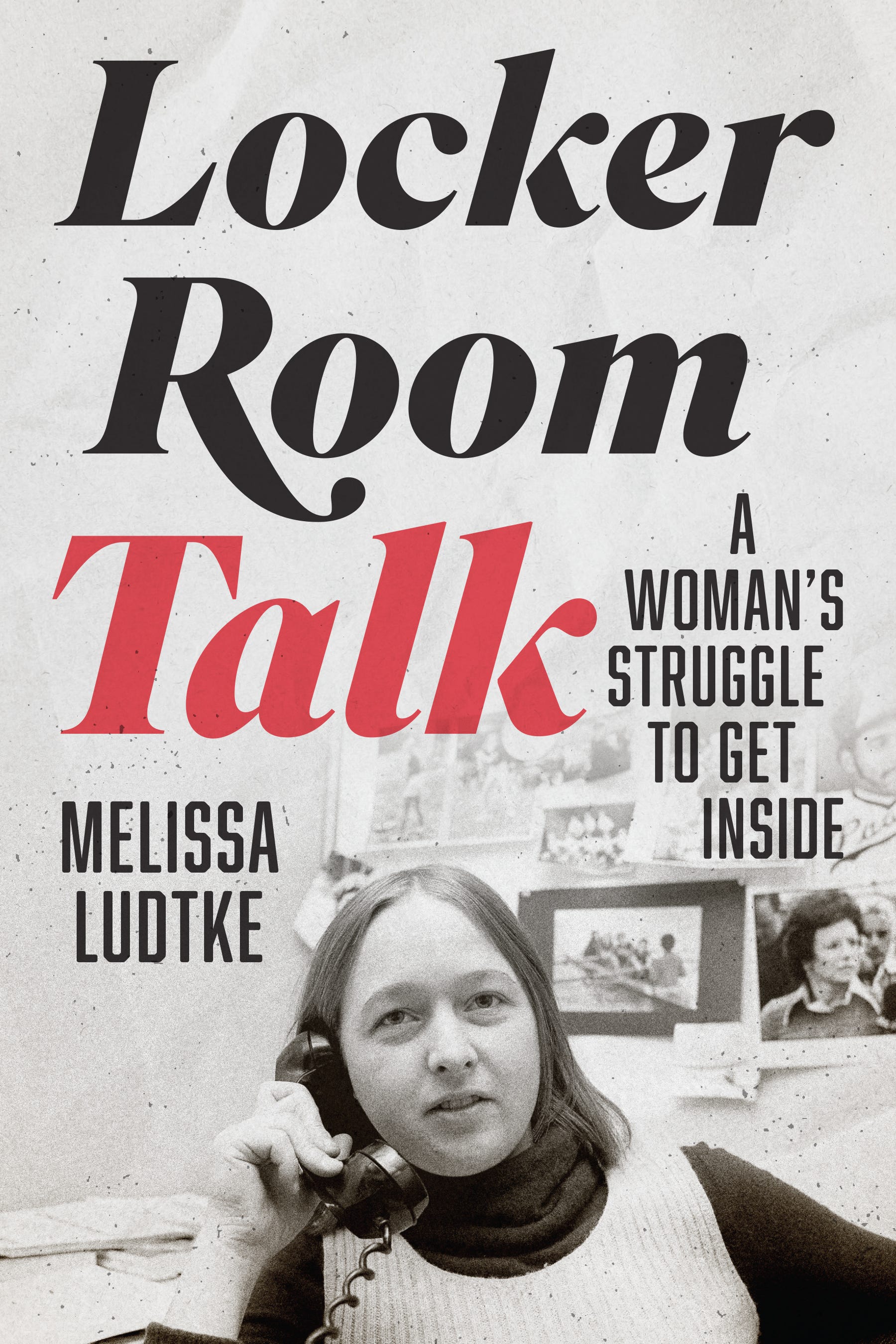
Along with my Cooperstown talk, delivered at the Hall of Fame on May 27, 2026.
Each morning I read “This Day in History,” written by Buffalo, New York attorney Jesse Cooke, and on June 9, 2026, he wrote about this anniversary. To follow his daily posts, go to Jesse Cooke on LinkedIn and click the Connect or Follow button.
M, glad Cooperstown went well!!
How do we overcome /stop Trump?
We continue sharing truths! Keep sharing these stories far & wide!
Unfortunately Donald Trump will never ever face jail time let alone see a court. The Founders of the USA 🇺🇸 never took into account a personality such as his in creating the constitution or Declaration of Independence. How could they have without handcuffing Freedom of Speech?
He himself will not outlive his narcissistic acts! He may think he is eternal but no one is.
However, try focusing on his key followers/supporters. Aside from the MAGA army who in
Past human history followed blindly Hitler, Mussolini, the UK 🇬🇧 when they colonized the world! They are “followers “ in the truest sense of the word!
Focus on members of his inner circle such as Rubio, Patel , HegenBreath. They are a lot younger than DJT. Put them on trial and jail
them. The true measure of the strength of the 250th year of the experiment of Democracy will be if the USA 🇺🇸 citizenry will be whether the country puts on trial his core group of minions or not. It will be the measure in the world’s eyes of the leader of the world’s freedom & hope (USA) or if its empire has seen its last days!
They may rise up, speak up and return the USA 🇺🇸 to its role as leader or fade like BREAKING NEWS 📰 of today !
Gosh I hope they don’t forget the extreme damage done by DJT & his cabinet of Minions! Also hope the Dollar Store takes back some of their fake Gold decorations DJT purchased!!
Enjoy your weekend !!!
Bill
Ps I intentionally left out RF Quackery from my list of the Cabinet of Minions as he has been a lost cause in my own eyes for decades 🤪
Melissa, thank you for sharing this history. Yes, there was a time, as you right when journalists were trusted and we believed in 'decency.' But my take from this is also that we have to keep our hope going.